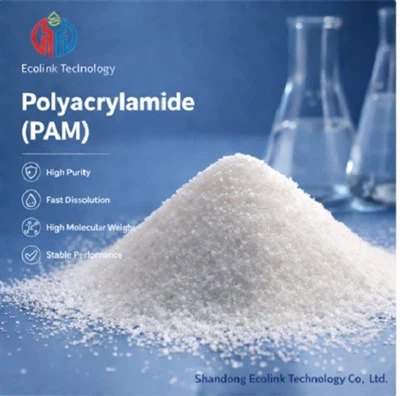
PAM Storage and Handling Guide for Stable Water Treatment Performance
In industrial applications such as wastewater treatment, sludge dewatering, mining, papermaking, and oil extraction, the actual treatment effect of polyacrylamide (PAM) depends not only on the product's molecular weight, ionic properties, and product quality itself, but is also closely related to transportation, warehousing, unsealing, dissolution, and field operation methods.
Even if a 25 kg bag of polyacrylamide powder is in normal condition upon arrival, if it remains in a high-temperature, humid, or poorly sealed environment for a long time, a significant decrease in flocculation performance may occur before entering the dosing system. Raw materials do not "suddenly fail" without pattern; their performance changes are usually related to temperature, moisture, oxidative environments, mechanical actions, and storage time. Therefore, risks can be reduced through standardized warehousing and operational management.
For water treatment systems that require stable operation, proper polyacrylamide storage methods are not only related to the shelf life of the chemical itself, but also directly affect chemical consumption, sludge treatment efficiency, and final effluent performance.
I. Why Does PAM Degrade?
The core role of PAM in water treatment is closely related to its polymer molecular chains. Longer molecular chains can form effective bridging actions in the aqueous phase, connecting suspended particles and forming flocs that are easier to settle or separate.
When the polymer chain breaks or its charge characteristics change, the flocculation performance will also change accordingly. Original data shows that when the average molecular weight drops by 20%, the chemical dosage may need to increase by 40%–50% to achieve the same effluent turbidity target. Therefore, PAM storage management is not merely a warehouse management issue, but part of the overall operational cost of water treatment.
The main degradation pathways include the following three categories:
1. Thermal Stress and Oxidative Degradation
When the storage temperature exceeds 35°C, the polymer main chain begins to face the risk of breakage under the influence of thermal stress; if dissolved oxygen or trace metal ions are present in the environment at the same time, this process may be further accelerated.
When the temperature exceeds 40°C for a long time, the rate of chain breakage increases significantly, and the original performance of the product may be irreversibly affected. Re-adding water to dissolve or re-preparing cannot restore the molecular chain damage that has already occurred.
Therefore, when using water treatment polyacrylamide in hot areas, special attention should be paid to warehouse ventilation, sunlight exposure, and heat source locations.
2. Moisture Absorption and Hydrolysis
Powder and granular PAM have a certain degree of hygroscopicity. If the packaging is poorly sealed, moisture in the air may gradually enter the surface of the product particles.
After moisture enters, it may cause hydrolysis of the amide side chains, thereby changing the ionic properties of the polymer. For anionic products, this change may affect their application performance; for cationic products, it may affect their charge interaction during sludge dewatering.
At the same time, after partial dissolution occurs on the surface of the particles, adhesion tends to occur, causing the particles to bind with each other and ultimately forming common caking problems.
3. Freeze-Thaw Phase Separation of Emulsion Products
Unlike solid products, emulsion PAM is more sensitive to temperature changes.
When the temperature drops below approximately 5°C, the water phase in the emulsion may freeze and expand, thereby destroying the structure of the polymer droplets. Once irreversible phase separation occurs, even if the temperature is subsequently raised again, there is no guarantee that the product will return to its original state.
Therefore, PAM emulsion storage conditions require specialized management based on local climate, transportation methods, and warehousing environment.
II. How Should Powdered and Granular Polyacrylamide Be Stored?
Powder and granular products are common product forms in the fields of water treatment and sludge dewatering. Proper polyacrylamide storage methods mainly include temperature control, moisture protection, packaging protection, isolation of incompatible substances, and proper stacking.
1. Control Warehouse Temperature
Powder and granular products are recommended to be stored in an environment of 5°C–30°C.
When the temperature exceeds 30°C, the product degradation rate may increase significantly; after exceeding 40°C, the polymer chain breakage rate accelerates further, and the storage period that could originally be maintained for several months may be shortened to several weeks.
In high-temperature areas, placing products in the following locations should be avoided:
Near boiler rooms;
Near steam pipes;
Near south-facing metal walls;
Locations exposed to direct sunlight.
Special attention should be paid to the fact that the actual ambient temperature of the warehouse is not necessarily equal to the surface temperature of the product. The surface temperature of pallets exposed to sunlight may be 10–15°C higher than the ambient temperature.
Therefore, for warehouses storing PAM flocculants for a long time, sunshading and ventilation are equally important.
2. Control Warehouse Humidity
It is recommended to control the relative humidity below 65%.
For humid coastal areas or tropical regions, especially for high-value cationic grade products, temperature-controlled storage can be further considered.
Regardless of the warehousing method used, packaging bags should not be placed directly on concrete floors. It is recommended to use pallets so that the bottom of the packaging is at least 15 cm off the ground, while avoiding placing products close to outer walls to reduce the risk of moisture absorption caused by condensation.
3. Maintain Packaging Integrity
Original factory sealed packaging is an important measure to protect product quality.
If the packaging has been opened, the remaining material should be transferred to a secondary container with good sealing performance, and the opening date should be recorded. Used but unresealed packaging bags are a common cause of moisture absorption and caking of powder products.
Anionic polyacrylamide powder for water treatment provided by ECOLINK TECHNOLOGY adopts double-layer polyethylene lined packaging, which can add a layer of moisture protection when the outer packaging is damaged.
III. Which Substances Should PAM Be Stored Separately From?
Polyacrylamide should not be mixed or stored in close proximity to strong oxidizers, strong acids, and strong bases for a long time.
Strong oxidizers include:
Sodium hypochlorite;
Hydrogen peroxide;
Potassium permanganate.
It is recommended that the product maintain a distance of at least 3 m from the above strong oxidizers, strong acids, and strong bases.
Oxidizers may accelerate the degradation of the polymer main chain, while acidic and alkaline environments may promote the hydrolysis of amide groups.
For industrial enterprises, establishing an independent PAM chemical storage management system and defining clear storage areas for different chemicals are important measures to reduce the risks of cross-contamination and product failure.
IV. Packaging Stacking and Inventory Management Are Equally Important
A qualified warehousing environment does not mean that stacking methods can be handled casually.
For 25 kg packaging bags, the stacking height should not exceed 10 layers; for 50 kg packaging bags, the stacking height should not exceed 6 layers.
Excessive stacking pressure may cause bottom-layer particles to be compacted and form cakes, which may affect subsequent uniform dissolution even if there is no obvious moisture absorption.
Inventory management is recommended to adopt the FIFO (First-In, First-Out) principle, and clearly mark on the pallet:
Product name;
Batch number;
Date of receipt;
Opening date;
Product status.
For wastewater treatment plants with unstable consumption or industrial projects with intermittent operation, it is also necessary to reasonably calculate the procurement batch size based on actual consumption to avoid exceeding reasonable storage periods due to over-procurement.
V. Storage Requirements for Emulsion PAM
The storage requirements for emulsion products and solid granular products are not completely identical.
Emulsion products need to rely on a stable system to maintain the polymer dispersion state, making them more sensitive to temperature changes and container materials.
1. Maintain a Storage Temperature of 5°C–35°C
Emulsion polyacrylamide is recommended to be stored in the temperature range of 5°C–35°C.
Among them, 5°C is an important low-temperature control point. Even a short period of local freezing may cause irreversible phase separation.
Insulation measures should be used during transportation or storage in cold areas; while in high-temperature environments, long-term exposure of products to environments above 35°C needs to be avoided.
2. Choose Appropriate Containers
Emulsion products are recommended to be stored in original iron drums or high-density polyethylene containers.
Avoid using:
Aluminum containers;
Copper containers;
Galvanized steel containers.
Stainless steel 316L can be used for bulk intermediate storage tanks.
3. Conduct Low-Shear Agitation Before Use
A slight phase gradient may form after emulsion stands for a long time, so gentle mixing can be performed before use.
For example, slow rolling on a drum rotator for 5–10 minutes can be used, or low-shear circulation can be used for homogenization.
Vigorous high-shear agitation is not recommended, as excessive mechanical action may destroy the emulsion structure.
For specific emulsion product storage temperatures, shelf life, and activation requirements, confirmation should be made in conjunction with the corresponding product data sheet.

VI. How to Determine Whether Polyacrylamide Has Undergone Performance Changes?
Inspecting chemicals before they formally enter the dosing system can prevent unqualified raw materials from further affecting the entire water treatment process.
Common inspection methods include visual observation, solubility testing, and solution viscosity comparison.
Powder or Granular Products
If the following situations occur, further inspection is required:
Obvious caking;
Product color changes;
Flowability decreases;
Particles are obviously broken;
Dissolution rate slows down significantly;
Gel lumps exist in the solution;
"Fish-eye" structures appear.
If the solution viscosity prepared at standard concentration is significantly lower than normal levels, it may also indicate that the molecular weight of the product has changed.
Emulsion Products
For emulsion products, focus can be placed on observing:
Whether obvious stratification occurs;
Whether color changes occur;
Whether abnormal odors appear;
Whether normal phase inversion occurs after dilution;
Whether viscosity drops significantly after dilution;
Whether abnormal oil film appears on the surface.
These phenomena can serve as references for further quality testing.
VII. How to Judge PAM Status Through Simple Bench Tests?
If the product status cannot be determined solely by visual appearance, a simple laboratory comparison can be performed.
Take a certain amount of sample, prepare a 0.1% solution with deionized water, and measure the solution viscosity under controlled stirring conditions.
A Brookfield viscometer can be used, or a flow time test through a fixed orifice can be conducted, and then compared with a reference sample of a known qualified batch.
At the same concentration, if the relative viscosity drops by more than 15%, it can serve as an important indicator that molecular weight degradation has occurred.
It should be noted that it cannot be simply assumed that "adding a little more chemical" can fully compensate for product performance loss. The relationship between polymer degradation and actual flocculation effect is not a simple linear relationship.
Therefore, a reasonable polyacrylamide quality inspection method should combine appearance, solubility, viscosity, and actual process performance to make a judgment.
VIII. Prepared PAM Solutions Cannot Be Stored for a Long Time
There is a clear difference between the storage periods of solid products and fully prepared chemical solutions.
Prepared solutions with a concentration of 0.1%–0.5% are generally not recommended for long-term storage and should be prepared as fresh as possible based on actual usage.
Original data recommends that prepared PAM solutions should not be stored for more than 24–48 hours.
As time increases, polymer chain breakage caused by mechanical action and microbial activity in process water may gradually reduce solution viscosity.
If the process water temperature exceeds 40°C, the allowable storage time may be further shortened.
Therefore, in continuous-operation wastewater treatment projects, preparation frequency should be reasonably determined according to actual treatment volume, chemical consumption, and dosing system capacity.
IX. Safety Protection During PAM Handling
The polymer itself has low acute toxicity, but during actual operation, residual acrylamide monomer as well as risks such as dust, leaks, and slips still need to be considered.
Original data points out that reputable manufacturers usually control the residual monomer content in finished polymers. The control reference given in the data is below 0.05% (500 ppm), and some industrial grade products can even be below 0.01%.
Therefore, when purchasing water treatment chemicals, it is recommended to request a Certificate of Analysis for each batch from the supplier to verify corresponding indicators.
Powder Product Handling
During bag opening, transfer, and dissolution, large amounts of dust entering the air must be avoided.
In enclosed or poorly ventilated environments, appropriate particulate respiratory protection should be adopted; during short-term, well-ventilated open environment operations, suitable dust masks should also be used.
At the same time, it is recommended to wear:
Nitrile gloves;
Chemical safety goggles;
Appropriate respiratory protection equipment.
When a powder leak occurs, using compressed air for blowing is not recommended, as it may cause fine particles to re-enter the air.
Industrial vacuum equipment can be used for collection, or wet wiping can be employed.
X. Special Attention Must Be Paid to Slip Risks for Emulsion and PAM Solution Leaks
For emulsion products and prepared PAM solutions, the main site risk may shift from dust to contact and slip risks.
In particular, low-concentration PAM solutions have significant slippery characteristics, so the site area should be controlled immediately after a leak occurs.
It is recommended to use vermiculite, dry sand, or other appropriate inert absorbent materials to control the leak, and rinse the relevant area with plenty of water after cleanup.
The leak area should be marked and access restricted until the ground completely returns to a safe state.
For anionic polyacrylamide powder leaks, priority should be given to containment, collection, cleanup, and proper disposal measures.
XI. APAM Leak Treatment: Avoid Entering Drainage Systems and Water Bodies
Anionic polyacrylamide (APAM) is widely used in wastewater treatment, mining, papermaking, and oil extraction industries. Due to its good flocculation and solid-liquid separation assistance capabilities, it plays an important role in industrial water treatment processes.
However, after a leak occurs, APAM may become extremely slippery upon contact with water, forming significant on-site safety risks.
Therefore, when a dry powder leak occurs, one should first:
Immediately seal off the leak area;
Restrict entry of uninvolved personnel and vehicles;
Use appropriate personal protective equipment;
Use vacuum equipment suitable for fine particle collection;
Place collected materials into suitable waste containers.
If APAM has already come into contact with water and formed a gel-like substance, inert materials such as sand, sawdust, or absorbent pads should be used for absorption and collection.
More importantly, the product should be prevented from entering drainage systems and natural water bodies. Polymers may swell upon contact with water and cause drainage system blockages, while also potentially exerting adverse impacts on the environment.
Therefore, when leaks occur near drains, waterways, or other sensitive areas, temporary barriers, drain covers, or other effective containment measures should be set up promptly.
XII. Establish a Complete PAM Storage and Handling System
Relying solely on the experience of warehouse staff cannot form a stable and reliable chemical management system.
For enterprises using polyacrylamide flocculants for a long time, a more reasonable method is to establish a complete management workflow covering procurement, transportation, warehousing, storage, unsealing, preparation, dosing, leak handling, and waste disposal.
It is recommended to record the batch number and receipt date upon arrival of each batch, and clearly mark the pallets.
For inventory that exhibits abnormalities, it should not all be immediately judged as unqualified product. The supplier can first be contacted for re-inspection, and the molecular weight or related performance can be further verified based on original product specifications.
During the supply of water treatment chemicals, ECOLINK TECHNOLOGY can provide customers with corresponding product information and technical support based on different water treatment application scenarios, helping users select, store, and use products more reasonably.

XIII. Typical Shelf Life of Different PAM Product Forms
Shelf life is not a completely fixed number; its actual performance is closely related to packaging integrity, temperature, humidity, and warehousing management standards.
Under the condition that the storage conditions described in this article are continuously met, the typical storage periods given by the data are as follows:
| Product Form | Sealed/Unopened Typical Shelf Life |
| Powder/Granular Polyacrylamide | 18–24 months |
| Emulsion PAM | 6–12 months |
| Prepared Solution (0.1–0.5%) | Not applicable, fresh solution should be prepared |
For projects with large variations in chemical consumption, such as seasonal wastewater treatment or intermittent industrial production, a reasonable procurement volume should be calculated based on actual consumption speed, rather than simply pursuing a lower unit procurement price through bulk purchasing.
Only when the product can enter the production process within a reasonable storage period does the cost advantage brought by bulk purchasing truly make sense.
XIV. Summary: Protecting PAM Performance Starts with Proper Storage
The application effect of polyacrylamide depends not only on the quality at the time of product procurement, but also on the entire supply chain process experienced by the product from the manufacturer to the final dosing system.
High temperatures may lead to polymer chain breakage; moisture may cause powder moisture absorption, caking, and changes in ionic characteristics; emulsion freezing may lead to irreversible phase separation; excessive stacking may cause particle compaction; and long-term storage of prepared solutions may result in viscosity loss.
Therefore, enterprises should focus on controlling the following aspects:
Temperature, humidity, packaging integrity, chemical isolation, stacking height, inventory cycle, product inspection, and personal safe operations.
For powder and granular products, focus should be on preventing high temperatures and moisture absorption; for emulsion products, focus should be on preventing freezing, overheating, and violent shear; for prepared solutions, they should be kept as fresh as possible for use.
ECOLINK TECHNOLOGY focuses on water treatment chemicals and water treatment solutions, and can provide corresponding PAM, PAC, and water treatment equipment support based on customers' specific applications, including wastewater treatment, sludge dewatering, mining, papermaking, oil extraction, and other scenarios.
Correct product selection is only the first step; proper storage, standardized preparation, and reasonable dosing can truly enable water treatment chemicals to exert their intended performance and economic value.