In modern wastewater treatment systems, wastewater usually contains organic matter, suspended solids, and dissolved nutrients. If these pollutants are discharged directly without effective treatment, they will impact the receiving water bodies and the ecological environment. The activated sludge process degrades pollutants through microbial metabolism and is currently one of the important secondary treatment processes for municipal sewage and various industrial wastewaters.
The activated sludge system utilizes microorganisms such as bacteria, protozoa, and fungi to convert biodegradable pollutants in wastewater into new biomass, carbon dioxide, and water. This technology was applied in Manchester, UK as early as 1914, and today it has developed into various process configurations including Conventional Activated Sludge (CAS), Sequencing Batch Reactor (SBR), Oxidation Ditch, and Membrane Bioreactor (MBR).
For a complete wastewater treatment project, biological treatment is not the end point. A large amount of waste activated sludge needs to be further thickened, conditioned, and dewatered, where Polyacrylamide (PAM) plays a vital role. For customers who need to solve problems regarding chemicals, sludge treatment, and equipment pairing simultaneously, ECOLINK TECHNOLOGY can provide comprehensive solutions from water treatment chemicals to sludge dewatering applications.
1. What is the Activated Sludge Process?
The Activated Sludge Process is essentially a controlled biological treatment technology.
In the aeration tank, wastewater comes into full contact with a mixed liquor containing a large number of active microorganisms, while oxygen is continuously provided through aeration equipment. Microorganisms utilize the biodegradable organic matter in the wastewater as energy and nutrient sources, forming biological flocs with good settling performance.
These flocs are not simple suspended particles, but rather a three-dimensional microbial structure capable of adsorbing and trapping colloidal and particulate organic matter. As operating time increases, the microbial community in the system gradually forms a relatively stable ecological system.
Under aerobic conditions, heterotrophic bacteria rapidly consume biochemical oxygen demand (BOD); as sludge age increases, nitrifying bacteria gradually establish themselves and convert ammonium to nitrate. If the system is configured with an anoxic zone, denitrifying bacteria can further reduce nitrate to nitrogen gas, thereby achieving biological nitrogen removal.
Therefore, a typical Activated Sludge Process generally consists of several core steps: biological reaction, solid-liquid separation, sludge recirculation, and waste sludge discharge.
2. Core Components of an Activated Sludge System
1. Aeration Tank: Completing the Main Biological Reaction
The aeration tank is the core biological reaction area of the activated sludge system.
After entering the aeration tank, wastewater is mixed with Return Activated Sludge (RAS). Aeration equipment releases fine bubbles from the bottom of the tank to introduce oxygen into the water while producing sufficient hydraulic turbulence to keep microbial flocs suspended.
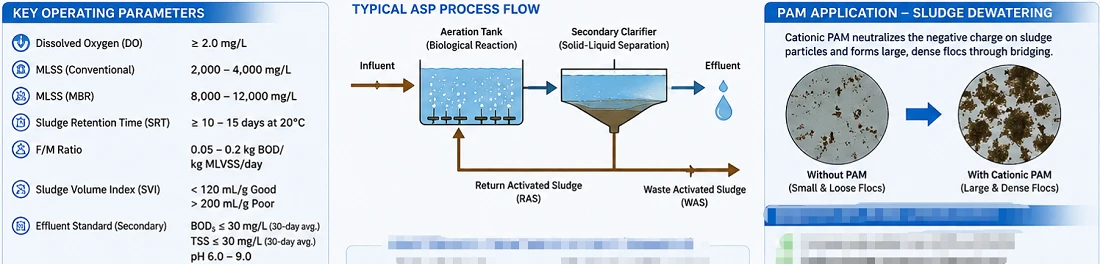
For systems requiring stable nitrification, the dissolved oxygen (DO) in the aerobic zone must be maintained above 2.0 mg/L. If DO remains below this level for a long time, the microbial community may undergo significant changes and may take days or even weeks to recover.
Therefore, in actual Activated Sludge Process design, the aeration system is not only related to pollutant degradation efficiency, but also directly affects energy consumption and subsequent settling performance.
2. Secondary Clarifier: Achieving Solid-Liquid Separation
The mixed liquor after biological reaction enters the secondary clarifier.
Here, activated sludge flocs settle by gravity, achieving the separation of treated water and biological sludge. The supernatant overflows and discharges from the clarifier, while the sludge settling to the bottom enters the return sludge and waste sludge treatment processes respectively according to system requirements.
The 30-day average BOD₅ and TSS of a typical secondary treatment system can reach 30 mg/L, with a pH range of 6.0 to 9.0.
If sludge flocs fail to form a good settling structure, issues such as increased effluent turbidity, sludge bulking, and sludge floating may occur. Therefore, sludge flocculation performance is one of the important factors determining the operation effectiveness of the secondary clarifier.
3. Return Activated Sludge (RAS)
A portion of the settled sludge needs to be returned to the aeration tank to maintain the microbial concentration in the bioreactor; this portion of sludge is called Return Activated Sludge (RAS).
The RAS flow rate is usually 50% to 100% of the influent flow rate, which needs to be adjusted in combination with the target MLSS concentration.
If the return flow rate is too low, the microbial concentration in the aeration tank may decrease; if the return flow rate is too high, it may cause an increased hydraulic load on the secondary clarifier.
4. Waste Activated Sludge (WAS)
Continuous microbial growth means that the system will continuously produce new cellular material. If the waste sludge is not discharged in a timely manner, the system solids concentration will gradually increase, and SVI may also rise, ultimately affecting sludge settling performance.
Therefore, WAS needs to undergo subsequent treatment such as thickening, chemical conditioning, and mechanical dewatering.
This is also an important entry point for PAM into the wastewater treatment process.
3. Common Activated Sludge Process Configurations
Different wastewater qualities, treatment scales, and effluent requirements correspond to different process configurations.
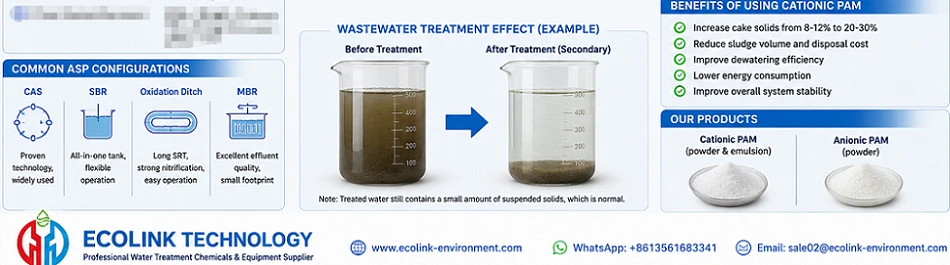
Conventional Activated Sludge (CAS)
Conventional Activated Sludge technology is mature, widely applied in engineering, and validated by large-scale operation.
Its main issues are a relatively large footprint and limited process flexibility.
Sequencing Batch Reactor (SBR)
SBR completes stages such as filling, reaction, settling, decanting, and idling in a temporal sequence.
A single reaction tank can fulfill multiple treatment functions, thus eliminating the need for separate continuous secondary clarifiers. SBR is particularly suitable for industrial wastewater projects that need to flexibly adjust operating cycles based on water quality changes.
Its drawbacks lie in more complex control logic and certain fluctuations in effluent flow rate.
Oxidation Ditch
Oxidation Ditches usually have a long SRT, which is conducive to nitrification, while operation and management are relatively simple.
However, their energy demand is higher, and the footprint is relatively large.
Membrane Bioreactor (MBR)
MBR adopts ultrafiltration or microfiltration membranes instead of conventional gravity sedimentation to achieve solid-liquid separation.
This process offers advantages such as excellent effluent water quality and a small footprint, but capital investment and membrane replacement costs are high.
In MBR systems, MLSS can usually reach 8,000–12,000 mg/L, so its sludge management also differs significantly from conventional systems.
4. Key Operating Parameters That Must Be Monitored in Activated Sludge Systems
A stably operating Activated Sludge Process requires simultaneous attention to multiple interconnected operating parameters.
MLSS: Mixed Liquor Suspended Solids
MLSS reflects the concentration of microorganisms and suspended solids in the bioreactor.
The MLSS of conventional activated sludge systems is usually maintained at 2,000–4,000 mg/L, while the MLSS in MBR configurations is typically higher, reaching 8,000–12,000 mg/L.
MLSS is not better simply by being higher. If the solids concentration is too high, it may increase aeration energy consumption, affect oxygen transfer, and alter settling performance.
SRT: Sludge Retention Time
SRT, also known as sludge age, refers to the average time biosolids remain in the system.
Nitrifying bacteria grow slowly, requiring at least 10-15 days at 20°C to establish a stable population. A shorter SRT may lead to nitrifying bacteria being washed out of the system, while a longer SRT, although beneficial to system stability, will increase sludge production and treatment costs.
F/M: Food-to-Microorganism Ratio
F/M represents the relationship between the organic load entering the bioreactor and the microbial mass.
A high F/M ratio may lead to dispersed growth of microorganisms, thereby causing poor sludge settling performance.
When F/M is 0.4–0.8 kg BOD/kg MLVSS/day, the system may experience dispersed growth and poor settling; traditional wastewater treatment plants typically have an F/M of 0.05–0.2 to form more stable flocs.
SVI: Sludge Volume Index
SVI is an important indicator for judging the settling performance of activated sludge.
After letting 1 liter of mixed liquor settle statically for 30 minutes, SVI is calculated based on the settled sludge volume and MLSS.
Generally, a value below 120 mL/g represents good settling performance; if it exceeds 200 mL/g, it may indicate sludge bulking, requiring further investigation into the cause.
DO: Dissolved Oxygen
DO in the aerobic zone should be maintained above 2.0 mg/L, while the anoxic zone required for denitrification needs near-zero dissolved oxygen.
Proper control between aerobic and anoxic zones is very important for biological nitrogen and phosphorus removal.
In addition, temperature also affects microbial reaction rates. A temperature drop of 10°C reduces the biological reaction rate by approximately half. Therefore, seasonal temperature variations must also be considered when designing an Activated Sludge Process.
5. Why is PAM Still Needed After Activated Sludge Treatment?
Biological treatment can effectively reduce organic pollutants in water, but it also generates a large amount of waste biological sludge.
Under normal circumstances, for every 1 kg of BOD removed, approximately 0.3-0.8 kg of dry solids are produced.
The total solids content of untreated WAS is usually only 0.5-1.5%. If direct mechanical dewatering is performed, it is often difficult to achieve an economically reasonable dewatering effect.
This is precisely the key stage where PAM plays its role.
PAM, or Polyacrylamide, is a water-soluble polymer. In the field of wastewater treatment, it primarily promotes fine sludge particles to form denser flocs through charge action and polymer chain bridging.
For sludge dewatering applications, Cationic Polyacrylamide is usually the focus of product selection.
6. How Does Cationic Polyacrylamide Improve Sludge Dewatering?
Activated sludge particles and microbial cell surfaces usually carry a certain negative charge, which keeps sludge particles in a dispersed state due to charge repulsion.
After Cationic Polyacrylamide enters the sludge system, it can reduce electrostatic repulsion between particles through charge neutralization, while utilizing polymer chains to form bridges, causing fine sludge particles to aggregate into larger, denser flocs.
Once flocs are formed, bound water in the sludge is more easily released under mechanical pressure or centrifugal force.
Therefore, PAM for Sludge Dewatering is not simply "increasing sedimentation," but rather improving the sludge floc structure so that mechanical dewatering equipment achieves better solid-liquid separation effects.
After conditioning with Cationic Polyacrylamide, belt filter presses and centrifuges can obtain a cake with 20-30% dry solids, whereas without polymer treatment, the cake dry solids content is only 8-12%.
For large wastewater treatment plants, an increase in cake solids content means that sludge transport frequency, final disposal volume, and associated costs can all potentially be reduced.
7. How to Choose the Appropriate PAM Model?
Not all sludge is suitable for the same PAM.
Sludge source, digestion method, organic content, mineral content, and mechanical dewatering equipment will all affect the final product selection.
1. Cationic PAM
Cationic Polyacrylamide is mainly used for sludge conditioning and sludge dewatering.
For aerobically digested sludge, if the degree of cell lysis is high, there may be more soluble organic matter in the sludge that consumes cationic charges, so products with higher charge density usually need to be considered.
For anaerobically digested sludge with higher mineral content, products with medium charge density and higher molecular weight may have better adaptability.
ECOLINK TECHNOLOGY provides cationic PAM in different molecular weight and charge density ranges, which can be selected according to sludge properties as well as equipment such as centrifuges and belt filter presses.
2. Anionic PAM
Anionic Polyacrylamide, besides some sludge treatment applications, can also be used in the upstream flocculation process of wastewater treatment.
Under shock load conditions, Anionic Polyacrylamide can assist in improving the solid-liquid separation performance of clarifiers and can be used in combination with inorganic coagulants.
Therefore, Polyacrylamide is not limited to sludge dewatering; it also has broad application space in industrial wastewater and comprehensive sewage treatment systems.
8. Technical Parameters of PAM: How to Judge Product Suitability for Wastewater Treatment?
In actual procurement of PAM, comparing price alone cannot determine product performance.
For sludge dewatering applications, attention should focus on the following technical indicators:
| Technical Indicator | Meaning / Significance to Focus On |
| Ionic Degree | Affects charge neutralization capability and sludge flocculation effect |
| Molecular Weight | Affects polymer bridging capability and floc structure |
| Solid Content | Affects effective polymer content |
| Residual Monomer | Reflects product quality control level |
| Dissolution Time | Affects on-site preparation and continuous dosing |
| pH | Affects adaptability under different application environments |
| Product Form | Powder or emulsion form affects dissolution and dosing methods |
ECOLINK TECHNOLOGY's PAM products cover cationic, anionic, and non-ionic types, allowing product selection based on sludge properties, treatment processes, and dewatering equipment.
It is particularly important to note that the final dosage of PAM should not be determined purely based on theoretical values. Because differences in organic matter, inorganic matter, MLSS, and charge characteristics among different sludges are significant, practical application usually requires beaker tests and on-site trials to determine the optimal product and dosage.
Therefore, in Cationic Polyacrylamide for Sludge Treatment projects, product selection, dissolution method, dosing point, and equipment operating parameters should be evaluated together.
9. Other Applications of PAM in Wastewater Treatment Systems
Although sludge dewatering is one of the most important applications of PAM, PAM can also be used to enhance flocculation and solid-liquid separation in complete wastewater treatment systems.
For example, when influent water quality changes suddenly, suspended solids load increases, or secondary clarifier settling performance declines, appropriate Polyacrylamide can be selected as an auxiliary flocculant based on actual water quality.
Proper polymer bridging can help fine particles form larger flocs, thereby improving settling speed, reducing effluent turbidity, and further helping to control suspended solids in the system.
For industrial wastewater projects requiring chemical coagulation, PAM can also be used in conjunction with inorganic coagulants such as PAC.
It should be emphasized that PAM selection cannot be separated from specific water quality. Oils, mineral particles, organic matter, and metal ions in different industrial wastewaters will all affect the actual performance of the polymer, so experimental screening remains an important step to determine the optimal product.
10. Common Operating Problems in Activated Sludge Systems
1. Sludge Bulking
Excessive growth of filamentous microorganisms is one of the important reasons for abnormal settling in secondary clarifiers.
Filamentous microorganisms such as Microthrix parvicella and Thiothrix sp. may grow in large quantities under low DO, low nutrient, or inappropriate F/M conditions, causing SVI to exceed 200 mL/g.
Improvements for this problem can be made by increasing DO, adjusting WAS discharge, optimizing F/M, and installing selector tanks.
2. Biological Foam and Scum
Gray-brown stable foam on the surface of aeration tanks is usually related to filamentous microorganisms, while white foam accompanied by a large number of bubbles may be related to influent containing detergents and surfactants.
If it is biological foam, it can be controlled by adjusting SRT and taking necessary physical sludge wastage measures.
3. Sludge Rising in Secondary Clarifiers
If unexpected denitrification occurs inside the secondary clarifier, generated nitrogen gas bubbles may carry settled sludge to the water surface.
This issue can be improved by increasing the RAS pumping rate, shortening the clarifier retention time to under 1.5 hours, or disturbing the stagnant sludge layer through appropriate recirculation.
4. Increased Effluent Turbidity and Pin Flocs
If a large number of fine, non-settling flocs appear in the effluent, it may be related to excessively short SRT caused by excessive WAS discharge, insufficient nutrients, or toxic substances entering the biological system.
At this time, it is necessary to re-evaluate SRT, influent inhibitory substances, and nutrient ratios, and confirm whether BOD:N conforms to the commonly used ratio of 100:5:1.
11. Why Shouldn't Sludge Dewatering Focus Solely on PAM Price?
In actual wastewater treatment projects, the procurement cost of PAM is only a part of the total operating cost.
If a PAM product is lower in price but insufficient in flocculation effect, it may lead to:
Decreased sludge cake solids content;
Reduced processing capacity of dewatering equipment;
Increased sludge transport frequency;
Elevated suspended solids in filtrate;
Increased subsequent disposal costs;
Reduced equipment operating stability.
Conversely, although the unit procurement price of a suitable PAM product may differ, if it can improve sludge dewatering efficiency, it may lower the comprehensive cost of the entire sludge treatment chain.
Therefore, PAM for Sludge Dewatering should shift from evaluating "price per ton of product" to "comprehensive treatment cost per ton of dry sludge."
ECOLINK TECHNOLOGY not only provides PAM products, but can also assist in product screening based on customer wastewater treatment processes, sludge properties, and equipment conditions, thereby reducing the risks associated with relying solely on price for procurement.
12. ECOLINK TECHNOLOGY: From Water Treatment Chemicals to Overall Solutions
For wastewater treatment plants, chemicals, equipment, and process control are often not independent of each other.
A stable wastewater treatment project needs to connect:
Influent Water Quality → Biological Treatment → Solid-Liquid Separation → Sludge Conditioning → Mechanical Dewatering → Sludge Disposal
into a complete treatment chain.
ECOLINK TECHNOLOGY focuses on water treatment chemicals and water treatment equipment, offering products and solutions such as PAM, PAC, and wastewater treatment equipment.
In terms of PAM application, Cationic Polyacrylamide or Anionic Polyacrylamide can be selected according to the customer's sludge type and treatment equipment, with appropriate molecular weight, charge density, and dosing conditions determined through experimental testing.
For customers needing to build or upgrade wastewater treatment facilities, chemicals and wastewater treatment equipment can also be considered together to achieve a one-stop service from chemicals to equipment.
13. How to Determine the Right PAM Product for You?
Sludge properties vary greatly among different wastewater plants, so no single PAM is applicable to all projects.
In actual projects, it is recommended to follow the process below:
Step 1: Understand the Sludge Source
Confirm whether the sludge comes from municipal sewage, industrial wastewater, food processing, paper making, textiles, mining, or other treatment systems.
Step 2: Confirm Sludge Properties
Focus on understanding MLSS, solid content, SVI, organic content, and whether the sludge has undergone aerobic or anaerobic digestion.
Step 3: Confirm Dewatering Equipment
Clarify whether centrifuges, belt filter presses, or other mechanical dewatering equipment are used.
Step 4: Conduct PAM Screening
Perform experimental comparisons on products with different molecular weights and ionic degrees, observing floc size, settling speed, filtrate clarity, and cake condition after dewatering.
Step 5: Determine On-site Operating Conditions
Finally, determine operating parameters by combining equipment processing capacity, chemical preparation concentration, dosing position, and actual sludge production.
This process is more reliable than simply procuring based on PAM model or single-ton price.
For Cationic Polyacrylamide for Sludge Treatment projects, ECOLINK TECHNOLOGY can provide product selection and technical support tailored to customers' actual process conditions.
14. Conclusion: Stable Biological Treatment is Equally Important as Efficient Sludge Management
The Activated Sludge Process achieves organic matter removal and partial nutrient conversion through microbial metabolism, serving as an important technical route in modern wastewater treatment.
However, a truly efficient wastewater treatment system cannot focus only on pollutant removal efficiency in the aeration tank. Operating parameters such as MLSS, SRT, F/M, SVI, and DO jointly determine whether the biological system is stable, while the solid-liquid separation performance of the secondary clarifier directly impacts final effluent quality.
Concurrently, waste activated sludge must undergo effective thickening, conditioning, and dewatering treatment.
PAM, especially Cationic Polyacrylamide, can improve sludge floc structure through charge neutralization and polymer bridging, thereby helping mechanical dewatering equipment obtain higher cake solid content.
For enterprises seeking to optimize sludge dewatering costs, improve wastewater treatment system stability, or procure water treatment chemicals and equipment, ECOLINK TECHNOLOGY can provide targeted products and solutions based on specific water quality and process conditions.