Product Overview
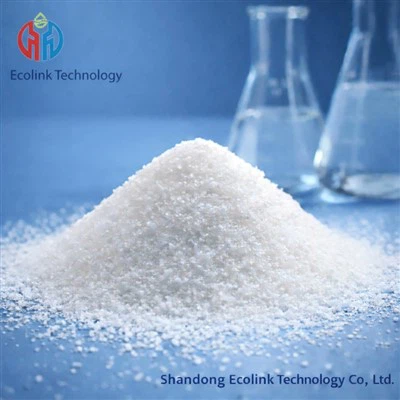
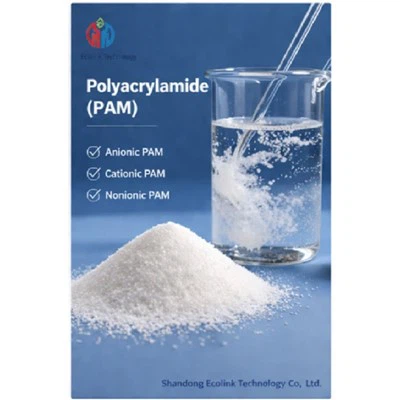
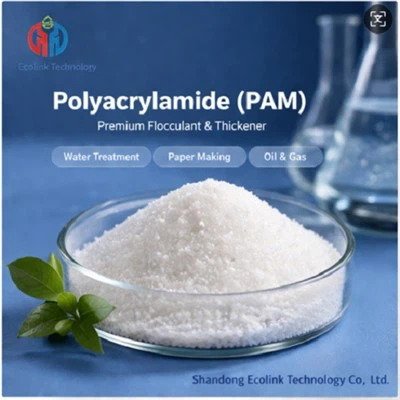
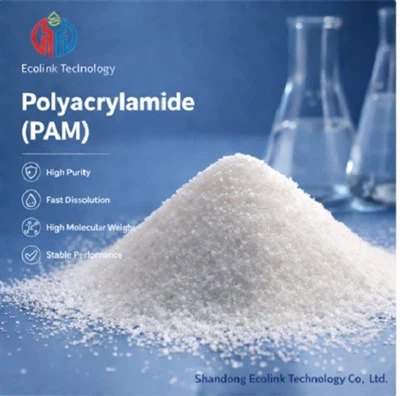
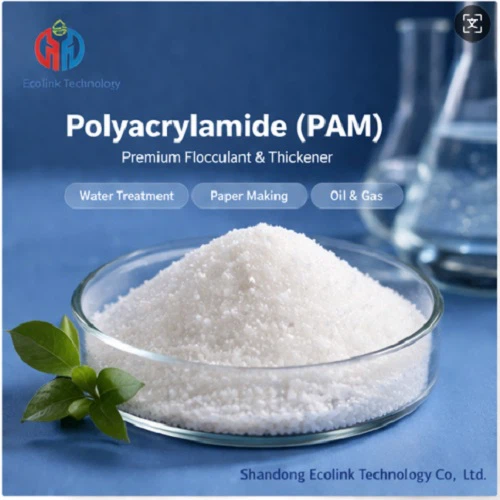
Ecolink supplies industrial-grade Polyacrylamide (PAM) in anionic, cationic, and non-ionic formulations, engineered for solid-liquid separation in municipal and industrial fluid processing. Produced via aqueous solution polymerization and precision drying systems, our polymers deliver controlled molecular weight distribution and consistent charge density.
Designed for high-throughput filtration and sedimentation operations, Ecolink PAM grades integrate directly into existing chemical conditioning loops, reducing sludge volume and improving filtrate clarity across wastewater, mining, and paper manufacturing streams.
-
![Cationic Flocculant]() Cationic FlocculantCationic Polyacrylamide (CPAM) is a highly efficient flocculant widely used in municipal and industrial wastewater treatment, especially for sludge dewatering and solid-liquid separation. Due to its cationic properties, it can rapidlyread more
-
![Cas Number 9003 05 8]() Cas Number 9003 05 8Cationic Polyacrylamide (CPAM) is primarily used for sludge dewatering and wastewater treatment. As a high-molecular flocculant, it delivers superior flocculation performance at lower dosage levels, helping customers address issues such asread more
-
![Cationic PAM]() Cationic PAMCationic Polyacrylamide (PAM) is a high-efficiency and stable water treatment flocculant, suitable for various industrial wastewater and sewage treatment systems. As a solid-liquid separation agent, it rapidly forms large flocs, enablingread more
-
![Cationic Polyacrylamide Powder]() Cationic Polyacrylamide PowderCationic Polyacrylamide (CPAM) is a highly efficient wastewater treatment flocculant and polymer flocculant. It is widely used in municipal wastewater treatment, industrial wastewater treatment, sludge dewatering, papermaking (as aread more
-
![Drilling Fluid Additives]() Drilling Fluid AdditivesCationic Polyacrylamide (CPAM), also known as cationic PAM or shale inhibitor, is an important chemical treatment agent used in oilfield drilling operations. It is specifically designed to address issues such as shale and clay swellingread more
-
![Polyacrylamide for Profile Control]() Polyacrylamide for Profile ControlCationic Polyacrylamide (CPAM) is used in oilfields as a profile control and water shutoff agent. It functions by selectively plugging high-permeability zones and adjusting the water injection profile, effectively reducing water cut in oilread more
-
![Oily Wastewater Treatment Polyacrylamide]() Oily Wastewater Treatment PolyacrylamideCationic Polyacrylamide (CPAM) can effectively neutralize negatively charged emulsified oil droplets and suspended colloids in produced water from oilfields. Through charge neutralization and adsorption-bridging mechanisms, it enablesread more
-
![Papermaking Retention Aid]() Papermaking Retention AidCationic polyacrylamide, as a key wet-end chemical in the papermaking industry, has become an ideal choice for improving paper quality, reducing raw material costs, and enhancing production efficiency due to its excellent strengthening,read more
-
![Polyacrylamide for Water Treatment]() Polyacrylamide for Water TreatmentAnionic Polyacrylamide (APAM) for Water TreatmentEfficient Flocculation & Sedimentation · Lower Treatment Cost · Stable Water Quality SolutionIf you are facing problems such as slow sedimentation, turbid effluent, high chemical dosage, andread more
-
![Polyacrylamide for Mining]() Polyacrylamide for MiningAnionic Polyacrylamide (APAM) for Mining IndustryCore Flocculant for Accelerating Sedimentation Separation · Improving Recovery Rate · Reducing Operating CostsIn mining and mineral processing operations, customers often face problems suchread more
-
![High Molecular Weight Polyacrylamide]() High Molecular Weight PolyacrylamideIf you are looking for a flocculant product with a wide range of applications, stable repeat purchases, and high customer acceptance, our anionic polyacrylamide (APAM) high molecular weight PAM is an ideal choice.This high molecular weightread more
-
![Papermaking Dispersant]() Papermaking DispersantAnionic Polyacrylamide (APAM) for Papermaking IndustryEfficient Flocculation Solution for Improving Paper Quality + Reducing Production CostsIf you are facing problems such as fine fiber loss, turbid white water, rising costs, or unstableread more


Product Specifications
Values below represent standard manufacturing thresholds. Custom molecular weights and ionic degrees are available upon pilot-scale testing.
|
Technical Parameter |
Anionic PAM (APAM) |
Cationic PAM (CPAM) |
Non-Ionic PAM (NPAM) |
Test Method |
|
Appearance |
White to off-white free-flowing granules |
White free-flowing granules |
White free-flowing granules |
Visual Inspection |
|
Solid Content (%) |
>= 89 |
>= 88 |
>= 90 |
|
|
Drying Loss (105 deg C, 2h) |
||||
|
Molecular Weight (Million) |
8 - 25 (Customizable) |
8 - 18 (Customizable) |
8 - 15 |
Ubbelohde Viscometer |
|
Ionic Degree / Charge (%) |
10 - 50 (Charge density) |
10 - 80 (Charge density) |
< 5 (Non-ionic) |
Colloid Titration |
|
Dissolution Time (min) |
<= 60 (In clean water at 25 deg C) |
<= 60 |
<= 60 |
Stirring Vortex Method |
|
Residual Monomer (%) |
< 0.05 |
< 0.05 |
< 0.05 |
HPLC |
|
pH Value (0.5% Solution) |
6.0 - 8.0 |
4.0 - 7.0 |
5.0 - 7.0 |
pH Meter |
Key Features
Narrow Molecular Weight Distribution:
Controlled chain growth polymerization minimizes low-molecular-weight fractions, preventing residual polymer carryover in the supernatant.
Rapid Hydration Kinetics:
Surface-treated granule morphology prevents agglomeration ("fish-eyes") during automatic makeup, ensuring complete dissolution within standard aging tanks.
High Charge Consistency:
Precision dosing of ionic comonomers maintains charge density within +/- 2% across production batches, stabilizing flocculation performance in variable influent conditions.
Low Residual Acrylamide:
Monomer conversion rates exceeding 99.95% comply with strict environmental regulations for municipal discharge and paper contact applications.
Municipal Sludge Dewatering: Applied in belt filter presses, centrifuges, and screw press dehydrators to flocculate digested and extended aeration sludges, reducing cake moisture to target disposal levels.
Industrial Wastewater Treatment: Used in the coagulation-flocculation of high-turbidity effluent from textile dyeing, paper mills, steel mill rolling wastewater, and chemical processing plants.
Mineral Processing & Tailings: Accelerates sedimentation rates of mineral slurries in copper, gold, iron ore, and coal washing circuits, improving water recycle efficiency in thickeners.
Papermaking Retention & Drainage: Functions as a wet-end additive to retain fillers and fine fibers, enhancing paper sheet formation and increasing drainage speeds on the wire.
Product Selection Guide
Selecting the correct Polyacrylamide grade requires matching polymer charge and molecular weight to your specific suspension chemistry. Follow this workflow:
Determine Effluent/Sludge Type:
Negatively charged suspended solids (e.g., metallic hydroxides, biological sludge, silica) typically require Cationic PAM (CPAM).
Positively charged or neutral solids (e.g., iron/steel plant effluent, coal washing) typically require Anionic PAM (APAM).
Acidic or high-electrolyte systems often require Non-Ionic PAM (NPAM).
Conduct Jar Tests:
Prepare a 0.1% stock solution of candidate PAM grades.
Test dosages ranging from 1 ppm to 10 ppm (or kg/dry ton for sludge).
Evaluate parameters: Flake size, settling velocity, supernatant clarity, and shear resistance of the floc.
Request Application Match:
Send your water chemistry report (pH, TDS, turbidity, temperature) to our technical team for a formulation recommendation.
Manufacturing & Quality Control
Polymerization Process:
Aqueous solution polymerization is conducted in temperature-controlled reactors under an inert nitrogen blanket to ensure uniform polymer chain extension.
Granulation & Milling:
Gels are extruded, dried using multi-stage fluidized bed dryers, and milled to a uniform particle size distribution (20 - 60 mesh), minimizing dust generation during handling.
Batch Testing Protocol:
Every production lot undergoes rigorous inspection before packaging. Viscosity, molecular weight, solid content, and residual monomer are verified using Ubbelohde viscometers and High-Performance Liquid Chromatography (HPLC).
Traceability:
Each bag is labeled with a unique batch number mapped directly to production logs, raw material supplier certificates, and retention samples kept for 12 months.
Standard Packaging:
25 kg multi-layer kraft paper bags with inner polyethylene liners.
750 kg - 1000 kg jumbo bags (FIBC) with discharge spouts.
Palletization & Transport Compliance: Bags are shrink-wrapped and stacked on ISPM 15-compliant heat-treated wooden pallets. Classified as non-hazardous for international ocean freight, complying with IMDG Code provisions and fully aligned with EU REACH regulatory requirements for safe import and handling.
Storage Conditions: Store in original, unopened packages in a cool, dry, and well-ventilated area away from direct sunlight and moisture.
Supply Capacity: Annual production capacity of 30,000 metric tons, supporting steady-state annual supply agreements for global distributors and industrial end-users.

Why Choose Ecolink
Batch Consistency: Strict control over reactor temperature and initiator feed rates ensures less than 3% viscosity variation across consecutive production runs.
Transparent Documentation: Full technical data sheets (TDS), safety data sheets (SDS), and batch-specific Certificates of Analysis (COA) provided with every shipment.
Logistics Support: Certified for safe chemical transport by sea, road, and rail, with export documentation compliant with North American and European import standards.
Technical Partnership: Direct access to application engineers for lab-scale sample evaluation and dosing optimization trials.
Frequently Asked Questions

Request a Quote / Sample
Need technical validation for your specific application? Provide your site parameters below so our engineering team can match the optimal polymer grade and prepare lab-grade sample kits for your jar tests.
Required Inquiry Details:
• Application Type: (e.g., municipal sludge dewatering, paper wet-end, mining thickener)
• Water / Sludge Parameters: Influent pH, TDS, temperature, and current sludge cake moisture (if applicable)
• Volume Requirements: Estimated annual consumption (metric tons) and target delivery port
Shandong Ecolink Technology Co., Ltd. is one of the most reliable polyacrylamide manufacturers and suppliers in China. We warmly welcome you to wholesale bulk high quality polyacrylamide from our factory. If you have any enquiry about cooperation, please feel free to email us.
-
![Cationic Flocculant]() Cationic FlocculantCationic Polyacrylamide (CPAM) is a highly efficient flocculant widely used in municipal and industrial wastewaterread more
-
![Cas Number 9003 05 8]() Cas Number 9003 05 8Cationic Polyacrylamide (CPAM) is primarily used for sludge dewatering and wastewater treatment. As a high-molecularread more
-
![Cationic PAM]() Cationic PAMCationic Polyacrylamide (PAM) is a high-efficiency and stable water treatment flocculant, suitable for variousread more
-
![Cationic Polyacrylamide Powder]() Cationic Polyacrylamide PowderCationic Polyacrylamide (CPAM) is a highly efficient wastewater treatment flocculant and polymer flocculant. It isread more
-
![Drilling Fluid Additives]() Drilling Fluid AdditivesCationic Polyacrylamide (CPAM), also known as cationic PAM or shale inhibitor, is an important chemical treatment agentread more
-
![Polyacrylamide for Profile Control]() Polyacrylamide for Profile ControlCationic Polyacrylamide (CPAM) is used in oilfields as a profile control and water shutoff agent. It functions byread more