
Shandong Ecolink Technology Co., Ltd. is one of the most reliable manufacturers and suppliers of polyacrylamide for mining in China, featured by quality products and good service. If you're going to wholesale high quality polyacrylamide for mining, welcome to get more information from our factory.
Product Overview

In mining and mineral processing operations, customers often face problems such as slow sedimentation, difficult tailings treatment, low water recycling efficiency, and high chemical costs.
Our mining-grade Anionic Polyacrylamide (APAM) can rapidly achieve solid-liquid separation in thickeners, tailings settling ponds, and coal washing wastewater systems. It significantly improves clear water reuse rate, reduces tailings moisture content, enhances mineral recovery efficiency, and optimizes tailings treatment processes. This mineral processing flocculant has become the preferred choice for mining enterprises.
Products Description
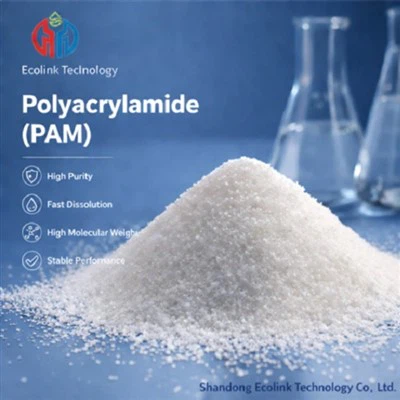
Anionic Polyacrylamide (APAM) appears as white granules or powder, easily soluble in water, non-toxic and non-corrosive.
In mining and mineral processing industries, APAM acts as a high-efficiency flocculant. Through adsorption bridging and charge neutralization, it rapidly aggregates suspended particles in slurry, and is widely used in:
- Tailings dewatering
- Concentrate thickening
- Coal washing wastewater treatment
- Solid-liquid separation in mineral processing
As a core flocculant in mining, APAM features:
- Excellent adsorption bridging performance
- Wide pH adaptability
- Strong synergistic effects
It has become a key auxiliary agent in tailings dewatering, concentrate thickening, and coal washing wastewater treatment.
As an efficient coal washing wastewater treatment agent, its parameters can be flexibly customized according to mineral characteristics:
- Molecular weight: 12–18 million
- Hydrolysis degree: 20%–30%
With very low dosage, it achieves efficient solid-liquid separation, significantly improves water recovery rate (up to over 90%), and reduces overall treatment costs.
Our company provides customized solid-liquid separation solutions with high-quality products, professional technical support, and dedicated services.

Product Parameter (specification)
|
Parameter |
Specification |
Remarks |
|
Appearance |
White or slightly yellow granules/powder |
|
|
Molecular Weight |
6–25 million |
Recommended 12–18 million |
|
Hydrolysis Degree |
10%–40% |
Common: 20%–30% |
|
Solid Content |
≥88%–90% |
|
|
Insoluble Content |
≤0.2% |
|
|
Residual Monomer |
≤0.05%–0.1% |
|
|
Effective pH Range |
4–14 |
Best in weak alkaline to alkaline |
|
Dissolution Time |
≤60 min |
Recommend stirring for 1 hour |
|
Product Form |
Dry powder |
25 kg bags |
|
Shelf Life |
2 years |
Store in cool, dry place |
Complies with ISO quality system and SGS testing standards, suitable for various minerals.
Product Advantages
|
Structure / Process / Material |
Performance |
Business Benefits |
|
Ultra-high molecular weight (18–28 million) |
Rapid bridging at low dosage |
Reduce chemical cost by 15–25% |
|
Narrow molecular weight distribution |
Large, dense flocs, fast settling |
Improve thickener capacity |
|
Controlled hydrolysis degree (15–40%) |
Adapt to different ores & water |
Reduce chemical inventory |
|
High shear resistance |
Flocs remain intact after pumping |
Stable flocculation performance |
|
Fast dissolution process |
Powder: 50 min / Emulsion: 5–10 min |
Lower labor & equipment cost |
|
Low residual monomer |
≤0.05% |
Meets environmental standards |

As a concentrate thickening agent, this product performs especially well in improving mineral recovery.
Applications / Solutions
|
Mining Type |
Application |
Molecular Weight |
Hydrolysis |
|
Iron ore |
Tailings thickening |
20–25 million |
25–35% |
|
Copper ore |
Tailings & concentrate |
22–26 million |
20–30% |
|
Gold ore |
Cyanide tailings |
20–24 million |
25–35% |
|
Bauxite |
Red mud settling |
18–22 million |
30–40% |
|
Phosphate |
Slurry thickening |
20–25 million |
20–30% |
|
Coal |
Coal slurry settling |
18–22 million |
20–30% |
|
Lead-zinc |
Tailings treatment |
20–25 million |
20–30% |

This red mud flocculant is widely recognized in the bauxite industry.
|
Mineral Type |
MW |
Hydrolysis |
Dosage |
Suggestion |
|
Iron tailings |
22–26M |
25–30% |
10–30 g/t |
Use with PAC |
|
Copper tailings |
20–24M |
20–25% |
15–40 g/t |
Adjust pH first |
|
Red mud |
18–22M |
30–40% |
20–50 g/t |
Alkali-resistant type |
|
Coal slurry |
18–22M |
20–30% |
5–15 g/t |
Can be used alone |
Our APAM provides faster settling, clearer overflow, and drier tailings at the same dosage.
Product Technology / Technical Strength

Response to Customer Concerns
|
Concern |
Our Solution |
|
Whether applicable to different mineral types |
Customizable models supported |
|
Product stability |
Batch consistency control |
|
Whether testing is supported |
Sample testing provided |
|
Cost control |
Low dosage, high cost performance |
|
MOQ |
Flexible minimum order quantity |
|
Delivery time |
Stable supply |
|
After-sales service |
Technical guidance provided |
|
Certification |
ISO system + SGS testing |
Our Thoughtful Services
Technical Support
Provide full-process technical services including product selection, laboratory testing, and on-site commissioning. Recommend optimal molecular weight and dosage based on different mineral characteristics.
01
Sample Service
Free samples are provided to assist customers in laboratory testing and determine the optimal product model and flocculant consumption.
02
Customized Production
Customized molecular weight, hydrolysis degree, and other parameters based on customer mineral characteristics (such as pyrite content, clay content) and process conditions.
03
After-sales Guarantee
Provide on-site technical guidance, track application performance, and respond promptly to customer needs.
04
Stable Supply
Large-scale production with sufficient inventory ensures timely and stable supply.
05
Frequently Asked Questions (FAQ)
Q: 1. What role does anionic polyacrylamide play in mineral processing?
A: APAM is mainly used as a flocculant in mineral processing. Through adsorption bridging, it rapidly aggregates suspended particles in slurry and is widely used in tailings dewatering, concentrate thickening, coal washing wastewater treatment, and solid-liquid separation in mineral processing.
Q: 2. How to select molecular weight and hydrolysis degree?
A: Molecular Weight:
Recommended molecular weight for mineral processing is 12–18 million.
Higher molecular weight products have more significant flocculation effects and form larger flocs.
Experiments at Beiminghe Iron Mine showed that APAM with a molecular weight of 12 million achieved the best performance.
Hydrolysis Degree:
Recommended range is 20%–30%.
Excessively high hydrolysis may affect salt resistance, while too low hydrolysis results in poor water solubility.
Q: 3. What is the recommended dosage?
A: The general dosage is 0.01–10 ppm (0.01–10 g/m³ of slurry).
The specific dosage should be determined through laboratory testing based on factors such as mineral type, slurry concentration, and particle size distribution.
In the Beiminghe Iron Mine case, the optimal flocculant consumption was 40 g/t tailings.
Q: 4. What mineral types is anionic PAM suitable for?
A: It is suitable for tailings treatment and mineral processing of various minerals such as copper ore, iron ore, gold ore, coal, bauxite, and phosphate ore.
It shows significant effectiveness when treating pyrite-containing tailings under alkaline conditions.
Q: 5. Can it be used together with inorganic flocculants?
A: Yes.
APAM can be used in combination with inorganic flocculants such as Polyaluminum Chloride (PAC) and Polyferric Sulfate (PFS), producing a synergistic effect, significantly improving treatment performance, and reducing overall chemical costs.
Q: 6. What precautions should be taken during use?
A: It should be fully dissolved before use; avoid direct addition of dry powder to prevent "fish-eye" formation
Dissolution water temperature should not exceed 50°C to prevent thermal degradation; decomposition occurs above 120°C
Stirring speed should be controlled at 100–300 rpm to avoid molecular chain breakage caused by high shear
Store in a cool and dry place; protect from moisture and caking; use as soon as possible after opening
Q: 7. Is it effective for high-salinity / high-mineralization slurry?
A: Yes.
Studies show that anionic polyacrylamide can still effectively promote flocculation of mineral particles under seawater or high-salinity conditions, but the dosage needs to be adjusted appropriately.
Q: 8. What is the shelf life of the product?
A: Under cool and dry storage conditions, the shelf life is 2 years.
The prepared solution is recommended to be used within 24 hours to avoid performance reduction.
Q: 9. How to determine whether APAM selection is appropriate?
A: It can be judged by the following phenomena:
Moderate floc size and dense structure
Clear supernatant
Fast settling speed
High underflow concentration
Good filtration efficiency
If flocs are too small or the supernatant is turbid, the molecular weight may be too low or the dosage insufficient.
If flocs are too large but loose, the molecular weight may be too high.

CTA
Get samples of APAM for mining
Obtain mineral processing and tailings treatment solutions
Contact us for quotation and technical support
Hot Tags: polyacrylamide for mining, China polyacrylamide for mining manufacturers, suppliers, factory