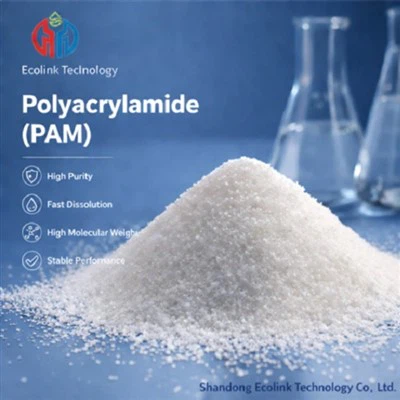

Shandong Ecolink Technology Co., Ltd. is one of the most reliable manufacturers and suppliers of polyacrylamide for hydraulic fracturing in China, featured by quality products and good service. If you're going to wholesale high quality polyacrylamide for hydraulic fracturing, welcome to get more information from our factory.
Product Introduction

In oilfield hydraulic fracturing operations, customers often encounter problems such as high pumping pressure, insufficient proppant carrying capacity, low operational efficiency, and high costs.
Our anionic polyacrylamide (APAM) dedicated for fracturing fluids can significantly improve the rheological properties of fracturing fluids.
While ensuring construction stability, it achieves lower energy consumption + higher proppant carrying efficiency + better fracture conductivity.
This fracturing fluid thickener has become a core additive in fracturing operations.
Product Overview
Anionic polyacrylamide (APAM) is a high molecular linear polymer. In fracturing fluid systems, it is mainly used as a thickener and rheology modifier. By forming a three-dimensional network structure, it increases the viscosity and proppant carrying capacity of fracturing fluids, thereby optimizing fracturing performance.
Our anionic polyacrylamide (APAM) adopts a low-temperature homogeneous polymerization + controllable post-hydrolysis process. Using high-purity acrylamide as the monomer, polymerization is carried out under strictly deoxygenated conditions. It is specially designed for water-based fracturing fluid systems as a fracturing fluid thickener / fracturing fluid drag reducer / fracturing fluid proppant carrier.

Product Parameter (specification)
|
Parameter Item |
Technical Specification |
Remarks |
|
Appearance |
White granules or powder |
Microbead / emulsion forms are also available |
|
Molecular Weight |
8–25 million |
Recommended 15–22 million for fracturing applications |
|
Ionic Degree (Hydrolysis Degree) |
0%–35% |
Common range 10%–25% |
|
Solid Content |
≥88%–90% |
|
|
Effective pH Range |
5–11 |
Strong adaptability to total dissolved solids (TDS) variations |
|
Dissolution Time |
≤60 minutes |
Microbead products can be reduced to 10–15 minutes |
|
Residual Monomer |
≤0.05%–0.1% |
|
|
Product Form |
Dry powder / Microbead / Emulsion |
Powder: 25 kg bags; Microbead/Emulsion: drums |
|
Shelf Life |
2–4 years (powder) / 6–12 months (emulsion) |
Store in a cool and dry place |
Complies with ISO quality system and SGS testing standards, suitable for various reservoir conditions.
Product Advantages
|
Structure / Process / Material |
Performance |
Business Benefits |
|
Ultra-high molecular weight (20–28 million) |
Target viscosity can be achieved at low concentration |
Reduce additive cost per ton of fluid by 15–25% |
|
Controllable hydrolysis degree (10–30%) |
Base fluid viscosity and crosslinking performance are adjustable |
Adapt to different temperature and salinity reservoirs, one fluid for multiple uses |
|
Low insoluble content process |
Residue content ≤5% |
Reduce blockage of reservoir pores and protect permeability |
|
Fast dissolution formulation |
Powder dissolves in 40 minutes, emulsion in 5 minutes |
Shorten fluid preparation time and improve fracturing efficiency |
|
Good crosslinking responsiveness |
Forms stable gel with zirconium/boron crosslinkers |
Temperature resistance up to 120°C, meeting medium-high temperature fracturing needs |
As a water-based fracturing fluid thickener, this product can achieve ideal viscosity enhancement at low concentration.
Applications / Solutions
- Linear gel fracturing fluid: As the main thickener, providing base viscosity and proppant carrying capacity
- Crosslinked gel fracturing fluid: Used with boron/zirconium crosslinkers to form high-viscosity gel, suitable for high-temperature deep wells
- Slickwater + linear gel combined fracturing: Pre-pad slickwater creates fractures, followed by linear gel for proppant transport
- Low-temperature low-permeability reservoirs: Fast-breaking formulations reduce reservoir damage
This polyacrylamide for crosslinked gel fracturing fluid shows excellent performance when used with boron/zirconium crosslinkers and is suitable for high-temperature deep well fracturing operations.
|
Reservoir Temperature |
Recommended MW |
Recommended Hydrolysis |
Recommended Concentration |
Crosslinking Scheme |
|
≤60°C (low temperature) |
20–22 million |
10%–15% |
0.3%–0.5% |
Organic boron crosslinking |
|
60–100°C (medium temperature) |
22–25 million |
15%–20% |
0.4%–0.6% |
Organic zirconium crosslinking |
|
100–120°C (high temperature) |
25–28 million |
20%–25% |
0.5%–0.8% |
Composite crosslinker |

Our APAM has stable viscosity, controllable crosslinking, and extremely low residue.
Response to Concerns
|
Concern |
Our Solution |
|
Whether it is resistant to high shear |
Provide shear-resistant optimized models |
|
Whether it affects the reservoir |
Low-residue design reduces damage |
|
Whether testing is supported |
Provide laboratory and field testing |
|
MOQ |
Flexible minimum order |
|
Delivery time |
Stable supply capacity |
|
Technical support |
Provide fracturing fluid formulation recommendations |
|
Certification |
ISO system + SGS testing |
Product Process / Technical Strength
By optimizing polymerization and production processes, we ensure stable performance under fracturing conditions:
Precise control of molecular weight distribution
Improve molecular chain integrity to enhance shear resistance
Control impurity content to reduce residue
Automated production to ensure batch consistency
Not only providing thickening effect, but also ensuring construction stability and long-term performance in fracturing operations.
This high-temperature deep well fracturing fluid additive is particularly suitable for medium-high temperature reservoir fracturing operations.

Frequently Asked Questions (FAQ)
Q: 1. What is the main function of anionic polyacrylamide as a fracturing fluid additive?
A: As a fracturing fluid additive, APAM is mainly used as a thickener and drag reducer: on one hand, it increases fluid viscosity and enhances proppant carrying capacity; on the other hand, it reduces friction resistance in pipelines and improves pumping efficiency.
Q: 2. How to select molecular weight and ionic degree?
A: Recommended molecular weight: 8–20 million for fracturing applications.
High molecular weight products provide more significant viscosity enhancement; low hydrolysis degree products provide better drag reduction performance.
Specific parameters can be customized according to fracturing fluid water quality and operational conditions. Hydrolysis degree: 0%–35%.
Q: 3. What is the recommended dosage?
A: Recommended dosage for emulsion/microbead products: 0.25–2.0 gpt (gallon per thousand gallons).
The specific dosage should be determined based on fracturing fluid water quality, displacement rate, and operational requirements. Field testing is recommended for optimization.
Q: 4. What is the dissolution speed of the product?
A: Microbead products dissolve within 10–15 minutes, while traditional powder products require more than 1 hour.
This provides great convenience for on-site continuous mixing operations.
Q: 5. What is the applicable temperature range?
A: The effective operating temperature range is 5–50°C.
When fluid temperature exceeds 50°C and lasts more than 2 days, it is recommended to add a thermal stabilizer to maintain product performance.
Q: 6. Is it suitable for high-salinity fracturing fluids?
A: Yes.
Anionic polyacrylamide has good adaptability to changes in total dissolved solids (TDS) and can be used in fracturing fluids prepared with flowback fluid or produced water.
Q: 7. Will it damage the reservoir?
A: When used at a reasonable dosage, the product leaves no residue after complete gel breaking and has minimal impact on reservoir permeability.
Excessive dosage may cause polymer residue blockage in reservoir pores, so it is recommended to determine the optimal dosage through testing.
Q: 8. What precautions should be taken during use?
A: Powder products are hygroscopic; store in a cool and dry place below 35°C
Dissolution water temperature should not exceed 50°C to prevent thermal degradation
Avoid direct contact with strong oxidants and high-concentration metal ions
Emulsion products should be stored at 5–30°C to prevent freezing or demulsification
Wear protective equipment during operation to avoid contact with eyes and skin
Q: 9. What is the shelf life of the product?
A: Powder products have a shelf life of 2–4 years under cool and dry storage conditions; emulsion products have a shelf life of 6–12 months.
Our Service
Direct supply from source factory
Customized R&D and samples
Strict quality control and packaging
Innovation
One-stop global logistics
Full-process technical support


CTA
Get APAM samples for fracturing fluid
Get fracturing optimization solutions and quotations
Contact us for technical support
Hot Tags: polyacrylamide for hydraulic fracturing, China polyacrylamide for hydraulic fracturing manufacturers, suppliers, factory, Fluid Loss Additive, Drilling Mud Viscosifier, Polyacrylamide Friction Reducer, Anionic Retention Agent, Polymer Thickener, Hydrolyzed Polyacrylamide for Drilling