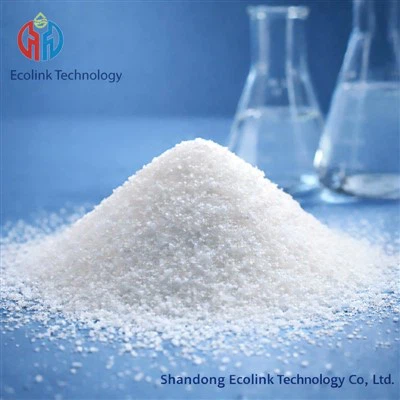

Shandong Ecolink Technology Co., Ltd. is one of the most reliable manufacturers and suppliers of polyacrylamide for water treatment in China, featured by quality products and good service. If you're going to wholesale high quality polyacrylamide for water treatment, welcome to get more information from our factory.
Product Overview

If you are facing problems such as slow sedimentation, turbid effluent, high chemical dosage, and rising operational costs in water treatment processes, our water-treatment-grade Anionic Polyacrylamide (APAM) provides an effective solution.
It is not only a water treatment flocculant, but also a proven solution that improves treatment efficiency, reduces operating costs, and enhances effluent stability.
This high-molecular-weight flocculant enables rapid solid–liquid separation in municipal wastewater, industrial effluent, and sludge dewatering applications, significantly reducing effluent turbidity and sludge moisture content.
As an industrial wastewater sedimentation treatment agent, APAM has become a preferred product in numerous water treatment projects.
Products Description
Anionic Polyacrylamide (APAM) is a highly efficient and environmentally friendly water-soluble polymer. Due to its excellent flocculation performance, wide pH adaptability, and good synergistic effects, it has become a key chemical in industrial wastewater treatment, drinking water purification, and sludge dewatering applications.
Our APAM products can be flexibly adjusted according to different application requirements, providing customized water treatment solutions for users.

Product Parameter (specification)
|
Parameter |
Specification |
Remarks |
|
Appearance |
White or light yellow granules/powder |
|
|
Molecular weight |
5–25 million |
Common range: 8–22 million |
|
Charge density (Hydrolysis degree) |
5%–60% |
Common range: 20%–30% |
|
Solid content |
≥88%–90% |
|
|
Insoluble matter |
≤0.2% |
|
|
Residual monomer |
≤0.05%–0.1% |
|
|
Effective pH range |
4–14 |
Best performance under neutral and alkaline conditions |
|
Dissolution time |
≤60 minutes |
Recommended stirring time: 1 hour |
|
Bulk density |
Approx. 0.75–0.80 g/cm³ |
|
|
Product form |
Dry powder |
Packed in 25 kg PE-lined woven bags or paper-plastic composite bags |
|
Shelf life |
2 years |
Store in a cool, dry place |
The product complies with ISO quality management system standards and SGS testing requirements, ensuring stable performance in various water treatment applications.
Product Advantages
|
Structure / Process / Material |
Performance |
Commercial Benefits |
|
Ultra-high molecular weight (12–25 million) |
Rapid bridging and flocculation even at low dosage |
Reduces chemical cost per ton of water by 10–20% |
|
Controllable hydrolysis degree (15%–40%) |
Adapts to different water qualities (acidic/alkaline/high salinity) |
One product for multiple uses, reducing chemical inventory types |
|
Fast-dissolving process |
Powder dissolves in ~50 minutes; emulsion in 5–10 minutes |
Reduces investment in dissolution tanks and labor cost |
|
Low residual monomer |
Free acrylamide ≤0.05% |
Meets drinking water treatment standards and ensures regulatory compliance |
|
Narrow molecular weight distribution |
Uniform floc formation and faster settling |
Improves clarifier efficiency and reduces solids carryover |
As a sludge dewatering agent, this product performs particularly well in reducing sludge cake moisture content.
Applications / Solutions
|
Application |
Function |
Recommended Molecular Weight |
Recommended Hydrolysis Degree |
|
Municipal wastewater treatment |
Flocculation and sedimentation in primary/secondary clarifiers |
15–20 million |
20%–30% |
|
Sludge dewatering |
Belt press / centrifuge dewatering |
12–18 million |
25%–35% |
|
Industrial wastewater (textile dyeing) |
Decolorization, removal of dye suspended solids |
18–22 million |
20%–25% |
|
Industrial wastewater (paper) |
White water recovery, fiber and filler retention |
15–20 million |
15%–25% |
|
Industrial wastewater (steel/electroplating) |
Heavy metal precipitate flocculation |
12–16 million |
25%–35% |
|
Coal washing wastewater |
Coal slurry sedimentation and water reuse |
18–22 million |
20%–30% |
|
Drinking water treatment |
Raw water clarification |
12–16 million |
15%–20% |

This coal washing wastewater coal slurry settling agent has been widely recognized in the coal industry.
|
Wastewater Type |
Recommended Molecular Weight |
Hydrolysis Degree |
Suggested Dosage |
Supporting Chemicals |
|
Domestic wastewater |
15–20 million |
20%–25% |
0.5–2 ppm |
Better with PAC |
|
Sludge dewatering |
12–18 million |
25%–35% |
3–5 kg/ton dry sludge |
With inorganic coagulant |
|
High suspended solids wastewater |
18–22 million |
15%–20% |
1–5 ppm |
Adjust pH to 6–8 first |
|
High salinity wastewater |
20–25 million |
30%–40% |
2–6 ppm |
Salt-resistant type recommended |
As a municipal wastewater flocculation and sedimentation agent, this product provides faster settling and clearer effluent at the same dosage level.

Procurement Concerns and Responses
|
Concern |
Our Solution |
|
Product stability |
Batch consistency control |
|
Adaptability to different water qualities |
Customized grades available |
|
Testing support |
Free samples provided |
|
Cost controllability |
Low dosage, high cost-performance ratio |
|
MOQ |
Flexible order quantity |
|
Delivery time |
Stable supply |
|
Certifications |
ISO system + SGS testing |
|
After-sales service |
Technical guidance provided |
Product stability and adaptability of anionic PAM are core focus areas of our continuous optimization.
Product Process / Technical Strength
We adopt advanced polymerization technology to ensure the stability of APAM products:
- Precise control of molecular weight and hydrolysis degree
- Optimized polymer chain structure to improve flocculation performance
- Controlled impurity content to improve product purity
- Automated production to ensure batch-to-batch consistency
👉 Core advantage: stable long-term performance and reduced customer risk.
This drinking water purification grade polyacrylamide strictly controls residual monomer content to ensure safety.
Instructions for Use
Preparation concentration
The product is typically prepared as a 0.05%–0.5% (W/W) solution, with 0.1% recommended.
01
Dissolution method
Disperse the product evenly under stirring. Dissolution takes about 1 hour until complete.
02
Water quality requirements
Use low-hardness water. Avoid metal containers that may affect performance.
03
Temperature control
Higher temperature accelerates dissolution, but water temperature should generally not exceed 50°C.
04
Synergistic use
When used with inorganic coagulants, add inorganic coagulant (e.g., PAC) first, then APAM for better performance.
05
Frequently Asked Questions (FAQ)
Q: 1. What is the difference between anionic, cationic, and non-ionic polyacrylamide?
A: Anionic (APAM): Suitable for neutral or alkaline wastewater with positively charged suspended particles, such as steel, electroplating, and coal washing wastewater
Cationic (CPAM): Suitable for acidic or high organic content wastewater with negatively charged particles, such as alcohol, beer, and dyeing wastewater
Non-ionic (NPAM): Suitable for acidic suspended wastewater with good electrolyte tolerance
Q: 2. How to select molecular weight and charge density?
A: Molecular weight: high molecular weight (>15 million) for inorganic suspended solids; medium/low for deep penetration applications
Hydrolysis degree: 20%–30% for most industrial wastewater; customized for special applications
Q: 3. Recommended dosage?
A: Typical dosage is 0.01–10 ppm (0.01–10 g/m³). Lower dosage is required when used with inorganic coagulants. Jar testing is recommended.
Q: 4. Shelf life of prepared solution?
A: Fresh solution is recommended. After 24 hours, viscosity decreases and performance may be affected.
Q: 5. Precautions?
A: Store in a dry, cool place, avoid moisture
Avoid contact with strong oxidants and metal ions
Wear protective equipment during operation
Avoid using metal containers for dissolution
Q: 6. Environmental impact?
A: APAM is non-toxic and non-corrosive. It does not harm aquatic organisms at proper dosage in stormwater treatment. However, dosage control is required due to residual acrylamide monomer.
Q: 7. Shelf life?
A: 2 years under cool and dry storage conditions.
Our Services

A. Direct supply from source factory
B. Custom R&D and sampling
C. Strict quality control and packaging
D. Innovation capability
E. One-stop global logistics
F. Full technical support
We provide professional technical support and stable products whether you need water treatment flocculants or other polymer flocculants.

CTA
Get APAM samples for water treatment
Get water treatment solution & quotation
Contact us for technical support
Hot Tags: polyacrylamide for water treatment, China polyacrylamide for water treatment manufacturers, suppliers, factory