From "Filter First" to "Coagulate First": A Crucial Step Determining Pollutant Removal Efficiency
In drinking water treatment, industrial wastewater treatment, and municipal sewage treatment, an often overlooked question is: why do many high-efficiency water treatment systems choose to perform coagulation and flocculation first, before entering the sedimentation or filtration stage?
The answer is not simply "better filter performance," but because many pollutants in raw water are naturally difficult to filter directly.
Pollutants in natural water bodies and industrial wastewater usually exist in different forms such as suspended solids, colloids, organic matter, microorganisms, and dissolved pollutants. Among them, a large number of tiny particles carry negative charges and exhibit electrostatic repulsion between each other, thus maintaining a dispersed state for a long time. Relying solely on gravity sedimentation or conventional filtration makes it difficult to efficiently remove these stable colloidal particles.
This is why a properly designed Coagulation and Flocculation process can usually significantly improve the operational effects of subsequent sedimentation, filtration, and even membrane treatment.
According to original data, coagulation pretreatment can reduce the suspended particulate matter content entering the filtration stage by 60% to 90%, with specific results depending on the raw water quality.
Therefore, in a complete wastewater treatment process, coagulation is not merely an added process step, but a process that transforms pollutants into forms that are "easier to be removed by downstream equipment."
I. Why Don't Tiny Pollutants Settle on Their Own?
Colloidal Stability Is the First Problem Water Treatment Needs to Solve
Raw water is not just "water containing mud."
The clay, colloidal silica, organic matter, fine sediments, and some microbial cells contained within often have extremely small particle sizes, and their surfaces usually carry negative charges.
Due to the electrostatic repulsion between these particles, even when they come close to one another, they do not easily combine naturally to form larger precipitates.
The original text points out that the diameter of such particles is usually about 0.001 to 1 micron. Among them, particles with a diameter of 0.1 microns may take several years to settle by one meter in a static water environment.
This means that if such water is directly fed into the filter, the filtration system actually needs to undertake a large number of tasks that were originally unsuitable for the filtration stage to perform independently.
Therefore, one of the core values of modern water treatment chemicals is to alter the physicochemical state of pollutants, allowing tiny pollutants that were originally difficult to separate to form flocs that are easier to settle and filter.
II. What Role Does PAC Play in the Coagulation Stage?
How Does PAC Achieve Charge Neutralization?
In actual water treatment processes, PAC (Polyaluminium Chloride) is a common inorganic coagulant.
After entering the water body, through processes such as hydrolysis, polymerization, and the formation of aluminum hydroxyl polymers, PAC exerts charge neutralization and adsorption effects on colloids and suspended particles in the water.
Colloidal particles in many natural water bodies and industrial wastewater carry negative charges, while the cationic aluminum species formed by the hydrolysis of PAC can reduce the electrostatic repulsion between particles, causing the originally stably dispersed particles to lose stability.
To put it simply:
Original state:
Negatively charged particles -- Mutual repulsion --Long-term dispersion --Difficult to settle
After adding PAC:
PAC hydrolysis --Charge neutralization/adsorption --Colloidal destabilization --Particles begin to aggregate
This is the core role of PAC coagulant in water treatment.
The original text also points out that common inorganic coagulants include aluminum sulfate, ferric chloride, and ferric sulfate, which enable particles to collide with each other and form aggregates by reducing the charge repulsion on the particle surface.
In actual projects, PAC is not a case of "the more added, the better." The dosage of PAC needs to be determined based on raw water turbidity, suspended solids, pH, alkalinity, organic matter content, and jar test results on site.
Therefore, for different water sources, a reasonable PAC for industrial wastewater treatment plan should be based on water quality analysis and Jar Tests, rather than simply adopting a fixed dosage.
III. Why Is PAM(polyacrylamide) Still Needed After PAC?
PAC Is Responsible for "Destabilization", PAM Is Responsible for "Growing"
PAC and PAM are not two chemicals that replace each other.
In a typical coagulation-flocculation process, the two bear different main functions.
The core role of PAC leans more toward coagulation:
Reducing colloidal stability;
Neutralizing particle surface charges;
Promoting colloidal destabilization;
Forming initial micro-flocs.
The core role of PAM leans more toward flocculation:
Promoting connections between micro-flocs;
Increasing floc particle size;
Improving floc structure;
Enhancing floc sedimentation performance;
Strengthening the retention capability in the filtration stage.
Therefore, the entire process can be understood as:
PAC: Makes particles "willing to gather together."
PAM: Makes these particles "gather bigger and stronger."
This is why PAC and PAM for water treatment are frequently used in combination.
IV. The Bridging Effect of PAM: How to Make Flocs Larger and Sturdier?
How Does Polyacrylamide Improve Flocculation Effects?
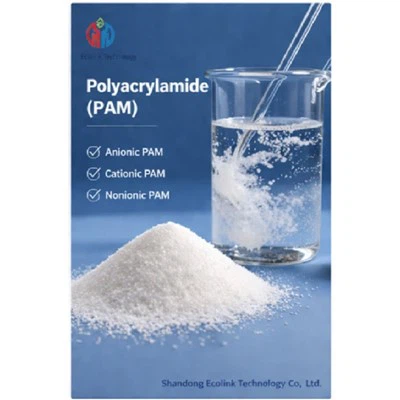
PAM (Polyacrylamide) is a class of polymer flocculants.
Unlike inorganic coagulants that mainly rely on charge effects, one of the important mechanism of action for PAM is polymer chain bridging.
PAM molecules possess long polymer chains. When part of the particles or micro-flocs have already formed, the PAM molecular chains can simultaneously adsorb or connect multiple particles, enabling the dispersed micro-flocs to further form larger aggregates.
This process can be summarized as:
Tiny particles $\rightarrow$ PAC coagulation destabilization $\rightarrow$ Initial micro-flocs $\rightarrow$ PAM bridging $\rightarrow$ Large flocs $\rightarrow$ Sedimentation/Filtration
The original text points out that PAM can connect partially formed flocs into larger, denser, and sturdier aggregates, making their settling speed faster and easier to be captured by filters; in related studies, when PAM is used in combination with inorganic coagulants, the turbidity removal rate can reach approximately three times that of using inorganic coagulants alone.
Therefore, in practical PAM for wastewater treatment applications, the value of PAM is not only "making flocs larger," but also includes improving floc strength, sedimentation performance, and solid-liquid separation efficiency.

V. PAM Is Not Just One Single Type: How to Choose the Right PAM?
Application Differences of Anionic PAM, Cationic PAM, and Non-ionic PAM
Particles in different wastewater have different properties, so it cannot be assumed that one type of PAM is suitable for all water treatment projects.
1. Anionic Polyacrylamide
Anionic PAM (APAM) is typically suitable for water treatment scenarios with high inorganic suspended solids content, such as:
Mining wastewater;
Sand washing wastewater;
Metallurgical wastewater;
General industrial wastewater;
Water clarification and suspended solids removal.
Its anionic groups can interact with certain inorganic particles and metal hydroxide flocs, thereby promoting further floc growth.
Therefore, in PAM flocculant for water clarification type applications, APAM is one of the common choices.
2. Cationic Polyacrylamide
Cationic PAM (CPAM) is more commonly used in applications with high organic content, biological sludge, and sludge dewatering.
Organic particles and biological solids in sludge usually carry negative charges. Cationic PAM can promote the aggregation of sludge particles through charge action and polymer bridging, making bound water easier to release, thereby improving sludge dewatering performance.
Therefore, PAM for sludge dewatering is an important application direction for Cationic PAM.
3. Non-ionic Polyacrylamide
Non-ionic PAM (NPAM) has relatively mild charge characteristics and can be selected based on water quality conditions in certain special industrial wastewater and mineral processing systems.
Actual model selection cannot rely solely on "anionic, cationic, or non-ionic", but also needs to combine:
Molecular weight;
Charge density / Degree of ionization;
Solid content;
Water quality pH;
Properties of suspended solids;
Sludge properties;
Floc formation speed;
Settling speed;
On-site equipment conditions.
Therefore, a professional wastewater treatment chemicals supplier should first analyze the water quality and process before determining the product type.
VI. Why Does "Coagulation First, Flocculation Second, Filtration Last" Work Better?
The Process Sequence Itself Is Part of the Pollutant Removal Efficiency
A typical traditional water treatment flow usually includes:
Coagulation $\rightarrow$ Flocculation $\rightarrow$ Sedimentation $\rightarrow$ Filtration
The traditional filtration process logic cited in the original text is also organized in the order of coagulation, flocculation, sedimentation, and filtration.
This sequence is extremely important.
If direct filtration is used, the filter faces a large number of extremely small colloidal and suspended particles.
However, after PAC coagulation and PAM flocculation, a large number of tiny pollutants have already been transformed into larger flocs.
As a result:
The filter does not face a large number of tiny colloids, but rather the small amount of remaining pollutants after pretreatment.
This brings two direct results:
First, Reducing the Particle Load on the Filter
When a large amount of suspended solids has been removed before entering the filter, the rate of filter media clogging decreases, and the backwash cycle can be extended.
The original text points out that coagulation pretreatment can significantly reduce the content of suspended particulate matter entering the filtration stage and improve the operating status of the filter.
Second, Improving Pollutant Retention Efficiency in the Filtration Stage
Particles formed through coagulation are easier to attach to the surface of the filter media than original colloids.
Thus, the filter does not need to independently undertake the task of "destroying colloidal stability," but rather focuses on retaining residual particles.
This is precisely why the coagulation and flocculation process is extremely important in modern water treatment systems.
VII. Why Can Coagulation Not Only Remove Turbidity, But Also Help Remove Heavy Metals?
Transitioning from "Dissolved State" to "Separable Solid"
The role of coagulation is not limited to suspended solids.
Under specific pH conditions, certain heavy metals can form insoluble hydroxides or other precipitates through chemical reactions and co-precipitate with metal hydroxide flocs formed during the coagulation process.
For example, formed under appropriate conditions:
$\text{Al(OH)}_3$
or
$\text{Fe(OH)}_3$
can form floc structures with larger volumes.
The original text points out that heavy metal ions can co-precipitate with metal hydroxide flocs during the coagulation process, transforming them from a dissolved state that is difficult to remove by conventional filtration into a solid form that is easier to settle and separate.
Therefore, in heavy metal industrial wastewater treatment, coagulants such as PAC usually need to be used synergistically with pH adjustment, sedimentation, PAM flocculation, and subsequent filtration processes.
It should be noted that the specific heavy metal removal effect highly depends on pollutant types, concentration, pH, alkalinity, coagulant type, and dosage, so fixed removal rates cannot be directly promised without water quality data.
VIII. How Can Coagulation Help Reduce Natural Organic Matter and Disinfection Byproducts?
NOM Removal Is Not Only Related to Water Quality, But Also Affects Subsequent Disinfection
Natural Organic Matter (NOM) mainly originates from the decomposition of organic matter in plants, algae, and soil.
Some of these organic compounds have strong water solubility and cannot be effectively removed through simple sedimentation or conventional filtration.
However, a portion of NOM carries negative charges and can be adsorbed onto the surface of positively charged metal hydroxide flocs.
Therefore, when coagulation is situated prior to disinfection, a portion of NOM can be removed in advance along with the settling of flocs.
The original text specifically points out that NOM is an important precursor for disinfection byproducts such as trihalomethanes (THM) and haloacetic acids (HAA). Reducing NOM in advance can reduce the opportunity for it to form disinfection byproducts during subsequent chlorine disinfection.
This means that a reasonable water treatment chemicals scheme should not only focus on "whether the water after filtration is clear," but also consider the impact of coagulation on subsequent disinfection, membrane treatment, and overall system operation.
IX. How Do PAC + PAM Form a Complete Coagulation-Flocculation System?
Two Chemicals Working Synergistically, Not Simple Stacking
In practical engineering, PAC and PAM usually undertake functions at different stages.
Step 1: PAC Coagulation
PAC first enters the raw water, reducing colloidal stability through hydrolysis and charge effects to destabilize particles.
Step 2: Rapid Mixing
Through rapid stirring, PAC is rapidly and evenly dispersed, allowing more particles to come into full contact with the coagulant.
Step 3: PAM Flocculation
Appropriate amounts of PAM are added after the micro-flocs are formed via coagulation, promoting further growth of micro-flocs through polymer chain bridging.
Step 4: Slow Flocculation
Reduce stirring intensity to allow gentle collisions between particles, preventing already formed flocs from being destroyed by excessive shear force.
Step 5: Sedimentation
The formed large flocs possess higher settling performance and quickly enter the sedimentation zone under the action of gravity.
Step 6: Filtration
After front-end coagulation, flocculation, and sedimentation, the particle load entering the filter is significantly reduced, and the filter further removes residual suspended solids.
Therefore, a mature PAC and PAM water treatment solution should focus not just on the chemicals themselves, but on the matching between the chemicals and the mixing, flocculation, sedimentation, and filtration equipment.
X. How Do PAM and PAC Help Protect Downstream Membrane Systems?
Coagulation Pretreatment Is an Important Protective Barrier for Membrane Filtration
Currently, an increasing number of water treatment systems adopt membrane technologies such as UF (Ultrafiltration), MF (Microfiltration), and RO (Reverse Osmosis).
Although membrane equipment possesses high separation precision, membrane fouling remains one of the critical issues affecting stable system operation.
If a large amount of colloids, suspended solids, and natural organic matter enter the membrane system directly without adequate pretreatment, a fouling layer may form on the membrane surface, leading to an increase in transmembrane pressure, a drop in flux, and an increased cleaning frequency.
Proper PAC coagulation and PAM flocculation pretreatment can reduce particle and colloidal loads as much as possible prior to the membrane system.
The original text points out that for systems employing ultrafiltration or microfiltration membranes downstream, coagulation pretreatment can form a flocculated layer that is more porous and easier to clean than an uncoagulated natural organic matter and colloidal fouling layer, thereby playing a membrane-protective role.
Therefore, PAM for wastewater treatment serves not only the sedimentation tanks, but can also become an important component of the entire pretreatment system.
XI. Practical Operational Value Brought by Coagulating First
1. Lowering Downstream Filtration Load
Through front-end coagulation and flocculation, a large amount of suspended solids and colloids are already removed before entering the filter. This means the particle load on the filter decreases, and the clogging rate of the filter media slows down.
2. Extending Backwash Cycles
When the pollutants retained by the filter are reduced, the operating time between two backwashes can be extended, thereby reducing backwash water usage, energy, and maintenance costs. The original text clearly points out that pre-coagulation helps extend the filter backwash cycle and reduce water loss, energy consumption, and maintenance costs.
3. Reducing Disinfectant Demand
When suspended solids and natural organic matter entering the disinfection stage are reduced, the disinfectant demand required to achieve target disinfection performance can also be lowered, while helping to control the formation of disinfection byproducts.
4. Improving Sludge Solid-Liquid Separation
For industrial wastewater and sludge treatment systems, proper selection of PAM can improve floc structure, making solid particles easier to separate from water.
5. Enhancing Stability of the Entire Water Treatment System
Truly efficient water treatment is not about letting a single piece of equipment undertake all tasks, but allowing each unit to process the pollutants it is best suited to handle. This is also the core philosophy of an integrated water treatment solution.
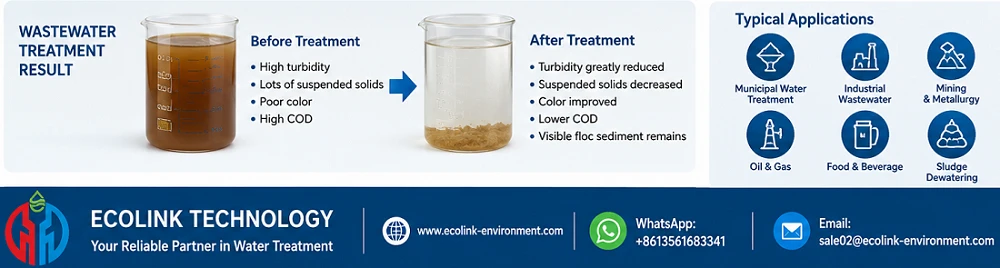
XII. How ECOLINK TECHNOLOGY Provides One-Stop Support for PAM, PAC, and Water Treatment Equipment
For actual industrial customers, purchasing a single bag of PAM or a single batch of PAC does not necessarily solve water treatment problems.
Because the final treatment effect depends on:
Raw water quality + Chemical selection + Dosage + Mixing conditions + Flocculation conditions + Sedimentation equipment + Filtration equipment + Subsequent treatment processes
Therefore, ECOLINK TECHNOLOGY focuses not only on water treatment chemicals, but also on the matching between chemicals and the entire system.
ECOLINK TECHNOLOGY can provide according to different application scenarios:
Anionic PAM;
Cationic PAM;
Non-ionic PAM;
PAM Emulsion;
Industrial-grade PAC;
Drinking water-grade PAC;
Coagulation and flocculation schemes;
Sludge dewatering schemes;
Industrial wastewater treatment equipment;
Municipal sewage treatment equipment;
RO/UF/EDI water treatment equipment;
MBR equipment;
Water reuse and comprehensive water treatment solutions.
For customers requiring PAM and PAC for wastewater treatment, chemical screening can be performed based on raw water quality, pollutant types, and target treatment performance, with suitable products and dosage conditions further determined through jar tests or on-site testing.
For customers requiring equipment, chemical pretreatment can be further systematically matched with units such as sedimentation, filtration, and membrane treatment.
XIII. How to Determine If a PAM/PAC Scheme Truly Fits Your Water Quality?
Do Not Just Compare the Price per Ton of Chemical
The purchasing price of water treatment chemicals is only part of the cost.
What is more important is the actual treatment cost per unit volume of water and the final treatment effect.
For example, two PAM products may have different purchasing unit prices, but if one of them can form larger and more stable flocs at a lower dosage while reducing sludge moisture content and extending filter operation cycles, the final operational cost may actually be lower.
Similarly, for PAC, one should not just compare $\text{Al}_2\text{O}_3$ content or price per ton, but must also combine:
Raw water turbidity;
SS concentration;
pH;
Alkalinity;
Organic matter content;
Metal ions;
Target effluent standards;
Sedimentation tank structure;
Filtration method.
Therefore, for applications such as PAC for industrial wastewater treatment or PAM for sludge dewatering, it is recommended to determine the most suitable product through actual water sample testing.
XIV. Why Is "Coagulate First" an Important Logic for High-Efficiency Water Treatment Systems?
From the perspective of pollutant forms, water treatment is actually continuously completing a process:
Stable Small Particles $\rightarrow$ Destabilization $\rightarrow$ Aggregation $\rightarrow$ Floc Formation $\rightarrow$ Sedimentation $\rightarrow$ Filtration $\rightarrow$ Obtaining Cleaner Effluent
PAC mainly helps complete the front-end coagulation and destabilization process, PAM further promotes floc growth and strengthens solid-liquid separation, while sedimentation and filtration equipment are responsible for removing the pollutants that have been transformed into separable forms from the water.
Therefore, "coagulating first and then filtering" is not merely a traditional process habit, but a processing logic established based on the physicochemical properties of pollutants.
The original text points out that whether in municipal water treatment or industrial systems, the basic logic remains consistent: coagulation should be conducted as far upstream as possible, because its function is to convert pollutants in water into forms that are easier for downstream treatment units to handle.
Conclusion: The Right Chemical and the Right Process Sequence Are Equally Important
The key to high-efficiency water treatment is never simply increasing chemical dosage, nor relying solely on more precise filtration equipment.
The truly effective approach is to establish a reasonable treatment sequence based on pollutant characteristics.
PAC is responsible for coagulation and destabilization, PAM promotes flocculation and particle growth, sedimentation accomplishes solid-liquid separation, filtration further removes residual particles, and membrane systems conduct deep treatment as needed.
When these units are properly combined, colloids and tiny particles that were originally difficult to settle can be transformed into flocs that are easier to settle, filter, and separate.
This is why in many water treatment systems:
Coagulate First $\rightarrow$ Flocculate Second $\rightarrow$ Settle Third $\rightarrow$ Filter Last
often yields better overall pollutant removal performance than relying solely on filtration.
ECOLINK TECHNOLOGY focuses on water treatment chemicals and water treatment equipment, providing one-stop services ranging from PAM and PAC product selection to water treatment process and equipment matching, centered around different industrial wastewater, municipal sewage, sludge dewatering, and water reuse requirements.
If you are looking for a PAM flocculant, PAC coagulant, or integrated water treatment solution suitable for your specific water quality, it is recommended to first provide raw water quality parameters or water sample test results before conducting chemical screening and process design.