How Do PAC and PAM Work Together to Improve Water Treatment Efficiency?
In applications such as drinking water treatment, municipal wastewater, industrial wastewater, mining tailings, and sludge dewatering, suspended solids, colloidal particles, and certain dissolved organic matters often exhibit high stability. Effective separation is difficult to achieve relying solely on natural sedimentation.
Chemical coagulation technology destabilizes stable colloids and suspended particles by adding appropriate water treatment coagulants. Then, through flocculation, larger and structurally stronger flocs are formed, achieving solid-liquid separation via sedimentation or filtration. Chemical coagulation has thus become a crucial foundational link in modern water treatment processes.
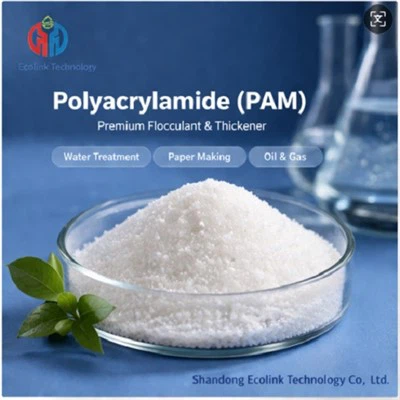
For industrial and municipal water treatment systems, selecting a single chemical agent often fails to simultaneously balance charge neutralization, floc formation, and subsequent settling performance. In practical engineering, polyaluminum chloride (PAC) usually handles the primary coagulation function, while polyacrylamide (PAM) serves as a flocculant aid, promoting the further growth of micro-flocs through the adsorption and bridging mechanism of its polymer chains.
ECOLINK TECHNOLOGY focuses on water treatment chemicals and equipment, providing product matching and technical support for coagulation, flocculation, sedimentation, and solid-liquid separation under various water quality conditions.
What is the Difference Between Coagulation and Flocculation in Water Treatment?
1. Why Are Fine Suspended Particles Difficult to Settle Naturally?
Many fine particles in natural water bodies and industrial wastewater carry negative surface charges. When these particles approach one another, electrostatic repulsion prevents them from easily aggregating.
Particles smaller than approximately 10 microns, in particular, are generally difficult to settle quickly by gravity alone. These pollutants may include colloids, fine clay, organic macromolecules, and certain microbial cells.
Therefore, water treatment systems must first destabilize the particles before creating sufficiently large particle aggregates.
This is the very first step where water treatment coagulants come into play.
2. Coagulation: First Solving the "Particle Instability" Problem
Coagulation is primarily a chemical process.
When coagulants enter the water body, they disperse rapidly under fast, high-intensity mixing conditions, interacting with suspended particles to partially or fully neutralize their surface charges, thereby reducing electrostatic repulsion between particles.
Once repulsion is reduced, van der Waals forces between particles become dominant. Particles collide and gradually form micro-flocs. This process typically occurs very quickly, with pH being one of the key control factors.
At this stage, the flocs are still relatively small and usually cannot achieve efficient solid-liquid separation directly through sedimentation.
Therefore, proceeding to the next step is necessary.
3. Flocculation: Allowing Micro-flocs to Grow Further
Flocculation is primarily a physical aggregation process.
After micro-flocs are formed during coagulation, the water flow enters a low-intensity, slow-mixing zone. Micro-flocs continuously collide and form larger flocs with the aid of polymeric flocculants.
In many industrial water treatment systems, PAM flocculant is a common flocculation aid. Its macromolecular chains can adsorb multiple particles, forming "bridges" between them and allowing micro-flocs to gradually grow into larger, structurally tighter flocs.
This means:
Coagulation solves the problem of particle destabilization.
Flocculation solves the problem of floc growth.
The two steps are not arbitrarily interchangeable.
4. Why Are PAC and PAM Usually Used Together?
In a typical coagulation–flocculation process, PAC primarily performs charge neutralization and coagulation, while PAM is mainly used to reinforce floc formation.
Polyaluminum chloride (PAC) is a pre-hydrolyzed aluminum-based inorganic coagulant. Compared with traditional aluminum sulfate, its hydrolysis process and applicable pH range offer distinct advantages. The effective pH range for PAC is 5.0–9.0.
PAM, on the other hand, is a polymeric flocculant. Its primary role is not simply to replace inorganic coagulants, but to utilize polymer chain adsorption and bridging so that destabilized micro-flocs form larger, easier-to-settle aggregates.
Therefore, in many applications, a logical process workflow is:
Influent → Fast PAC Mixing → Micro-floc Formation → PAM Flocculation → Sedimentation / DAF → Filtration
This is far more effective than simply increasing chemical dosages.

Technical Parameters of PAC and PAM in Practical Water Treatment Systems
5. PAC Functions and Scope of Application
PAC (polyaluminum chloride) is a common aluminum-based coagulant used in industrial and municipal water treatment.
Compared to traditional alum, PAC features pre-hydrolysis characteristics, allowing it to exert coagulation effects across a broader pH range. For water treatment systems that need to reduce turbidity, remove suspended solids, and improve downstream sedimentation performance, PAC holds high application value.
Different Coagulant Parameters:
| Coagulant | Type | Effective pH Range |
| Aluminum Sulfate (Alum) | Aluminum Salt | 6.5–7.5 |
| Ferric Chloride (FeCl₃) | Iron Salt | 5.0–8.5 |
| Ferric Sulfate | Iron Salt | 5.0–9.0 |
| PAC | Pre-hydrolyzed Aluminum | 5.0–9.0 |
| Sodium Aluminates | Alkaline Aluminum | 7.0–9.0 |
It should be noted that the actual optimal pH and dosage still depend on raw water quality and cannot be determined solely based on theoretical ranges.
For example, when treatment goals involve phosphorus removal, lower influent pH, or specific pollutants, iron-based coagulants may offer certain advantages.
Therefore, water treatment coagulant selection should be established based on actual water samples, pollutant types, and target effluent standards.
6. PAM Functions: From Micro-flocs to Large Flocs
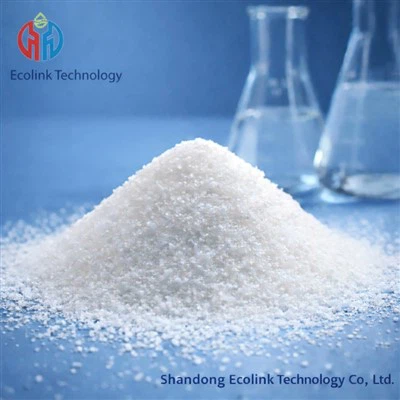
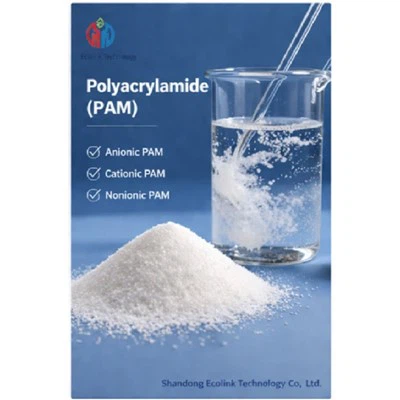
PAM refers to a class of polymeric flocculants, typically categorized by ionic characteristics into:
Anionic PAM (APAM)
Cationic PAM (CPAM)
Non-ionic PAM (NPAM)
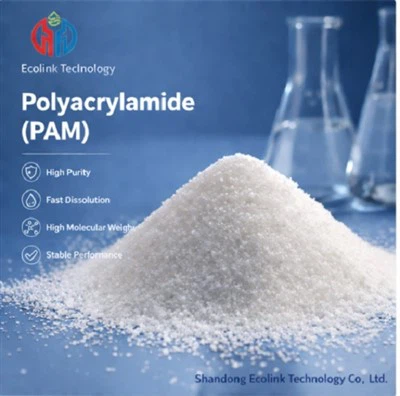
The molecular weight range of PAM spans from 5 million to 25 million Daltons. High molecular weight PAM possesses longer polymer chains capable of simultaneously adsorbing multiple particles, thereby exerting a distinct bridging effect.
Different ionic types are suitable for different water quality conditions:
Anionic PAM
Anionic PAM is generally suitable for systems where inorganic coagulants have already formed positively charged micro-flocs. It adsorbs onto particle surfaces and bridges them via negatively charged polymer chains.
Anionic PAM is a common choice in drinking water treatment, mining tailings clarification, and many industrial clarification systems utilizing inorganic coagulants.
Cationic PAM
Cationic PAM is typically used in applications where suspended solids carry strong negative charges, organic content is high, or in sludge dewatering and dissolved air flotation (DAF).
Its characteristic is the ability to participate in both charge neutralization and polymer bridging simultaneously, allowing some systems to reduce reliance on standalone inorganic coagulants.
Non-ionic PAM
Non-ionic PAM is suitable for certain treatment scenarios involving low ionic strength water or extreme pH environments, such as specific mining and oilfield applications.
Therefore, PAM selection should not focus solely on molecular weight; it must comprehensively evaluate ionic type, charge density, water quality, pH, suspended solid characteristics, and downstream equipment.
7. PAM Dissolution and Dosing Parameters
The practical effectiveness of PAM depends not only on the product model, but is also closely linked to the dissolution and aging process.
Operating Parameters:
PAM should be dissolved in clean water before use.
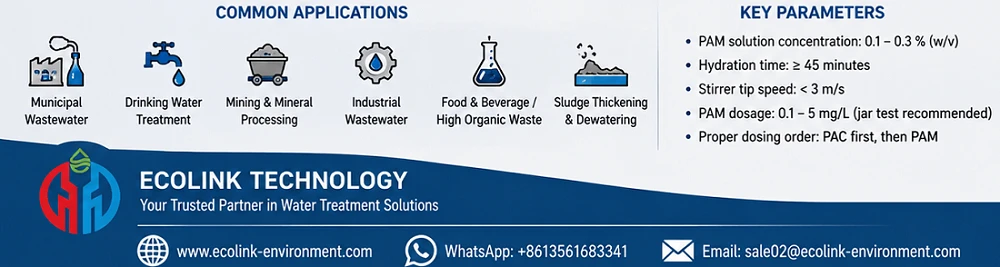
Recommended preparation concentration: 0.1–0.3% (w/v).
Soak/age for at least 45 minutes before use.
Agitator tip speed should be kept below 3 m/s.
PAM should be added at the inlet of the slow-mixing flocculation stage.
Typical effective dosage range: 0.1–5 mg/L, with the final dosage confirmed via jar testing on site water samples.
It is particularly important to note that PAM is not suitable for prolonged agitation under high-shear conditions. Excessive mechanical shear can lead to degradation of polymer chains, thereby reducing bridging capacity.
8. Correct Dosing Sequence for PAC and PAM
For typical PAC + PAM coagulation–flocculation systems, the dosing sequence is crucial.
Usually, the inorganic coagulant should be added first to complete particle destabilization during the fast-mixing stage. Afterward, PAM is introduced so that the polymeric flocculant can link the micro-flocs that have already formed.
If PAM is added prematurely and contacts particles extensively before micro-flocs are formed, polymer consumption may increase, or particles may even become re-stabilized.
Therefore, a more rational basic sequence is:
PAC → Fast Mixing → Micro-flocs → PAM → Slow Flocculation → Large Flocs → Sedimentation / DAF
This forms an important foundation for optimizing the synergistic treatment of PAC and PAM in engineering practice.
Coagulation–Flocculation Process Design, Troubleshooting, and Chemical Optimization
9. Four-Stage Water Treatment Process
A complete coagulation–flocculation system can generally be divided into four main stages:
Stage 1: Rapid Mixing
After coagulants like PAC enter the influent, they must disperse rapidly and uniformly within a short period.
Rapid mixing G-value: typically 300–1000 s⁻¹.
Retention time: typically 30 seconds to 2 minutes.
The primary goal of rapid mixing is not to create large flocs, but to ensure the coagulant contacts the raw water as evenly as possible.
Stage 2: Slow Mixing and Flocculation
After completing coagulation, the water flow enters the flocculation zone.
Slow mixing G-value: 10–75 s⁻¹.
Typical flocculation time: 15–45 minutes.
PAM is usually added during this stage, and floc growth is promoted by gradually decreasing mixing intensity.
If agitation is too intense, flocs may be sheared apart; if agitation is too weak, particle collision frequency becomes insufficient, slowing down floc formation.
Stage 3: Sedimentation
After flocculation is complete, the water enters clarification or sedimentation tanks.
At this point, water flow velocity drops, and flocs rely on gravity to achieve solid-liquid separation.
Target surface overflow rate for traditional rectangular or circular clarifiers: 0.5–2.5 m/h. Settled sludge then enters sludge treatment or dewatering systems.
Stage 4: Filtration
Small amounts of fine particles may still remain after sedimentation.
Sand filters, anthracite media, or dual-media filtration can further reduce residual suspended solids and turbidity. In systems requiring high effluent quality, membrane filtration can also be adopted as a polishing unit.
Therefore, a complete coagulation-flocculation-sedimentation process does not rely on a single chemical alone; it is the combined outcome of chemicals, mixing conditions, settling parameters, and downstream filtration.
10. How to Select PAC and PAM Under Different Water Quality Conditions?
Pollutant characteristics vary significantly across different application scenarios.
| Application Scenario | Primary Treatment Objective | Common Coagulant Choice |
| Municipal Drinking Water | Natural turbidity, NOM, color | Alum or PAC |
| Secondary Municipal Effluent | Suspended solids, phosphorus | Ferric chloride or PAC |
| Mining & Tailings Water | Fine mineral particles, high turbidity | Lime or PAC |
| Metal / Electroplating Wastewater | Heavy metals, suspended solids | NaOH precipitation + PAC |
| Food Processing Wastewater | Fats/oils, proteins, high BOD | PAC or Ferric sulfate |
| Sludge Thickening & Dewatering | Water release from sludge | Primarily PAM |
| Low-Temperature Water Treatment | Slow hydrolysis, reduced flocculation performance | Pre-hydrolyzed PAC |
These scenarios demonstrate that there is no single fixed formula applicable to all industrial wastewater coagulation projects.
For projects in mining, papermaking, textiles, food, metal processing, or sludge dewatering, ECOLINK TECHNOLOGY can assist in matching appropriate PAC, Anionic PAM, Cationic PAM, or Non-ionic PAM according to customer water quality, treatment targets, and equipment processes.
11. Why Is Jar Testing a Crucial Step in Chemical Selection?
When determining actual chemical product models and dosing rates, theoretical parameters serve only as an initial reference.
One of the most reliable methods is conducting jar tests using actual on-site water samples.
One can individually adjust PAC dosage, PAM type, PAM dosage, and pH conditions, while observing:
Floc size
Floc formation speed
Settling velocity
Supernatant turbidity
Final clarification effectiveness
Sludge production volume
Conducting jar tests on actual water samples prior to large-scale chemical procurement is an essential method for confirming coagulant and PAM grades.
For projects requiring PAC and PAM dosage optimization, it is recommended not to copy fixed ratios from other projects directly, but to determine economical, stable operating conditions through actual water testing.
12. Common Coagulation–Flocculation Issues and Solutions
Flocs are small, loose, and difficult to settle
This situation may be related to insufficient PAM dosage, inadequate flocculation time, or excessive slow-mixing intensity.
First check PAM dissolution concentration and aging time.
If PAM is not fully dissolved, it may form gel particles resembling "fish eyes," preventing its bridging effect from fully functioning.
Once proper PAM preparation is confirmed, gradually adjust the dosage and check whether the slow-mixing G-value stays within the range of 10–75 s⁻¹.
Flocs form but break apart afterward
If flocs are large prior to settling but break apart suddenly after passing through pumps or piping, focus inspection on mechanical shear.
Pump impellers, valves, and pipe elbows can all generate high shear forces.
Additionally, an excess of PAM can cause steric hindrance layers to form on particle surfaces, lowering floc stability.
High residual aluminum in effluent
Operating pH is extremely important for aluminum-based coagulants.
When pH drops below 6 or exceeds 8, aluminum solubility increases significantly. Therefore, pH control must be tightened to maintain effluent pH from aluminum coagulant systems within 6.5–7.5 (iron-based systems can be controlled within 5.5–8.5).
Thus, PAC selection cannot be discussed in isolation from pH control.
Excessive sludge generation
Coagulants are not "the more, the better."
Exceeding the optimal dosage causes excess chemical to convert directly into additional sludge, increasing both chemical costs and sludge disposal pressure.
For projects with high sludge volumes, re-evaluate via jar testing while optimizing PAM model and molecular weight to form stronger flocs at lower coagulant dosages.
This represents a key goal of water treatment chemical optimization: aiming not only for compliant effluent, but also balancing chemical costs, sludge volume, and system stability.
13. ECOLINK TECHNOLOGY: From Water Treatment Chemicals to Integrated Solutions
The practical results of PAC and PAM do not depend solely on the products themselves.
The exact same chemical may perform differently under varying raw water qualities, pH levels, temperatures, mixing conditions, and solids loadings.
Therefore, a professional water treatment scheme should holistically consider:
Water Quality Analysis → Coagulant Selection → PAM Ionic Type Selection → Jar Testing → Dosage Optimization → Mixing Condition Adjustment → Clarification / DAF Design → Sludge Treatment → Effluent Target Compliance
ECOLINK TECHNOLOGY focuses on water treatment chemicals and equipment, providing PAC, Anionic PAM, Cationic PAM, Non-ionic PAM, and related technical support tailored to industrial wastewater, municipal sewage, sludge dewatering, and water reuse projects.
For customers looking to construct or upgrade treatment systems, integrated process configurations can also be provided across units including coagulation, flocculation, sedimentation, filtration, and membrane treatment.
14. Conclusion: Correct Chemical Selection Matters More Than Merely Increasing Dosage
Chemical coagulation is a fundamental process in modern water treatment, but an efficient coagulation–flocculation system is not simply a matter of "adding more chemicals."
Truly stable performance results from the synergy of several key factors:
Suitable Coagulant + Correct pH + Proper Dosing Sequence + Appropriate PAM Type + Precise Dosage + Reasonable Mixing Intensity + Thorough Jar Test Validation.
PAC is primarily responsible for particle destabilization and micro-floc formation, whereas PAM further enhances floc size, strength, and settling performance through macromolecular bridging.
In practical projects, different PAM ionic types should be selected based on water quality and treatment goals, with final parameters confirmed via on-site water sample testing rather than relying on fixed chemical ratios.
For clients seeking high-turbidity wastewater treatment, industrial effluent coagulation, sludge dewatering, or mining tailings clarification, an appropriate combination of PAC and PAM can enhance solid-liquid separation efficiency while reducing unnecessary chemical consumption and sludge disposal burden.
ECOLINK TECHNOLOGY can provide chemical matching and technical support tailored to specific water quality, flow rates, and process goals, helping clients transition from simple chemical purchasing toward more stable, economical water treatment solutions.