Heavy Metal Removal from Industrial Wastewater with PAM Flocculant Solutions
With the growth of electroplating, mining, metal processing, battery manufacturing, tanning, electronics manufacturing, and chemical production, heavy metal-containing industrial wastewater has become a key pollution source that many enterprises must strictly control.
Unlike some organic pollutants that can naturally degrade, heavy metals cannot completely disappear through ordinary biodegradation processes and may continuously accumulate in water bodies, sediments, and living organisms. Therefore, industrial enterprises not only need to reduce the concentration of heavy metals in wastewater, but also need to establish stable and sustainable solid-liquid separation and sludge treatment systems.
In practical industrial wastewater treatment, chemical precipitation + coagulation/flocculation + solid-liquid separation is a common treatment combination, in which polyacrylamide (PAM) usually plays an important role in strengthening flocculation, promoting settling, and improving sludge dewatering.
ECOLINK TECHNOLOGY focuses on industrial water treatment chemicals and water treatment solutions. It can provide anionic, cationic, and other types of polyacrylamide according to different wastewater characteristics, and assist customers in determining more suitable product grades and operating conditions combined with experimental testing.
I. Why Does Heavy Metal Wastewater Treatment Require Efficient Solid-Liquid Separation?
The sources of heavy metal wastewater pollution are very broad.
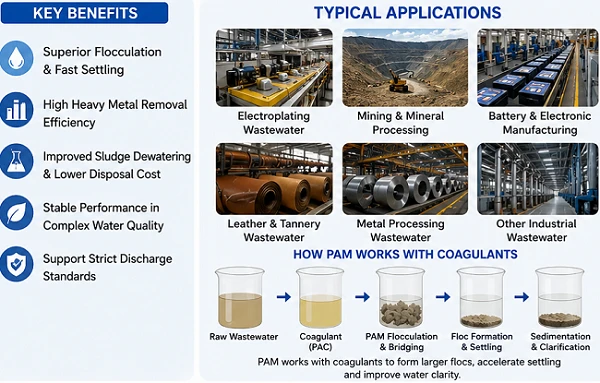
Chromium, nickel, copper, and zinc may be generated during electroplating and metal surface treatment processes; mining and mineral processing wastewater may contain lead, zinc, arsenic, copper, and iron; battery and electronics manufacturing industries may generate pollutants such as cadmium, lead, and nickel.
Common heavy metals include:
Lead (Pb)
Cadmium (Cd)
Chromium (Cr)
Hexavalent Chromium (Cr VI)
Mercury (Hg)
Arsenic (As)
Nickel (Ni)
Copper (Cu)
Zinc (Zn)
The forms of these pollutants in industrial wastewater are not entirely identical. Some exist as dissolved metal ions, while others combine with suspended solids, colloids, or other compounds.
What makes it more complex is that industrial wastewater is often not contaminated by a single metal.
For example, automotive manufacturing or metal processing wastewater may simultaneously contain nickel, zinc, and iron. Mining wastewater may also contain multiple metals along with large amounts of mineral particles.
Therefore, heavy metal wastewater treatment cannot be simply understood as adding a single chemical to the wastewater; instead, a complete treatment process must be established based on the metal species, concentration, pH, suspended solids content, and final discharge requirements.
II. Common Treatment Methods for Industrial Heavy Metal Wastewater
Currently, various mature heavy metal wastewater treatment technologies have been developed in the industrial field, including chemical precipitation, coagulation and flocculation, ion exchange, adsorption, membrane filtration, and electrochemical treatment.
Different technologies have different scopes of application.
1. Chemical Precipitation Method
Chemical precipitation is a widely applied method in industrial-scale heavy metal removal.
Its basic approach is to convert dissolved metal ions into insoluble metal hydroxides or metal sulfides by adjusting the wastewater pH, followed by solid-liquid separation through sedimentation, filtration, and other methods.
Chemical agents such as lime, sodium hydroxide, or sodium sulfide are commonly used in actual operation.
The advantages of this method lie in:
Relatively mature process;
High processing capacity;
Relatively low chemical cost;
Ability to treat multiple metals simultaneously.
However, chemical precipitation does not mean the treatment process is complete.
After metal ions are converted into solid precipitates, these particles must be effectively separated from the water. If the generated particles are small in size and slow in settling speed, it may lead to high suspended solids in the effluent.
At the same time, chemical precipitation usually generates a certain amount of metal-containing sludge, so subsequent sludge dewatering is equally critical.
III. Coagulation and Flocculation: Key Steps Where PAM Plays a Role
In many industrial wastewater treatment systems, chemical precipitation and coagulation/flocculation are two sequentially linked steps.
Coagulants first destabilize colloidal particles, and then through the flocculation process, micro-particles gradually aggregate into larger, easier-to-settle flocs.
Commonly used coagulants include:
Polyaluminum Chloride (PAC)
Ferric Chloride
Aluminum Sulfate
And polyacrylamide (PAM) usually acts as a flocculant or coagulant aid in subsequent particle aggregation.
How Does PAM Help Remove Heavy Metals?
PAM itself does not simply "dissolve heavy metals".
In a typical chemical precipitation process, heavy metals first form precipitate particles through chemical reactions. Subsequently, PAM utilizes its polymer chain structure to bridge and adsorb scattered small particles together.
Particles that were originally small in size and poor in settling performance gradually form larger, denser flocs.
It can be simply understood as: Heavy metal ions → Chemical reaction forms precipitate → PAM promotes particle aggregation → Forms larger flocs → Sedimentation/filtration → Achieves solid-liquid separation
Therefore, in practical PAM for heavy metal wastewater treatment applications, the value of PAM is mostly reflected in:
Accelerating floc formation;
Improving floc structure;
Increasing settling speed;
Improving clarified liquid quality;
Assisting subsequent filtration;
Improving dewatering performance of metal-containing sludge.
IV. Technical Value of Combined Use of PAM and PAC
For many heavy metal industrial wastewaters, relying solely on a single flocculant cannot achieve ideal solid-liquid separation.
Inorganic coagulants such as PAC are mainly responsible for reducing colloidal stability, while PAM further promotes bridging and aggregation between particles.
Therefore, PAC + PAM is a very common combination.
Source data shows that under optimized conditions, PAC combined with anionic polyacrylamide applied in automotive wastewater treatment can achieve a 98% iron removal rate while significantly reducing zinc and nickel content.
The technical logic of this combination can be summarized as:
PAC: Responsible for Coagulation After PAC is added to wastewater, it helps destabilize colloids and fine particles, making them easier to enter the subsequent flocculation stage.
PAM: Responsible for Flocculation and Bridging PAM uses the adsorption and bridging mechanism of its polymer chains to aggregate coagulated micro-particles into larger flocs.
Solid-Liquid Separation: Completes the Transfer of Pollutants from the Aqueous Phase The formed flocs can then be separated from water through sedimentation, air flotation, filtration, etc.
Therefore, reasonable PAM flocculant for industrial wastewater is not purely about pursuing "higher molecular weight" or "higher dosage", but requires comprehensive judgment based on PAC type, water quality conditions, metal load, and downstream solid-liquid separation equipment.
V. Application of Anionic PAM in Heavy Metal Wastewater
After chemical precipitation, heavy metals in wastewater have usually been converted into metal hydroxide or metal sulfide precipitates.
Such particles often have good flocculation conditions, making anionic polyacrylamide (APAM) one of the common choices.
Anionic polyacrylamide possesses negatively charged functional groups that can interact with particles formed after coagulation and promote rapid particle aggregation through polymer bridging.
In metal processing, electroplating, and other industrial wastewater treatment, APAM can be used for:
Metal precipitate flocculation;
Suspended solids removal;
Clarified liquid improvement;
Sludge sedimentation;
Sludge thickening;
Sludge conditioning before filter pressing.
Source data clearly indicates that in metal processing and electroplating wastewater treatment, APAM can be used to optimize the separation of suspended solids and metal sludge, providing better conditions for subsequent filter press or centrifugal dewatering.
VI. Why Does Complex Metal Wastewater Require PAM Selection Consideration?
Actual industrial site water quality rarely remains completely stable.
Metal concentration, pH, salt content, suspended solids, organic matter, and coagulant dosage can all change.
Therefore, when selecting anionic polyacrylamide for metal wastewater, procurement should not be done purely based on the name "anionic PAM", but needs further consideration of:
Molecular weight;
Charge density;
Ionic type;
Wastewater pH;
Metal precipitate properties;
PAC type and dosage;
Floc size;
Settling speed;
Subsequent dewatering equipment.
For wastewater with particularly obvious water quality fluctuations, other PAM types can also be evaluated based on actual working conditions.
Source data points out that in complex wastewater such as multi-metal ore processing, amphoteric polyacrylamide can utilize both positive and negative charge groups to function across a wider pH range and under different ionic conditions.
Therefore, PAM selection for heavy metal wastewater is essentially a matter of matching "water quality – chemical – process – equipment", rather than a simple product model selection.
VII. Role of PAM in Dewatering Heavy Metal-Containing Sludge
Sludge generated during heavy metal treatment cannot be ignored.
After chemical precipitation and flocculation, large amounts of metal pollutants transfer from the aqueous phase to the solid phase and ultimately enter metal-containing sludge.
If the sludge moisture content is high, it not only increases transportation and disposal costs, but also reduces the operating efficiency of filter presses, centrifuges, and other equipment.
Therefore, PAM for sludge dewatering is also an important application direction in heavy metal wastewater treatment systems.
Cationic polyacrylamide (CPAM) is usually used for sludge conditioning, promoting sludge floc formation by altering the binding state between sludge particles, thereby releasing more free water.
After proper conditioning, it helps:
Increase filter cake dryness;
Accelerate belt filter press processing speed;
Improve centrifugal dewatering performance;
Reduce sludge volume;
Reduce subsequent hazardous waste disposal amounts.
It should be noted that PAM selection for heavy metal wastewater and PAM selection for sludge dewatering are not necessarily identical.
Upstream heavy metal precipitation flocculation and downstream sludge dewatering belong to different process targets; thus, chemical screening and jar testing should be performed separately rather than defaulting to using the same PAM for the entire system.
VIII. PAM Preparation and Dosing: Important Operational Links Determining Flocculation Effect
In heavy metal wastewater treatment, the actual effect of PAM depends not only on the product itself, but is also closely related to PAM preparation concentration, dissolution conditions, aging time, mixing intensity, and site dosage.
Even if an appropriate PAM model is selected, unreasonable preparation or dosing methods may lead to issues such as undersized flocs, slow settling speed, increased effluent suspended solids, and higher chemical consumption.
Therefore, for PAM for heavy metal wastewater treatment, field applications require simultaneous focus on product selection and operating conditions.
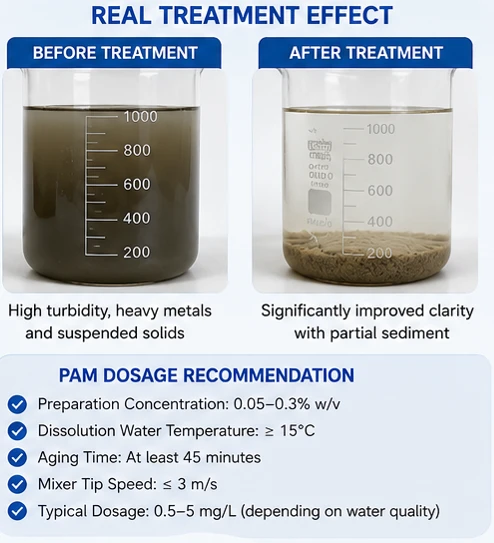
The common operating parameters provided by the source data are as follows:
| Operating Parameter | Recommended Range |
| PAM Preparation Concentration | 0.05–0.3% w/v |
| Dissolution Water Temperature | ≥ 15°C |
| Soaking Time Before Use | At least 45 minutes |
| Agitator Tip Speed | ≤ 3 m/s |
| PAM Dosage | Typically 0.5–5 mg/L |
The above parameters should serve as the foundation for field testing and process adjustment, rather than mechanically applying fixed values to all wastewater streams.
IX. Why Does PAM Require Full Dissolution and Aging?
PAM belongs to high-molecular-weight polymer flocculants, and its molecular chains need to fully unfold in water to exert adsorption and bridging functions more effectively.
If PAM is not fully dissolved, localized high-concentration polymer lumps may form. These lumps not only fail to participate fully in flocculation, but may also lead to decreased chemical utilization efficiency.
Therefore, during the actual operation of industrial wastewater treatment with PAM, attention should be paid to the following aspects during the PAM preparation process.
1. Control Preparation Concentration
Source data recommends a PAM preparation concentration of: 0.05–0.3% w/v
The specific concentration adopted needs to be adjusted according to the PAM model, field dosing equipment, and wastewater treatment scale.
Excessive concentration may increase dissolution and pumping difficulty; overly low concentration may increase storage liquid volume and dosing system load.
2. Ensure Water Temperature Conditions
Water temperature during PAM dissolution should reach: ≥ 15°C
Overly low temperature may affect the polymer dissolution process; therefore, attention must be paid to PAM dissolution time and aging state especially in low-temperature operating environments.
3. Ensure Sufficient Aging Time
Before use, PAM is recommended to soak for at least: 45 minutes
Thorough dissolution and aging help polymer molecular chains unfold, allowing them to interact more effectively with suspended particles and metal precipitates after entering the flocculation reaction zone.
X. Why Can't PAM Be Stirred at High Speed?
PAM is different from ordinary inorganic chemicals.
Its flocculation mechanism relies on long polymer chains. If mechanical shear is too strong, polymer molecular chains may undergo degradation, thereby affecting bridging capability.
Therefore, source data recommends: Agitator tip speed ≤ 3 m/s.
This is also one of the factors easily overlooked in field PAM application.
In practical systems, PAM typically undergoes: Dissolution → Aging → Dilution → Metered Dosing → Gentle Mixing → Floc Formation → Solid-Liquid Separation
If excessively vigorous stirring is used during the flocculation formation stage, even if the correct PAM model was selected, it may cause already formed flocs to break up.
Therefore, PAM flocculant application is not simply about increasing chemical dosage, but matching chemical dosing with hydraulic flow conditions.
XI. How to Determine PAM Dosage?
The common PAM dosage provided by source data is: 0.5–5 mg/L
Actual dosage is affected by multiple factors, including:
Metal load;
Coagulant type;
Wastewater pH;
Suspended solids concentration;
Metal precipitate properties;
Target effluent quality;
Subsequent sedimentation or filtration equipment.
Therefore, even for electroplating wastewater, optimal PAM dosages across different factories may vary.
Likewise, the optimal dosage of the same PAM product in different wastewater streams cannot be simply replicated.
Source data particularly emphasizes that before formal application, jar tests should be conducted on site-specific wastewater samples to determine the appropriate PAM grade-including ionic type, charge density, and molecular weight-and confirm the optimal dosage.
XII. Why Is Jar Testing a Crucial Step in PAM Selection?
For complex industrial wastewater, purchasing PAM purely based on industry sector names has certain limitations.
For example: "This is electroplating wastewater, so a specific anionic PAM must be used."
Such judgment is incomplete.
A more reliable method is to conduct experiments directly using the customer's site wastewater.
During jar testing, different PAM models and dosages can be compared for:
Floc formation speed;
Floc size;
Floc compactness;
Settling speed;
Supernatant clarity;
Sludge volume;
Sludge dewatering performance.
The final choice should not merely be the product with the "largest flocs in the lab", but a scheme that balances overall treatment effectiveness and operating costs.
Therefore, PAM selection for heavy metal wastewater should be established on actual water samples and process conditions.
XIII. How Different Industrial Sectors Select Heavy Metal Wastewater Treatment Schemes
Heavy metal types, concentrations, and wastewater properties vary significantly across different industrial sectors, requiring corresponding adjustments in treatment processes.
The industries and main treatment methods provided by source data are as follows.
1. Electroplating and Metal Surface Treatment Wastewater
Electroplating wastewater typically involves:
Chromium;
Nickel;
Copper;
Zinc.
For such wastewater, common processes are: Chemical Precipitation (Lime/Sodium Hydroxide) + Coagulation
First, pH adjustment is performed to form metal precipitates, followed by coagulants like PAC and PAM flocculants to promote particle aggregation.
Among them, APAM helps metal precipitate particles form more stable flocs, improving subsequent settling and filtration performance.
For systems requiring further sludge dewatering, re-screening for CPAM can be conducted in downstream sludge treatment stages.
2. Mining and Mineral Processing Wastewater
Mining and mineral processing typically have high suspended solids loads, along with potential pollutants such as lead, zinc, arsenic, copper, and iron.
The basic treatment direction recommended by source data is: Lime Precipitation + Flocculation
For this wastewater, in addition to helping heavy metal precipitate particles aggregate, PAM can also handle large amounts of fine mineral particles.
Therefore, anionic polyacrylamide for metal wastewater applies not only to heavy metal removal, but also to improving solid-liquid separation of mineral particles.
In practical mine water treatment systems, PAM performance usually needs to simultaneously consider: Metal Removal + Suspended Solids Removal + Settling Speed + Sludge Dewatering
This is also an important concept when selecting PAM in the mineral processing industry.
3. Battery and Electronics Manufacturing Wastewater
Battery and electronics manufacturing industries may involve:
Cadmium;
Lead;
Nickel.
The treatment direction provided by source data is: Sulfide Precipitation + Filtration
In this process, chemical reactions are first used to form metal precipitates, followed by filtration to achieve solid-liquid separation.
If generated particles are fine, appropriate coagulation/flocculation measures can improve filtration performance.
Therefore, in complex electronics industrial wastewater, PAM can serve as an auxiliary flocculant post-precipitation, creating more stable influent conditions for downstream filtration.
XIV. Cr(VI) Wastewater Treatment in the Tanning Industry
Heavy metal issues in the tanning industry differ somewhat from general metal wastewater.
Source data points out that for Cr(VI) wastewater, it typically requires: Cr(VI) → Cr(III) Reduction → Alkaline Precipitation
That is to say, hexavalent chromium removal cannot rely simply on PAM directly.
First, a reduction process is needed to change the chromium species form, followed by alkaline precipitation to form solids.
On this basis, PAM can further participate in the flocculation process, promoting the aggregation of generated precipitate particles and improving solid-liquid separation.
This illustrates that PAM's positioning in heavy metal wastewater treatment is very clear: PAM mainly strengthens particle aggregation and solid-liquid separation, rather than replacing upstream chemical reactions.
Understanding this is essential for properly designing PAM dosing systems.
XV. Low-Concentration Heavy Metal Wastewater: Ion Exchange and Adsorption
For low-concentration wastewater, especially rinsing water with low metal concentrations, relying purely on traditional chemical precipitation has limitations.
The reference range given in source data is: Various heavy metals, <10 mg/L
In such scenarios, consider:
Ion Exchange;
Adsorption.
Ion exchange resins can selectively capture metal ions, making them suitable for applications with strict discharge standards and low metal concentrations.
Adsorption technologies can utilize activated carbon, zeolites, biosorbents, or other adsorbents to further lower pollutant concentrations.
However, both technologies face practical operating costs as well as adsorbent regeneration or replacement issues.
Therefore, in complete industrial wastewater treatment systems, treatment units should be determined based on pollutant concentration and final discharge requirements, rather than purely pursuing maximum removal rate.
XVI. How to Combine PAM with Membrane Treatment Technologies?
When industrial enterprises require not only standard compliance but also wastewater reuse or near-zero liquid discharge, relying solely on precipitation and flocculation is often insufficient for final water quality requirements.
At this point, consider: Chemical Precipitation → PAM Flocculation → Solid-Liquid Separation → Membrane Treatment
Membrane treatment technologies include:
Nanofiltration (NF);
Ultrafiltration (UF);
Reverse Osmosis (RO).
Among them, RO can further reduce dissolved pollutant concentrations in water, serving as an advanced treatment unit for high-standard reuse systems.
However, membrane systems are sensitive to suspended solids and colloidal particles.
If heavy metal precipitates are not fully removed upstream, entering the membrane system directly increases membrane fouling risks.
Therefore, the value of PAM in such systems lies not only in "helping remove heavy metals", but also in: Improving upstream solid-liquid separation → Reducing suspended solids entering membrane systems → Creating more stable influent conditions for advanced treatment like RO/UF.
Source data also indicates that in zero liquid discharge or ultra-clean wastewater reuse scenarios, a combined process of precipitation + polyacrylamide flocculation + reverse osmosis polishing can be adopted.
XVII. Why Are Combined Processes Better Suited for Complex Industrial Wastewater?
Heavy metal wastewater usually possesses clear complexity.
The same wastewater stream may simultaneously contain:
Multiple heavy metals;
Suspended solids;
Colloidal particles;
Organic pollutants;
Metals in different valence states;
pH fluctuations.
Therefore, it is difficult to solve all problems relying on a single treatment technology.
A more practical engineering approach is to combine different technologies.
For example:
Basic Heavy Metal Wastewater Treatment pH Adjustment → Chemical Precipitation → PAC Coagulation → PAM Flocculation → Sedimentation/Filtration Suitable for scenarios focusing on removing metal precipitates and suspended particles.
Advanced Treatment Scheme Chemical Precipitation → PAC + PAM → Solid-Liquid Separation → UF/NF/RO Suitable for industrial wastewater with higher effluent quality requirements.
Reuse and High-Standard Treatment Pretreatment → Chemical Precipitation → PAM Flocculation → Solid-Liquid Separation → Membrane Treatment → Reuse Reduces pollutant and suspended solids load through upstream chemical treatment, leaving advanced purification to membrane systems.
This staged treatment approach avoids concentrating all treatment pressure onto a single piece of equipment.
XVIII. Three Key Control Points in PAM Application
Synthesizing actual heavy metal wastewater treatment processes, PAM performance is closely tied to three factors.
Key Point 1: Select the Right PAM Type
First, determine whether to use:
APAM;
CPAM;
Amphoteric PAM;
Other specialty types.
Heavy metal precipitation flocculation and sludge dewatering have different process targets; thus, the same product cannot be used blindly.
Key Point 2: Determine Appropriate Molecular Weight and Charge Density
PAM molecular weight and charge density affect:
Floc size;
Floc strength;
Settling performance;
Chemical consumption;
Sludge dewatering results.
Therefore, appropriate grades need to be determined through water sample testing.
Key Point 3: Control Actual Chemical Dosage
The common dosage range provided by source data is: 0.5–5 mg/L
However, this range does not mean all projects should adopt the exact same dosage.
The proper approach is determining the optimal point via jar tests, then making adjustments based on field equipment and continuous operation conditions.
XIX. ECOLINK TECHNOLOGY's Technical Service Approach for PAM
For industrial clients, purchasing PAM is not merely buying a bag of chemicals.
Factors that truly impact long-term project operating costs include: Product Grade + Water Quality Adaptation + Preparation Method + Dosage + Coagulation/Flocculation Conditions + Solid-Liquid Separation + Sludge Treatment
Therefore, ECOLINK TECHNOLOGY not only provides PAM for industrial wastewater treatment, but can also offer application support centered on the client's actual water quality and treatment goals.
According to source data, ECOLINK has an annual PAM supply capacity exceeding 100,000 tons and features an in-house laboratory to support application testing, assisting customers with verification from preliminary jar testing to product selection and site deployment.
For heavy metal wastewater projects, technical support from ECOLINK TECHNOLOGY can unfold around the following process: Customer Wastewater Info → Water Sample Testing → PAM Model Screening → Jar Testing → Dosage Optimization → Process Matching → Field Application
This approach reduces selection discrepancies caused by procuring solely based on product names or industry experience.
XX. How to Establish a Complete Heavy Metal Wastewater Treatment Process?
Heavy metal wastewater treatment can rarely rely on a single treatment technology.
Different pollutants may exist in dissolved, colloidal, and particulate states; thus, chemical reactions, coagulation/flocculation, solid-liquid separation, and advanced treatment must be combined rationally based on wastewater properties.
A typical industrial heavy metal wastewater treatment workflow can be designed as: Wastewater Collection → pH Adjustment → Chemical Precipitation → PAC Coagulation → PAM Flocculation → Solid-Liquid Separation → Sludge Dewatering → Advanced Treatment → Standard Discharge or Reuse
Each step fulfills a distinct role:
pH Adjustment: Creates Metal Precipitation Conditions Chemical precipitation efficiency is closely tied to pH. Different metal hydroxides have different optimal precipitation ranges; therefore, actual operation requires controlling pH based on target metal species rather than adopting a fixed value.
Chemical Precipitation: Converts Dissolved Metals to Solids Metal ions form insoluble precipitates using reagents like lime, sodium hydroxide, or sodium sulfide. The focus of this stage is completing the chemical reaction.
PAC Coagulation: Destabilizes Particles After chemical reactions, large amounts of fine precipitate particles may be generated. PAC helps destabilize these particles, creating conditions for downstream flocculation.
PAM Flocculation: Promotes Particle Aggregation At this stage, polyacrylamide (PAM) links micro-particles into larger flocs through adsorption and polymer chain bridging.
Solid-Liquid Separation: Removes Flocs from Water Formed flocs can be removed via sedimentation, filtration, or other solid-liquid separation equipment.
Sludge Dewatering: Lowers Subsequent Disposal Costs Heavy metal-containing sludge requires further dewatering. Suitable cationic polyacrylamide (CPAM) can be selected for sludge conditioning based on sludge properties.
Therefore, in a complete heavy metal wastewater treatment system, PAM may simultaneously appear in both upstream flocculation and downstream sludge dewatering stages, but the selection logic for PAM differs between the two stages.
XXI. Technical Synergy Among PAM, PAC, and Membrane Treatment
In projects requiring high-standard discharge or wastewater reuse, using chemical precipitation and flocculation alone may not meet final water quality requirements.
In such cases, a combined treatment approach can be adopted: Chemical Precipitation + PAC + PAM + Solid-Liquid Separation + RO
Source data points out that membrane technologies include nanofiltration (NF), ultrafiltration (UF), and reverse osmosis (RO), among which reverse osmosis can achieve extremely high metal removal rates for high-standard reuse scenarios.
However, membrane systems are not suited to directly withstand heavy loads of suspended solids and colloidal particles.
If upstream precipitation and flocculation perform poorly and fine particles enter membrane systems, membrane fouling risks increase.
Therefore, the value of PAM in membrane treatment systems is not only reflected in heavy metal precipitate flocculation, but also in improving upstream solid-liquid separation to provide more stable influent conditions for downstream membrane systems.
The functions of each process unit can be understood as:
| Process Unit | Primary Function |
| pH Adjustment |
Creates suitable reaction conditions for metal precipitation |
| Chemical Precipitation |
Converts dissolved metals into solids |
| PAC |
Promotes particle destabilization and preliminary aggregation |
| PAM |
Further flocculation and bridging |
| Sedimentation/Filtration |
Removes formed flocs |
| Sludge Dewatering |
Reduces sludge water content and disposal volume |
| UF/NF/RO |
Advanced treatment and reuse |
This staged treatment concept reduces processing pressure on single equipment units and is better suited for complex industrial wastewater.
XXII. Common Application Issues with PAM in Heavy Metal Wastewater Treatment
Even when using an appropriate PAM flocculant for industrial wastewater, issues like abnormal flocs, slow settling, or high chemical consumption may still occur on site.
These problems are usually related to product models, preparation methods, dosages, and upstream water quality conditions.
Issue 1: Flocs Are Too Small, Settling Speed Is Slow
Possible causes include:
PAM model mismatch;
Insufficient PAM dosage;
Inappropriate PAC dosage;
pH failed to reach optimal precipitation conditions;
Incomplete PAM dissolution or aging;
Inappropriate mixing conditions.
Directly increasing PAM dosage significantly is not recommended at this point.
A more reasonable method is re-checking upstream chemical precipitation and coagulation conditions, then comparing different PAM models via jar testing.
Issue 2: The More PAM Added, the Worse the Performance
PAM is not "the more, the better".
When chemical dosing exceeds the appropriate range, excess polymer may alter particle surface states and increase chemical consumption.
Therefore, practical PAM application requires finding a reasonable dosage window rather than blindly pursuing higher chemical concentrations.
The common PAM dosage provided by source data is: 0.5–5 mg/L
The final dosage should still be adjusted based on metal load, coagulant type, and target effluent quality.
XXIII. How to Reduce PAM Usage Costs?
For industrial wastewater treatment enterprises, PAM procurement price is only a part of total costs.
More noteworthy is: Unit Water Chemical Consumption × Actual Treatment Effect × Sludge Production × Dewatering Efficiency
Therefore, a PAM with a lower unit price but higher required dosage is not necessarily more economical than a product with a slightly higher unit price but lower dosage and better floc performance.
For example, under the same water volume:
Product A has a lower unit price, but requires a higher dosage;
Product B has a slightly higher unit price, but lowers actual usage through superior flocculation while improving sludge dewatering.
What should ultimately be compared is: Actual PAM Cost Per Ton of Wastewater
Rather than purely comparing: PAM Price Per Ton
This is also one of the key technical metrics ECOLINK TECHNOLOGY focuses on during PAM application testing.
XXIV. How to Determine Optimal PAM Conditions via Jar Testing?
For new projects or projects with significant water quality variations, jar testing is a highly practical screening method.
Different PAM models and dosages can be set up for parallel comparison.
For instance, testing can be conducted around the following variables:
Group 1: Different PAM Types Compare: APAM; CPAM; Amphoteric PAM; Other suitable specialty PAMs.
Group 2: Different Product Grades Under identical water samples and process conditions, compare PAMs of varying molecular weights and charge densities.
Group 3: Different Dosages Stepwise adjust dosage around the recommended range, observing: Floc formation; Floc size; Settling speed; Supernatant clarity; Sludge volume.
Group 4: Comprehensive Economics Do not choose a sample solely because it has the largest flocs. Consider also: PAM consumption; Sludge dewatering performance; Effluent stability; Downstream filtration load; Total operating cost.
Through this approach, the best PAM for heavy metal wastewater treatment can be determined more scientifically.
XXV. Core Technical Values of PAM in Heavy Metal Wastewater Treatment
Summarizing the preceding process analyses, the role of PAM can be encapsulated into five aspects:
Strengthening Flocculation PAM uses polymer chain bridging to bind fine particles into larger flocs.
Improving Sedimentation Forming denser flocs enhances particle settling performance.
Enhancing Solid-Liquid Separation Efficiency Effective flocculation reduces the risk of fine particles entering downstream filtration or advanced treatment systems.
Improving Sludge Dewatering For metal-containing sludge, conditioning with appropriate CPAM improves filter press or centrifugal dewatering performance.
Lowering Total Operating Costs Correct PAM selection reduces unnecessary chemical consumption while improving downstream sludge treatment and equipment operating efficiency.
Therefore, the value of PAM in industrial wastewater treatment goes far beyond being just a "flocculant".
Across the entire process chain, it connects: Chemical Precipitation → Particle Aggregation → Solid-Liquid Separation → Sludge Dewatering → Advanced Treatment
XXVI. How ECOLINK TECHNOLOGY Provides Heavy Metal Wastewater PAM Solutions
Wastewater conditions vary greatly among different customers.
Therefore, ECOLINK TECHNOLOGY focuses more on matching PAM products with actual water treatment processes.
According to source data, ECOLINK possesses an annual production capacity exceeding 100,000 tons and is equipped with an in-house laboratory for application testing, offering PAM selection support from preliminary jar testing to site deployment.
For industrial wastewater clients, ECOLINK TECHNOLOGY provides product and technical support around the following directions:
Water Treatment Chemicals
Cationic Polyacrylamide (CPAM)
Nonionic Polyacrylamide (NPAM)
Other Water Treatment Chemicals
Water Treatment Equipment
Based on specific treatment needs, further configurations can include:
Industrial Wastewater Treatment Equipment
Sewage Treatment Equipment
RO Systems
UF Systems
EDI Systems
Water Reuse Systems
Desalination Equipment
In this way, pure chemical supply is extended into complete water treatment solutions.
XXVII. From PAM Product Supply to Complete Water Treatment Solutions
For heavy metal wastewater projects, what customers truly need to solve is often not "which PAM to buy", but: How to consistently meet discharge standards while controlling chemical, sludge, and equipment operation costs.
Therefore, a complete technical service workflow can unfold around these steps:
Step 1: Understand Raw Water Conditions Collect info on: Heavy metal species, metal concentration, pH, suspended solids, water flow rate, discharge or reuse requirements.
Step 2: Determine Basic Treatment Route Based on wastewater characteristics, judge whether to use: Chemical Precipitation → PAC Coagulation → PAM Flocculation Or further add: Filtration → UF/NF/RO
Step 3: PAM Experimental Screening Compare different PAM types and grades through water sample testing.
Step 4: Determine Optimal Dosing Conditions Observe floc and settling performance under various dosages to establish a reasonable operating range.
Step 5: Match Solid-Liquid Separation Equipment Select sedimentation, filtration, filter press, or centrifuge equipment based on floc properties and sludge characteristics.
Step 6: Add Advanced Treatment Based on Final Water Quality For reuse or high-standard discharge projects, further consider membrane treatment.
This approach-from chemicals to equipment, from laboratory testing to engineering application-reduces communication and technical coordination costs incurred by clients dealing with multiple suppliers separately.
XXVIII. Different Treatment Goals Correspond to Different Technical Routes
Not all customers require the exact same system.
Goal 1: Standard Heavy Metal Discharge
Focus on: Chemical Precipitation + PAC + PAM + Solid-Liquid Separation Focus on heavy metal removal rate, suspended solids, and sludge treatment.
Goal 2: Increase Wastewater Reuse Rate
Add on top of basic treatment: Chemical Precipitation + PAC + PAM + Solid-Liquid Separation + UF/RO Key focus is controlling suspended solids and colloidal load entering membrane systems.
Goal 3: High-Standard Reuse or Zero Liquid Discharge
Further adopt: Pretreatment + Precipitation + PAM Flocculation + Solid-Liquid Separation + Membrane Treatment
Source data points out that for zero discharge or ultra-clean wastewater reuse scenarios, a combination of precipitation, polyacrylamide flocculation, and reverse osmosis polishing can be utilized.
The final scheme should still be determined based on actual water quality, treatment goals, and engineering conditions.
XXIX. Why Does PAM Selection Directly Affect Project Operating Costs?
In heavy metal wastewater treatment, although PAM is usually not the most expensive equipment or chemical in the system, it impacts multiple downstream stages.
Inappropriate PAM selection can cause: Inadequate Floc Formation → Poor Settling → High Effluent Suspended Solids → Increased Downstream Filtration Load → Higher Membrane Fouling Risk → Difficult Sludge Dewatering → Increased Total Operating Cost
Conversely, proper PAM selection leads to: Thorough Particle Flocculation → Stable Solid-Liquid Separation → Improved Supernatant Quality → Reduced Downstream Treatment Load → Improved Sludge Dewatering Performance
Therefore, PAM selection should be evaluated from the perspective of the entire system rather than looking solely at product price.
Source data indicates that selecting the correct PAM from the initial project stage avoids common operational issues such as insufficient flocculation force, excessive polymer consumption, and poor sludge dewatering performance.
XXX. Conclusion: PAM Is a Vital Aid in Solid-Liquid Separation for Heavy Metal Wastewater
Heavy metal wastewater treatment is a comprehensive engineering project involving chemical reactions, particle aggregation, solid-liquid separation, sludge treatment, and advanced purification.
Chemical precipitation is typically responsible for converting dissolved metals into solid precipitates; coagulants like PAC help destabilize particles; and polyacrylamide (PAM) further promotes fine particles to form larger flocs via polymer bridging, thereby improving settling and solid-liquid separation.
For metal processing, electroplating, and mineral processing wastewater after chemical precipitation, anionic polyacrylamide (APAM) holds significant application value; for downstream dewatering of metal-containing sludge, cationic polyacrylamide (CPAM) can be selected based on sludge characteristics.
For industrial wastewater with complex and fluctuating water quality, actual water sample testing is required to select the appropriate PAM type, molecular weight, charge density, and dosage.
Therefore, PAM is not a standalone product to be evaluated in isolation from the process, but a crucial process variable within industrial wastewater treatment systems.
ECOLINK TECHNOLOGY can provide industrial customers with support ranging from chemical selection and laboratory testing to water treatment process configuration around PAM, PAC, and water treatment equipment.
For heavy metal wastewater, mining wastewater, electroplating wastewater, metal processing wastewater, and other complex industrial wastewaters, a reasonable technical route is usually not simply picking a single chemical, but through: Water Quality Analysis → Chemical Precipitation → PAC Coagulation → PAM Flocculation → Solid-Liquid Separation → Sludge Dewatering → Advanced Treatment establishing a complete solution suitable for actual working conditions.
If the goal is further elevated from "standard discharge" to "wastewater reuse", membrane treatment technologies like UF, NF, or RO can be combined.
Ultimately, through proper PAM selection, reasonable dosing control, and a well-integrated process combination, treatment goals can be met while better controlling chemical consumption, sludge production, and long-term operating costs.