Part 1: Optimization Challenges of Thickeners in the Mineral Processing Industry and the Application of Polyacrylamide (PAM) Flocculation Technology
1. Role and Operational Challenges of Thickeners in the Mineral Processing Industry
In modern mineral processing, the thickener is a vital piece of equipment connecting mineral separation, tailings disposal, and water recycling. With declining ore grades and stricter environmental regulations, mining enterprises need not only to increase pulp processing capacity, but also to reduce water consumption and tailings treatment costs.
Thickeners achieve solid-liquid separation primarily through gravity sedimentation, allowing solid particles in the slurry to settle rapidly and form a high-concentration underflow, while obtaining cleaner overflow water for recycling. However, during actual operation, fine mineral particles, variations in clay content, water quality fluctuations, and changes in slurry surface charge all affect the sedimentation performance.
When thickener operational efficiency drops, the following issues typically arise:
Insufficient underflow solid concentration, affecting downstream filtration and tailings disposal;
Elevated suspended solids content in overflow water, reducing recycled water utilization efficiency;
Decreased settling velocity, leading to reduced equipment processing capacity;
Increased water consumption, raising overall mining operational costs.
According to practical mineral processing experience, proper selection and application of flocculants can significantly improve thickener operation. The appropriate flocculant type, molecular weight, and charge density directly influence the aggregation effect between slurry particles, settling velocity, and final clarification efficiency.
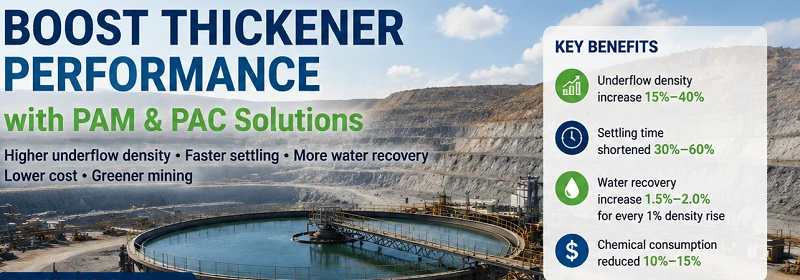
By optimizing the selection and dosage method of Flocculant, thickener underflow density can typically be increased by 15%–40%, and settling time can be shortened by 30%–60%, thereby improving pulp processing efficiency and promoting process water recovery.
2. Core Advantages of Polyacrylamide (PAM) as a Mineral Processing Flocculant
In mining tailings treatment and mineral thickening processes, Polyacrylamide (PAM) is a widely used polymer flocculant material. Through its long-chain polymer structure, PAM can adsorb fine mineral particles and form larger flocs via the "Bridging Effect", allowing particles to settle rapidly.
ECOLINK TECHNOLOGY provides PAM products suitable for different mineral processing environments, including:
Anionic Polyacrylamide (APAM)
Cationic Polyacrylamide (CPAM)
Nonionic Polyacrylamide (NPAM)
PAM Emulsion
For application scenarios such as mine thickeners, tailings sedimentation, and pulp solid-liquid separation, Anionic PAM is typically the most commonly used product type.
According to mineral processing application data, Anionic Polyacrylamide accounts for approximately 70%–80% of flocculant usage in mineral thickening, making it particularly suitable for processing oxide ores, coal mines, copper mines, gold mines, and base metal concentrates.
3. Technical Selection of Anionic PAM in Mine Thickeners
Different mineral systems have different performance requirements for flocculants. When selecting a Mining Flocculant, comprehensive consideration must be given to:
Ore type;
Particle size distribution of slurry;
Slurry pH value;
Solid concentration;
Ionic composition in water;
Target settling velocity.
For most copper, gold, and tailings thickening applications, high molecular weight Anionic PAM generally offers superior particle capture capabilities.
Typical application parameters are as follows:
| Item | Recommended Range |
| PAM Type | Anionic Polyacrylamide |
| Molecular Weight | 12–20 Million Daltons |
| Charge Density | 20%–40% |
| Primary Function | Promote particle aggregation, increase settling velocity |
For example, in an application case at a Chilean copper mine, upgrading the flocculant product from 15 million Daltons to 18 million Daltons increased the thickener underflow solid density from 58% to 68%, while chemical consumption dropped from 45 g/t to 38 g/t.
This case demonstrates that PAM with high molecular weight and appropriate charge density can not only improve sedimentation performance, but also reduce unit ore processing costs.
4. Selection Strategies for PAM in Different Mineral Systems
Due to differences in surface properties among different ores, a single type of PAM cannot be applied to all mines.
4.1 Anionic Polyacrylamide (APAM)
Anionic PAM is primarily applied in:
Copper tailings thickening;
Gold ore tailings treatment;
Iron ore concentrate dewatering;
Coal mine wastewater treatment.
Its advantages include:
Long molecular chain with strong adsorption and bridging capabilities;
Ability to form larger flocs;
Increased settling velocity;
Improved thickener underflow density.
For mining enterprises needing to improve tailings sedimentation efficiency, High Molecular Weight Polyacrylamide is typically the preferred solution.
4.2 Cationic Polyacrylamide (CPAM)
In certain slurry systems with high clay content and negatively charged particle surfaces, Cationic PAM also exhibits good application results.
For example:
Phosphate ore processing;
Potash production;
Oil sands extraction.
Reference materials indicate that cationic polymers are typically applied in clay-rich systems, with a molecular weight range reaching 5 million to 12 million Daltons.
4.3 Nonionic PAM (NPAM)
When the mine site experiences:
High salinity environments;
Significant fluctuations in water quality;
Marked ionic strength fluctuations;
Nonionic Polyacrylamide can serve as an alternative option to improve system operational stability.
5. ECOLINK TECHNOLOGY Provides Overall Mine Solid-Liquid Separation Solutions
As a supplier of water treatment chemicals and equipment, ECOLINK TECHNOLOGY not only provides high-performance Polyacrylamide (PAM) products, but also combines the actual needs of mining clients to provide:
Mine tailings treatment chemical solutions;
Thickener flocculation optimization solutions;
PAM selection technical support;
Laboratory jar test guidance;
PAC coagulation treatment solutions;
Industrial wastewater reuse equipment.
By reasonably selecting a combined PAC and PAM solution, mine wastewater treatment effectiveness can be further improved, recycled water utilization increased, and environmental compliance pressure reduced.
For enterprises looking for Polyacrylamide Flocculant for Mining Wastewater Treatment, ECOLINK TECHNOLOGY can provide custom-tailored technical support and product selection.
Part 2: PAM Dosing Optimization, Mineral Thickening Process Control, and PAC(polyaluminium chloride) Synergistic Water Treatment Technology
6. Correct Preparation and Dosing Methods of PAM Flocculant Determine Treatment Effectiveness
In mineral processing, selecting the right Polyacrylamide (PAM) is only the first step toward improving thickener performance; correct chemical dissolution, aging, and dosing methods equally determine the final treatment effectiveness.
Because PAM is a high-molecular-weight chain polymer, improper dissolution and mixing methods can easily lead to:
Polymer chains failing to fully unfold;
Reduced effective adsorption surface area;
Insufficient floc size;
Decreased settling velocity;
Increased chemical consumption.
ECOLINK TECHNOLOGY recommends that mining customers optimize the PAM preparation process based on on-site slurry characteristics.
Normally, controlling the active polymer solution concentration at 0.05%–0.2% ensures complete PAM hydration and optimal flocculation performance. Compared with single-stage dilution systems, utilizing a two-stage dilution approach with an aging tank can further enhance polymer activation. PAM aging time is generally recommended to be maintained at 30–60 minutes to ensure complete unfolding of the polymer chains.
6.1 Design of PAM Dosing Points and Mixing Control
In mineral thickening systems, the addition location of PAM directly affects flocculation efficiency.
If the dosing point is too far from the thickener:
Flocs may form prematurely and break up;
Increased shear damage during transportation.
If the dosing point is too close:
PAM cannot sufficiently contact the slurry;
Incomplete particle aggregation.
In practical applications, it is recommended to locate the Flocculant dosing point approximately 3–5 meters before the thickener feed well, combined with gentle online mixing, allowing the polymer to fully contact the slurry while avoiding excessive shear that destroys floc structure.
A Western Australian nickel mine enterprise improved overflow clarity by 22% by adjusting the flocculant dosing location and adding static mixing equipment.
This demonstrates that optimizing the PAM application process relies not only on chemical performance, but also requires systematic adjustment in conjunction with on-site equipment conditions.
7. PAM Dosage Optimization in Different Mineral Processing Applications
PAM dosage needs to be adjusted according to ore characteristics, solid concentration, and target settling effectiveness.
An under-dosage of chemicals will lead to:
Inadequate particle aggregation;
Decreased settling velocity;
Increased overflow water turbidity.
Over-dosing, on the other hand, may cause:
Charge reversal;
Particle re-stabilization;
Deterioration of supernatant quality.
Therefore, properly controlling the PAM dosage is a critical link in reducing operational costs.
Typical flocculant dosage ranges in mineral processing applications are as follows:
| Application Type | Recommended Dosage Range |
| Copper Tailings | 25–50 g/t |
| Gold Tailings | 30–60 g/t |
| Iron Ore Concentrate | 15–35 g/t |
| Coal Tailings | 20–45 g/t |
| Phosphate Slimes | 40–80 g/t |
For mining enterprises, the optimal solution is not simply increasing chemical addition, but finding through experimental screening:
Optimal molecular weight;
Optimal charge density;
Optimal dosing concentration;
Optimal addition location.
ECOLINK TECHNOLOGY can assist with PAM selection and application optimization based on slurry samples, ore types, and on-site operational parameters provided by customers.
8. Thickener Operational Performance Monitoring and Evaluation of PAM Application Results
To ensure long-term, stable performance of the Mineral Processing Flocculant, key operational indicators of the thickener must be continuously monitored.
Mainly including:
8.1 Underflow Density
Underflow density is a critical indicator for evaluating thickener performance.
Higher underflow solid content means:
More water resources recovered;
Reduced tailings transportation costs;
Decreased downstream dewatering pressure.
8.2 Overflow Clarity
Thickener overflow water usually needs to be recycled back into the production system, so its clarity directly affects the entire mine water system.
Treatment effectiveness is typically evaluated via:
Turbidity (NTU);
Suspended Solids concentration (SS).
Under target conditions, overflow turbidity should generally be controlled below 200 NTU.
8.3 Settling Velocity
Settling experiments allow evaluation of PAM's ability to aggregate slurry particles.
For slurry systems with good flocculation results, typical settling velocities can reach: 15–40 meters/hour
9. Combining PAC and PAM to Enhance Mine Wastewater Treatment Effectiveness
In addition to solid-liquid separation during tailings thickening, mining enterprises often need to treat:
Tailings return water;
Equipment washing wastewater;
Mineral processing wastewater;
Suspended solids-containing industrial wastewater.
In these applications, ECOLINK TECHNOLOGY provides not only Polyacrylamide (PAM), but also Polyaluminium Chloride (PAC) as a coagulation treatment chemical.
Primary function of PAC:
Neutralize surface charges on suspended particles in water;
Promote micro-particles to form primary flocs;
Reduce wastewater turbidity.
Primary function of PAM:
Further expand floc size through polymer bridging;
Increase settling velocity;
Improve sludge dewatering performance.
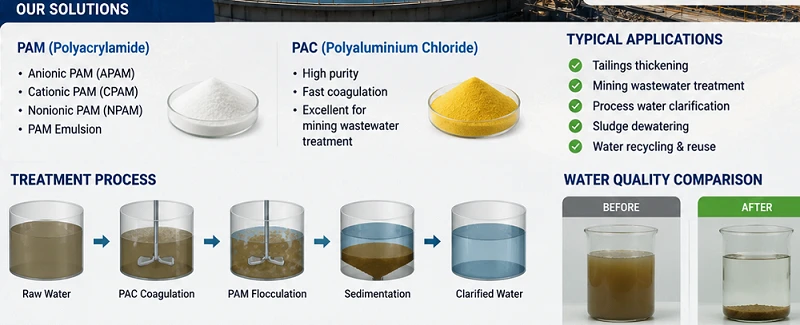
Therefore, in mine wastewater treatment, a combined process is frequently adopted: PAC Coagulant + PAM Flocculant
Typical treatment flow: Mine Wastewater → PAC Coagulation Reaction → PAM Flocculation Enhancement → Sedimentation / Thickening → Clean Water Reuse
This combined approach helps mining enterprises increase water recycling rates while reducing environmental discharge pressures.
10. High-Performance PAM Product Forms: Selection Between Emulsion and Powder Types
Tailored to different mine site conditions, ECOLINK TECHNOLOGY offers PAM products in various forms:
Solid PAM (Powder Polyacrylamide)
Features:
Stable storage;
Convenient transportation;
Suitable for long-term continuously operating mining projects.
PAM Emulsion
Features:
Higher active content;
Fast dissolution rate;
Reduced on-site preparation time.
Data indicates that active ingredient content in emulsion flocculants can typically reach 30%–40%, reducing transportation and storage costs compared to traditional products. Dispersion-type polymer activation time can be shortened to under 10 minutes, whereas traditional products usually require 30–60 minutes.
For large-scale mines with high levels of automation, PAM emulsion provides a more flexible chemical dosing control solution.
11. Comprehensive Service Value of ECOLINK TECHNOLOGY Mine Water Treatment
The mineral processing industry's demand for chemical suppliers has shifted from purchasing a single chemical to seeking a stable, efficient, and economical comprehensive solution.
ECOLINK TECHNOLOGY can provide:
✅ Mining Flocculant selection services
✅ Polyacrylamide Flocculant for Mining Wastewater Treatment solutions
✅ PAC + PAM combined treatment schemes
✅ Tailings thickening optimization recommendations
✅ Industrial wastewater treatment equipment
✅ Water resource recycling schemes
By combining chemical agents with water treatment equipment, we help customers achieve:
Higher underflow density;
Lower chemical consumption;
Higher water recovery rate;
More stable mine production operation.
Part 3: Advanced Mineral Flocculation Technology, Cost Optimization, and ECOLINK TECHNOLOGY Comprehensive Mine Water Treatment Solutions
12. Advanced Flocculant Technology Helps Mines Improve Thickening Efficiency
As ore resources become increasingly complex, traditional single-chemical solutions can hardly satisfy the demands of large mines for high efficiency, low water consumption, and environmentally friendly production.
Modern mineral processing enterprises pay growing attention to:
Higher tailings thickening efficiency;
Lower chemical agent consumption;
More stable recycled water quality;
Higher equipment operational reliability.
By optimizing the molecular structure, charge density, and combined application method of Polyacrylamide (PAM), thickener performance can be further enhanced.
12.1 Dual Polymer System Optimization Scheme
For certain complex slurry systems, such as:
High clay content ores;
Ultra-fine particle tailings;
High-salinity mine wastewater;
A single Flocculant may fail to achieve optimal results. In such cases, a Dual Polymer System can be adopted.
Typical application method:
First Stage: Use a low molecular weight, high charge density polymer to adjust the surface charge of mineral particles.
Second Stage: Add high molecular weight Polyacrylamide to form large settling flocs from micro-flocs through molecular chain bridging.
This technology can improve:
Floc size;
Settling velocity;
Underflow solid concentration;
Overflow clarification effectiveness.
Data shows that in a Brazilian iron ore processing plant with an annual capacity of 15 million tons, adopting a dual polymer system increased settling velocity by 35% and reduced chemical costs by 28%.
The conditioning polymer neutralizes particle surface charge, while the bridging polymer forms rapidly settling large flocs. Critical factors include proper ratio control, typically with a ratio of conditioning agent to bridging polymer ranging from: 1:3 to 1:5
13. Automated Dosing Control Enhances PAM Application Stability
In large-scale mine production, slurry characteristics can constantly fluctuate with ore source, production load, and water quality changes.
Relying on manual adjustment of PAM dosage easily leads to:
Chemical deficiency;
Chemical waste;
Underflow fluctuations;
Unstable overflow water quality.
Therefore, an increasing number of mines are adopting automated Flocculant dosing systems.
Intelligent control systems can adjust PAM dosage in real time based on:
Feed rate;
Slurry concentration;
Particle size;
Underflow density;
Overflow clarity.
Utilizing feedforward control combined with feedback control maintains stable thickener operation during slurry condition changes while reducing flocculant consumption.
Relevant application data indicates that automated control systems can reduce flocculant consumption by approximately 10%–15%.
14. PAM and PAC Combined Scheme Optimizes Mine Wastewater Recycling
In mining production, water resource management has become a crucial factor influencing operational costs.
Traditional mine wastewater usually contains:
Suspended mineral particles;
Fine slimes;
Colloidal substances;
Certain organic pollutants.
Relying solely on natural gravity settling often fails to meet recycling requirements.
Mine wastewater treatment solutions provided by ECOLINK TECHNOLOGY typically combine:
First Stage: PAC Coagulation Treatment
Polyaluminium Chloride (PAC) acts as an efficient inorganic coagulant:
Rapidly compresses the electric double layer;
Neutralizes particle surface charges;
Promotes micro suspended solids aggregation.
Second Stage: PAM Flocculation Enhancement
Polyacrylamide (PAM) further:
Increases floc size;
Elevates settling velocity;
Improves sludge thickening performance.
Through PAC and PAM synergy, a more stable Coagulation + Flocculation treatment process is formed, applied in:
Mine tailings return water treatment;
Mineral processing wastewater treatment;
Mineral processing recycled water treatment;
Pretreatment for industrial wastewater Zero Liquid Discharge (ZLD).
15. Economic Value Analysis: High-Performance PAM Reduces Chemical Costs and Enhances Overall Revenue
For mining enterprises, evaluating flocculant performance should not focus solely on price per ton of chemical, but requires comprehensive consideration of:
Water recovery volume;
Equipment processing capacity;
Tailings disposal costs;
Production stability.
Data indicates that flocculant costs usually account for approximately $0.10–$0.50 per ton of processed ore. However, optimizing thickener operation can create higher economic value.
Comprehensive value is mainly reflected in:
15.1 Increasing Water Recovery Rate
For every 1% increase in underflow density, typically about 1.5%–2.0% of process water can be recovered, thereby reducing fresh water make-up requirements.
15.2 Enhancing Production Capacity
After optimizing sedimentation performance, it is possible to:
Increase thickener processing capacity;
Reduce equipment stress;
Improve downstream filtration efficiency.
In some applications, production capacity can be increased by 10%–25% without additional capital investment.
15.3 Reducing Long-Term Operational Risks
A stable PAM application solution can reduce:
Thickener operational fluctuations;
Frequency of emergency adjustments;
Water supply pressure.
Therefore, selecting appropriate Tailings Treatment Chemicals is not merely a purchasing decision, but a key link in mine production optimization.
16. ECOLINK TECHNOLOGY - Comprehensive Supplier of Mine Water Treatment Chemicals and Equipment
As a professional water treatment solution provider, ECOLINK TECHNOLOGY is committed to providing global clients with:
Water Treatment Chemicals
Including:
Polyacrylamide (PAM)
Anionic Polyacrylamide (APAM)
Cationic Polyacrylamide (CPAM)
Nonionic Polyacrylamide (NPAM)
PAM Emulsion
Polyaluminium Chloride (PAC)
Industrial Water Treatment Equipment
Including:
Industrial wastewater treatment equipment;
Sewage treatment equipment;
Water reuse systems;
RO reverse osmosis equipment;
Ultrafiltration equipment;
Seawater desalination equipment.
Technical Service Support
ECOLINK TECHNOLOGY not only supplies products, but also offers based on customer site requirements:
Product model recommendations;
PAM molecular weight and charge density optimization;
PAC/PAM combination testing;
Laboratory jar test guidance;
Water treatment process scheme design.
Addressing mining application requirements such as Polyacrylamide Flocculant for Mining Wastewater Treatment and High Molecular Weight Anionic PAM for Tailings Sedimentation, ECOLINK TECHNOLOGY can assist clients in selecting solutions best suited to local ore conditions and operating environments.
17. Conclusion: Choose the Right PAM Solution to Enhance Mine Thickening Efficiency and Sustainable Development Capacity
The mineral processing industry is advancing toward high efficiency, low water consumption, and green production.
Thickener performance optimization depends not only on the equipment itself, but more importantly on:
Appropriate Flocculant selection;
Scientific PAM dosing methods;
Stable PAC coagulation synergy;
Continuous data monitoring and process adjustments.
Through high-performance Polyacrylamide (PAM), Polyaluminium Chloride (PAC), and professional technical support, mining enterprises can achieve:
✔ Faster settling velocity
✔ Higher underflow density
✔ Cleaner recycled water
✔ Lower operational costs
ECOLINK TECHNOLOGY is eager to partner with global mining customers to provide reliable, efficient, and economical mine water treatment solutions.