In modern mining production processes, ore processing, mineral dressing, and tailings treatment generate large volumes of wastewater containing fine mineral particles, suspended solids, and complex chemical components. If this slurry wastewater is not effectively treated, it will not only increase enterprise operating costs but may also impact the surrounding ecological environment.
Therefore, efficient solid-liquid separation technology has become a vital link in mining water treatment. Among these, Polyacrylamide Flocculant is widely used in tailings thickening, slurry settling, wastewater reuse, and mine wastewater treatment systems due to its excellent flocculation performance.
ECOLINK TECHNOLOGY focuses on water treatment chemicals and comprehensive water treatment solutions, providing global mining customers with one-stop services including Anionic Polyacrylamide, Nonionic Polyacrylamide, and supporting water treatment equipment, helping customers optimize solid-liquid separation processes and improve water resource recycling rates.
1. The Role of Polyacrylamide Flocculants in the Mining Industry
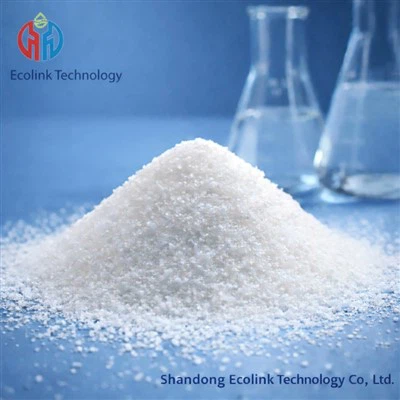
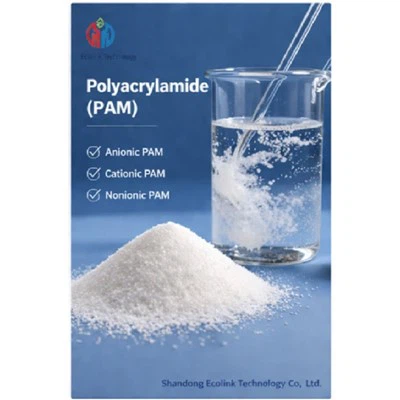
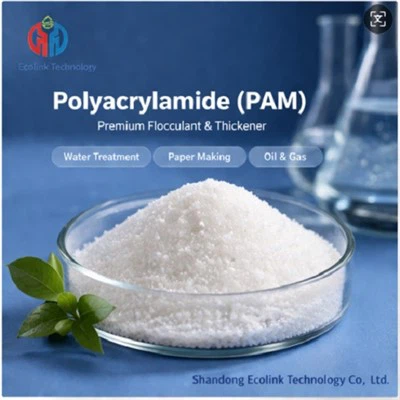
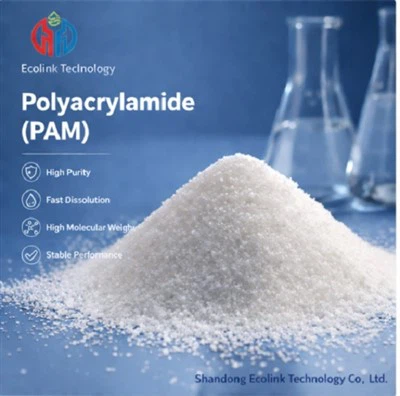
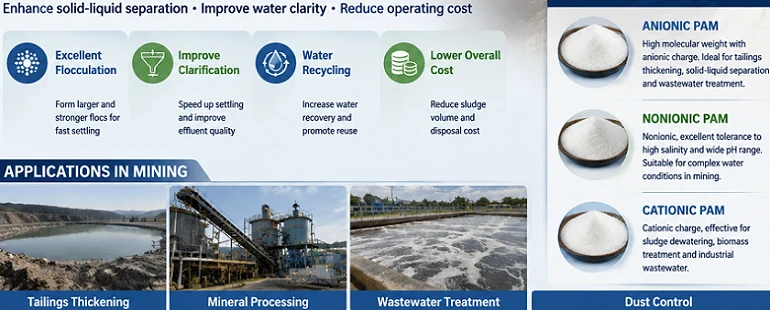
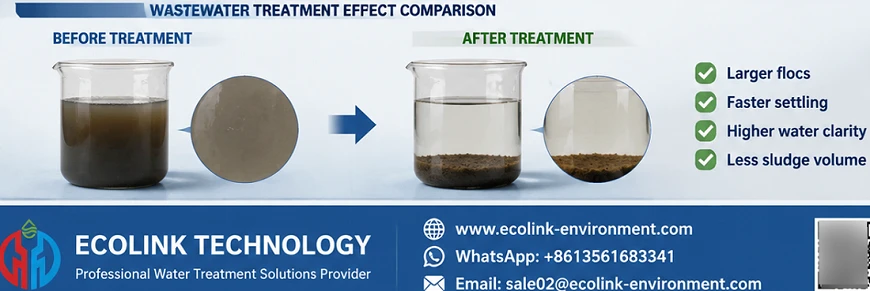
Polyacrylamide (PAM) is a high-molecular-weight, water-soluble polymer whose primary role is to aggregate tiny solid particles in water into larger flocs through adsorption bridging, charge interaction, and net-enmeshment mechanisms, thereby increasing settling velocity and achieving solid-liquid separation.
In mining wastewater treatment, mineral slurry typically contains:
Clay particles;
Metallic mineral particles;
Total suspended solids (TSS);
Flotation residues;
Other fine mineral impurities.
Because of their small particle size and slow settling speed, relying solely on natural sedimentation makes it difficult to achieve desired results. Therefore, suitable polyacrylamide flocculants must be added to improve settling performance.
According to different charge properties, PAM is mainly classified into:
Anionic Polyacrylamide;
Nonionic Polyacrylamide;
Cationic Polyacrylamide.
Among them, anionic and nonionic products are widely applied in the mining industry.
2. Technical Characteristics of Anionic Polyacrylamide
Anionic polyacrylamide is a negatively charged, water-soluble high-molecular material whose negative charge originates from anionic groups within the polymer chain, such as carboxyl structures.
This product is usually formed by copolymerizing acrylamide monomers with anionic co-monomers, giving the polymer chain strong adsorption capacity.
Reference materials show that anionic polyacrylamide can effectively adsorb positively charged particles-such as clay, metallic particles, and suspended solids-and promote pollutant removal by forming larger flocs.
Working Mechanism of Anionic PAM in Mining Wastewater
In mine tailings treatment, Anionic PAM functions primarily through the following ways:
Adsorption Bridging Effect High-molecular chains can connect multiple mineral particles simultaneously, causing dispersed small particles to form larger flocs.
Promoting Rapid Settling The formed large-sized flocs possess better settling performance, which can improve the processing efficiency of thickeners and sedimentation equipment.
Improving Recycled Water Recovery By enhancing the solid-liquid separation effect, the water content in tailings ponds can be reduced, increasing the reuse ratio of mine wastewater.
Therefore, Anionic PAM is commonly used in:
Mine tailings thickening;
Mineral dressing wastewater treatment;
Slurry solid-liquid separation;
Industrial wastewater treatment.
3. Technical Characteristics of Nonionic Polyacrylamide
Nonionic polyacrylamide is a high-molecular polymer with no net charge. Its structure consists mainly of acrylamide units without introducing anionic or cationic groups.
Due to the absence of significant charge effects, nonionic PAM exhibits strong adaptability to variations in water quality, making it particularly suitable for industrial environments with high salinity and complex ionic compositions.
Reference materials indicate that nonionic polyacrylamide performs stably in high-salinity water bodies and is suitable for fields such as mining, soil conditioning, and industrial water treatment.
Advantages of Nonionic PAM in Mining
Compared to certain charged flocculants, Nonionic PAM offers:
Broader adaptability to water chemical conditions;
Less susceptibility to salinity variations;
Resistance to altering the ionic balance of the slurry system;
Suitability for complex mineral environments.
Therefore, Nonionic Polyacrylamide is an essential choice in mine wastewater treatment with high TDS, high mineral content, and significant water quality fluctuations.
4. Differences Between Anionic PAM and Nonionic PAM in Mining Applications
When selecting a Mining Wastewater Treatment Flocculant, decisions should not be made simply based on product price, but must be combined with ore type, water quality parameters, and final treatment goals.
4.1 Impact of Charge Properties on Flocculation Effect
Anionic polyacrylamide carries a negative charge and interacts more readily with certain positively charged particles, thereby forming larger, stable flocs.
Nonionic polyacrylamide has no distinct charge effect and relies more on adsorption and bridging between polymer chains, giving it superior compatibility in complex water quality environments.
When selecting, the following need to be tested:
pH value;
TDS (Total Dissolved Solids);
Slurry concentration;
Solid particle properties.
5. Application Technology of Nonionic PAM in Tailings Treatment
Tailings are typically by-products after mineral extraction, consisting of fine particles, water, and residual chemicals. Improper treatment increases pressure on tailings storage facilities.
Nonionic polyacrylamide promotes the aggregation of fine particles, causing tailings particles to form larger flocs and boosting settling velocity.
Its main applications include:
5.1 Tailings Thickening
Adding Nonionic Polyacrylamide into thickeners can:
Accelerate slurry settling;
Increase underflow density;
Reduce tailings moisture content.
5.2 Mineral Processing Operations
During mineral dressing, flocculants can help improve solid-liquid separation efficiency, making valuable minerals easier to separate from gangue.
Because Nonionic PAM is charge-neutral, it is less likely to interfere with chemical reactions during mineral processing, making it suitable for certain special mineral systems.
5.3 Mining Area Dust Control
Besides wastewater treatment, PAM can also be applied to haul roads and stockpile areas in mining zones to reduce fugitive dust by enhancing particle cohesion.
6. Flocculant Selection Methods for Mining Wastewater Treatment
Correct selection of Polyacrylamide Flocculant requires comprehensive consideration of the following factors:
6.1 Water Quality Parameter Analysis
Different mine wastewaters possess distinct characteristics:
Low-Salinity Mining Wastewater
Anionic PAM can usually be tested first to enhance flocculation via charge adsorption.
High-Salinity Mining Wastewater
Because salt ions may interfere with charge interactions, Nonionic Polyacrylamide often exhibits better stability.
Reference materials indicate that under high-TDS or high-salinity conditions, nonionic polyacrylamide may be more suitable because it is less affected by salinity.
6.2 Influence of Ore Type
Different ores have varying surface properties:
Silicate ores;
Metal oxide ores;
Sulfide ores;
High-clay content ores.
Different mineral surface charges vary, so beaker experiments (Jar Tests) are required to determine the optimal model.
7. Technical Precautions for Using Polyacrylamide
To achieve optimal treatment performance, practical engineering applications require attention to:
7.1 Dissolution Concentration
PAM usually requires thorough dissolution prior to use to avoid localized over-concentration caused by direct addition.
7.2 Agitation Speed
Rapid mixing helps distribute the chemical evenly, followed by slow agitation to promote floc growth.
7.3 Dosage Optimization
Over-dosing may lead to:
Oversized/improper flocs or overly small flocs;
Increased viscosity;
Higher treatment costs.
Therefore, laboratory testing based on actual slurry water samples is recommended.
ECOLINK TECHNOLOGY can assist in selecting the appropriate PAM model and provide technical support based on customer-provided slurry water samples, processing capacities, and target indicators.
8. Mining Water Treatment Solutions Provided by ECOLINK TECHNOLOGY
As a professional water treatment product supplier, ECOLINK TECHNOLOGY not only provides polyacrylamide flocculants, but also supplies complete water treatment solutions, including:
Wastewater treatment equipment;
Industrial wastewater treatment systems;
Water reuse solutions.
For mining industry customers, our focus extends beyond providing chemical agents to helping customers reduce:
Tailings treatment costs;
Fresh water consumption;
Sludge disposal pressure;
Environmental compliance risks.
9. Why Choose ECOLINK TECHNOLOGY?
Professional Product Matching
Different mine wastewaters require different PAM models. ECOLINK TECHNOLOGY recommends highly matched flocculant schemes based on:
Slurry properties;
Solid content;
pH range;
Salinity conditions;
Settling velocity requirements.
Technical Support Services
We recommend that customers conduct experimental testing before formal procurement, determining the optimal product model and dosage through:
Jar Tests (beaker experiments);
Settling speed tests;
Floc observation;
Supernatant testing.
One-Stop Water Treatment Capability
In addition to water treatment chemicals, ECOLINK TECHNOLOGY can also provide:
Mining Wastewater Treatment Equipment;
Tailings Water Treatment Solution;
Industrial Wastewater Treatment System.
Helping customers achieve integrated services from chemical selection to engineering applications.
10. Conclusion: Choose the Right PAM to Improve Mine Water Treatment Efficiency
In the mining industry, both Anionic PAM and Nonionic PAM possess significant application value.
Anionic polyacrylamide is suitable for scenarios requiring strong particle adsorption and rapid flocculation, whereas nonionic polyacrylamide is better suited for high-salinity, complex slurries, and environments requiring strict ionic balance.
No single flocculant applies to all mining projects; thus, practical applications must combine water quality analysis and experimental testing.
ECOLINK TECHNOLOGY is committed to providing global customers with efficient, stable, and economical mine wastewater treatment solutions, helping clients achieve greener and more sustainable mining production through advanced water treatment chemicals and equipment technology.