Comparative Analysis of Standalone PAM vs. PAC + PAM Combined Scheme in Industrial Wastewater Treatment
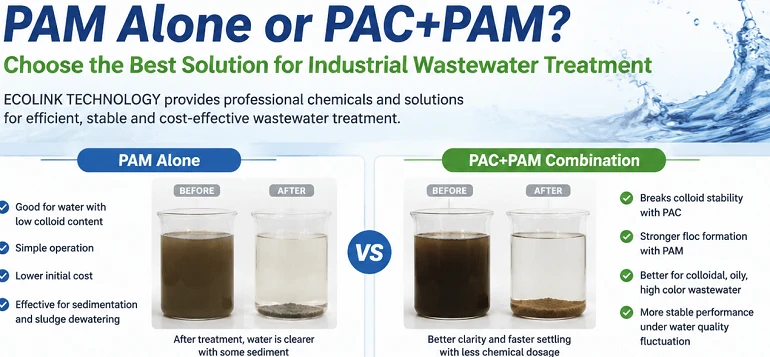
Standalone PAM or PAC + PAM Combination? How to Choose a More Suitable Scheme for Industrial Wastewater Treatment
In the process of industrial wastewater treatment, many enterprises hope to solve the issues of suspended solids removal, sludge settling, and water quality stabilization through a single simple chemical reagent. However, the composition of pollutants in different industrial wastewaters varies significantly. For example, suspended solids, colloidal particles, emulsified oil, color substances, surfactants, and metal ions will all affect the flocculation effect.
As a professional water treatment chemical supplier, ECOLINK TECHNOLOGY believes that there is no "universal single solution" applicable to all industries in industrial wastewater treatment. According to wastewater characteristics and treatment targets, enterprises can usually choose the following two main technical routes:
Using polyacrylamide (PAM) alone as a flocculant
A two-step treatment scheme using a coagulant (PAC) first, combined with polyacrylamide (PAM)
The correct selection depends on particle stability, water quality components, and final treatment targets in the wastewater, such as improving sedimentation efficiency, enhancing dissolved air flotation (DAF) performance, optimizing sludge dewatering performance, or improving system operation stability.
In practical industrial wastewater treatment, polyacrylamide (PAM) mainly plays a flocculating role, while coagulant (PAC) is mainly used to destroy the colloidal stability structure, enabling fine particles to form micro-flocs that settle more easily. When combined, a more stable PAC + PAM water treatment scheme can be formed.
1. Working Principle of Polyacrylamide (PAM) in Industrial Wastewater Treatment
Polyacrylamide (PAM) is a high-molecular polymer widely used in industrial wastewater treatment, sludge dewatering, mine tailings treatment, and papermaking wastewater treatment.
The main mechanism of action of PAM is to connect fine suspended particles in water through Polymer Bridging via high-molecular chains, causing them to form larger and tighter flocs, thereby improving:
Solid-liquid separation efficiency
Sludge settling speed
Filtration performance
Sludge dewatering effect
In wastewater systems where the particles themselves already have a certain aggregation tendency and low colloidal stability, using PAM alone can usually achieve good treatment results.
For example:
Washing wastewater
Some mineral slurry wastewater
Pretreated industrial wastewater
Sludge concentration and dewatering systems
Solid particles in these wastewaters are usually easy to be adsorbed by polymer chains, so PAM can rapidly promote floc growth.
2. Under What Circumstances is Standalone PAM Suitable?
When selecting industrial wastewater treatment flocculants, it is necessary to first judge the nature of pollutants in the wastewater.
If the wastewater has the following characteristics, using PAM alone may be an economical and simple solution:
2.1 High suspended solids content, but low colloidal substances
When pollutants in wastewater exist mainly in the form of suspended particles rather than highly stable colloidal states, PAM can directly adsorb onto the particle surface and form larger flocs through molecular chain connection.
For example:
Mine tailings wastewater
Sand and gravel washing wastewater
Some industrial circulating water blowdown
In such cases, by adjusting the PAM model (such as anionic polyacrylamide) and dosage, the settling performance can be rapidly improved.
2.2 Sludge itself has good dewatering performance
In sludge dewatering applications, PAM is usually used as an important sludge dewatering agent.
For example:
Belt filter presses
Centrifugal dewatering machines
Plate and frame filter presses
PAM can promote the combination of sludge particles, making free water easier to release and improving sludge dewatering efficiency.
For systems that have completed coagulation and sedimentation with stable sludge properties, merely adjusting the PAM dosage can often further optimize the dewatering effect.
2.3 Small changes in wastewater pH and water quality
If industrial wastewater has:
Stable pH range
Low surfactant content
Stable solid particle properties
Then PAM can maintain a good flocculation effect.
According to practical testing experience, in some clarification treatments, the effective dosage of PAM is usually approximately: 0.2–5.0 mg/L
The specific dosage needs to be determined through jar tests based on:
Wastewater pollutant concentration
Solid load
Equipment type
Floc formation status
It should be noted that:
Insufficient PAM dosage → Small, loose flocs and slow settling speed;
Excessive PAM dosage → May cause re-stabilization of particles, forming gelatinous flocs and affecting filtration efficiency.
Therefore, in the application process of PAM in industrial wastewater treatment, selecting the proper model and controlling the dosage ratio is more important than simply increasing the chemical dose.
3. Potential Problems Encountered with Standalone PAM
Although PAM has good flocculation capability, it cannot solve all industrial wastewater problems.
When highly stable colloidal particles exist in wastewater, relying solely on PAM may fail to achieve ideal results.
Common problems include:
3.1 High-concentration colloids lead to unstable flocculation effects
Fine particles in some industrial wastewaters carry strong surface charges, causing particles to repel each other and making natural combination difficult.
For example:
Dye particles in printing and dyeing wastewater
Emulsified oil droplets in oily wastewater
Surfactant-containing wastewater
High-color industrial wastewater
At this time, even if the PAM dosage is increased, the following may still occur:
Water remains turbid
Flocs are relatively small
Improvement in supernatant clarity is limited
3.2 Chemical costs increase but treatment improvement is limited
When encountering a decline in treatment efficiency, some enterprises directly increase the PAM dosage.
However, if the problem stems from colloidal stability rather than floc size, increasing PAM cannot effectively resolve the issue.
Under such circumstances, the following may occur:
Increased PAM consumption
Higher operating costs
Deterioration of sludge properties
Increased downstream filtration pressure
Therefore, in complex industrial wastewater treatment, a more systematic evaluation of combined PAC and PAM usage effects is required.
3.3 Oil and surfactants affect PAM bridging effect
For oily wastewater, machining wastewater, and some petrochemical wastewater, emulsified oil droplets usually exhibit strong stability.
Although PAM can promote particle aggregation, it cannot effectively destroy the emulsified structure.
Therefore, it is usually necessary to first perform the following using a coagulant (PAC):
Charge neutralization
Colloidal destabilization
Micro-floc formation
And then utilize PAM to further enhance floc size and settling speed.
4. Preliminary Judgment Criteria for Standalone PAM Scheme
In practical industrial wastewater treatment, whether standalone PAM is suitable can be judged through the following phenomena:
| Wastewater Phenomenon | Recommended Scheme |
| Flocs form rapidly, supernatant improves significantly |
Standalone PAM scheme |
| Increased PAM dosage but turbidity remains high |
Combined PAC + PAM scheme |
| Flocs form but break easily |
Combined PAC + PAM scheme |
| Contains large amounts of emulsified oil or color substances |
Combined PAC + PAM scheme |
| Good coagulation effect exists, only settling needs reinforcement |
Standalone PAM scheme |
Therefore, when choosing appropriate industrial wastewater treatment chemicals, the pollutant types should be analyzed first, rather than simply determining which chemical has a lower price.
5. Why Coagulant (PAC) + Polyacrylamide (PAM) Usually Achieves Better Treatment Results?
In complex industrial wastewater treatment, relying solely on polyacrylamide (PAM) for flocculation sometimes cannot effectively solve problems such as colloidal stability, emulsified oil, and high color substances.
In such cases, adopting a combined coagulant (PAC) + polyacrylamide (PAM) treatment scheme can usually achieve a more stable solid-liquid separation effect.
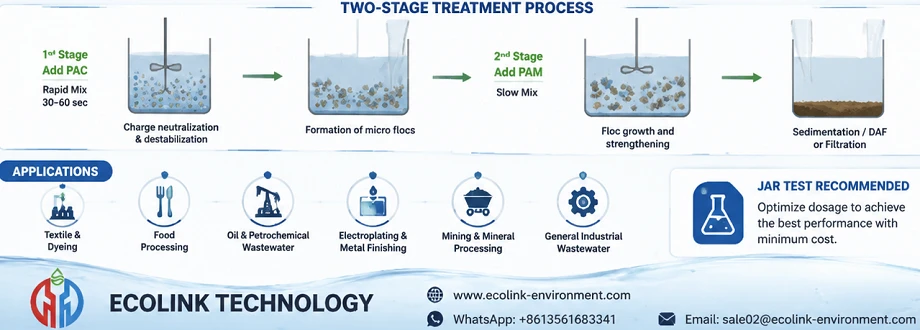
ECOLINK TECHNOLOGY usually recommends in practical water treatment solutions: Step 1: Use coagulant (PAC) for coagulation treatment; Step 2: Use polyacrylamide (PAM) to promote floc growth.
This two-stage treatment method can leverage the respective advantages of the two water treatment chemicals:
PAC is responsible for destroying the stable structure of pollutants;
PAM is responsible for connecting micro-flocs and improving settling performance.
Through reasonable combination, a more efficient PAC + PAM wastewater treatment solution can be formed.
6. Mechanism of Action of Coagulant (PAC) in Industrial Wastewater Treatment
Coagulant (PAC), namely Poly Aluminium Chloride, is a commonly used inorganic polymer coagulant.
In industrial wastewater treatment, many pollutants do not exist simply as suspended particles, but in the form of stable colloids.
These colloidal particles usually have:
Small particle size;
Negative surface charge;
Mutual repulsion;
Long-term dispersion status.
Therefore, when only PAM is added, polymer chains can hardly fully exert their bridging effect.
Coagulant (PAC) can improve water quality through the following ways:
6.1 Charge neutralization, reducing particle stability
Aluminum-based polymers in PAC can neutralize the surface charges of colloidal particles in water, reducing the repulsive force between particles.
After coagulation action:
Small particles begin to aggregate;
Stable colloids are destroyed;
Primary micro-flocs are formed.
Subsequently adding PAM can further promote micro-floc growth.
6.2 Forming sweep flocs, improving pollutant removal rate
When PAC is added, a large number of micro-floc structures will form, which can adsorb:
Suspended particles;
Part of organic matter;
Color substances;
Metal hydroxide precipitates.
These micro-flocs then form larger flocs through the polymer bridging action of PAM.
Ultimately improving:
Settling speed;
Air flotation separation efficiency;
Sludge concentration effect.
7. Advantages of PAC + PAM Combined Scheme Compared to Standalone PAM
7.1 Better water quality adaptability
During industrial production, wastewater quality changes frequently, such as:
Changes in raw materials;
Changes in production batches;
Changes in cleaning cycles;
Fluctuations in pollutant concentration.
When using PAM alone, the treatment effect is easily affected by colloidal stability.
The combined PAC + PAM scheme can first solve the pollutant stability problem, and then optimize the floc structure through PAM, thus possessing a broader operational range.
7.2 Improving sedimentation and dissolved air flotation (DAF) performance
In many industrial wastewater treatments, rapid achievement of the following is required:
Solid-liquid separation;
Air flotation oil removal;
Sludge concentration.
PAC can rapidly generate micro-flocs, while PAM can enhance floc strength.
When combined, they can form:
Larger floc size;
Better shear resistance;
Faster settling speed.
Therefore, in scenarios requiring enhanced industrial wastewater flocculation efficiency, the PAC + PAM combination is usually more suitable.
7.3 Stronger processing capability for oil and surfactants
Oily wastewater is a difficult class to treat in industrial water treatment.
For example:
Petrochemical wastewater;
Machining wastewater;
Oilfield-related wastewater.
Emulsified oil droplets usually have strong stability, and PAM cannot complete the demulsification process alone.
Adopting: Coagulant (PAC) → Destroy emulsified structure
PAM → Aggregate oil droplets and suspended particles
Can effectively improve oil-water separation efficiency.
8. Analysis of PAC + PAM Application Schemes in Different Industries
Pollutant compositions vary across different industrial wastewaters, so appropriate treatment methods need to be selected according to industry characteristics.
8.1 Textile and printing & dyeing wastewater
Textile wastewater usually contains:
Dyes;
Color substances;
Surfactants;
Suspended impurities.
These pollutants easily form stable colloids.
Therefore, printing and dyeing wastewater is usually more suitable for: Coagulant (PAC) + Polyacrylamide (PAM) combination scheme.
Recommended process:
First reduce color and form micro-flocs via PAC;
Then add PAM to increase floc size;
Achieve separation via sedimentation or air flotation equipment.
Common PAM test range: 0.5–2.0 mg/L
The specific dosage still needs to be determined through jar tests based on:
Wastewater COD;
Color;
Solid content;
pH conditions.
8.2 Food processing wastewater
Food processing wastewater usually features:
High organic content;
Large variations in solid concentration;
Obvious water quality fluctuations across production shifts.
For example:
Meat processing wastewater;
Food washing wastewater;
Beverage production wastewater.
For such wastewater, a two-step treatment method can usually expand the operational stability range.
Recommendations:
Step 1: Adjust pH value and alkalinity;
Step 2: Test PAC + PAM combination effect.
Evaluation metrics should include not only floc size, but also:
Filtrate clarity;
Sludge dewatering performance;
Effluent stability.
8.3 Electroplating and metal surface treatment wastewater
Electroplating wastewater usually contains:
Metal ions;
Hydroxide precipitates;
Fine particles.
If at the front end:
pH adjustment is effective;
Metal precipitation is sufficient;
Then using PAM alone may also achieve good separation results.
Typical PAM initial test range: 0.5–3.0 mg/L
However, if fine colloids still cause turbidity, it is recommended to add a small amount of PAC before optimizing the PAM dosage.
8.4 Oily industrial wastewater
For:
Petrochemical wastewater;
Machining wastewater;
Oilfield wastewater;
The main difficulty is usually emulsified oil stability.
Therefore, priority consideration is given to: PAC Demulsification + PAM Flocculation
Comprehensive consideration is required during treatment for:
Chemical reagent selection;
Mixing intensity;
Reaction time.
Only when all three are reasonably matched can stable oil-water separation results be obtained.
9. Importance of PAC and PAM Dosing Order in Industrial Wastewater Treatment
In actual operation, the order of chemical addition directly impacts the treatment performance.
Recommended order:
Step 1: Add coagulant (PAC)
Through rapid mixing:
Complete charge neutralization;
Form micro-flocs;
Reduce colloidal stability.
Rapid mixing time is usually: 30–60 seconds
Step 2: Add PAM
After PAC forms micro-flocs, add PAM.
PAM function:
Increase floc size;
Accelerate settling speed;
Improve filtration and dewatering performance.
If PAM is added prematurely, it may cause:
Colloids to be encapsulated;
Decreased coagulation efficiency;
Unstable floc structure.
Therefore, when choosing industrial wastewater treatment flocculants, attention must be paid not only to chemical types, but also to:
Dosing order;
Mixing method;
Reaction time.
10. Jar Test: The Fastest Method to Determine the Optimal Combination of PAM and PAC + PAM
In industrial wastewater treatment, no single chemical reagent can fit all water quality conditions completely. Therefore, before formal dosing, determining the optimal chemical combination via Jar Test is a key step to reduce trial-and-error costs and improve treatment stability.
ECOLINK TECHNOLOGY recommends that customers compare through a standardized testing process:
Standalone Polyacrylamide (PAM)
Coagulant (PAC) + Polyacrylamide (PAM)
The actual results of both schemes.
The test goal is not simply pursuing the "largest flocs", but under minimal chemical risk and reasonable operating cost conditions, achieving:
Stable solid-liquid separation;
Lower effluent turbidity;
Better sludge dewatering performance;
More stable long-term operation results.
11. Recommended PAC + PAM Jar Test Procedure
Step 1: Prepare fresh chemical solutions
Before the experiment, prepare separately:
Coagulant (PAC) solution;
Polyacrylamide (PAM) solution.
PAM is usually prepared as: 0.05–0.2% polymer solution
This ensures:
Uniform chemical dispersion;
More accurate dosing;
Comparability between different test groups.
Step 2: Establish a baseline for standalone PAM testing
First test the treatment effect when using PAM alone.
It is recommended to set multiple dosage points, for example:
0.2 mg/L
0.5 mg/L
1.0 mg/L
2.0 mg/L
3.0 mg/L
By comparing across different dosages:
Floc formation speed;
Supernatant clarity;
Settling speed;
Sludge status;
Judge whether standalone PAM can meet the treatment requirements.
Step 3: Test PAC + PAM combined scheme
For industrial wastewater requiring a two-step treatment:
Add coagulant (PAC) first
Perform rapid mixing: 30–60 seconds
Main functions: Destroy colloidal stability; Complete charge neutralization; Form micro-flocs.
Then add PAM
Mix gently to let PAM exert its bridging role.
Main observations: Floc size; Floc strength; Settling speed; Effluent clarity.
Step 4: Record key processing metrics
During the test, focus on:
Turbidity changes: Judge removal efficiency of suspended particles in water.
Supernatant clarity: Evaluate water quality improvement after coagulation and flocculation.
Floc settling speed: Judge solid-liquid separation efficiency.
Sludge volume and dewatering performance: Especially applicable to sludge dewatering systems, filter presses, centrifuges.
Through these metrics, judgment can be made on:
Whether PAC is required;
Whether the PAM model is appropriate;
Whether the chemical ratio needs adjustment.
12. How to Judge Treatment Direction Based on Different Test Results?
In actual industrial wastewater flocculation processes, experimental results can usually help quickly determine the scheme.
Scenario 1: Standalone PAM yields good results
If:
Flocs form rapidly;
Supernatant becomes significantly clear;
Settling speed meets requirements;
It indicates that particle stability in wastewater is low. At this point, choose Standalone PAM treatment scheme to reduce chemical types and operational complexity.
Scenario 2: PAM dosage increases but improvement is limited
If the following occurs:
PAM dosage increases;
Water quality improvement is not obvious;
Turbidity or misty suspended matter remains;
It usually indicates that colloidal particles in the wastewater have not been effectively destroyed. In this case, adopt Combined PAC + PAM treatment scheme to first perform coagulation via PAC, then enhance flocculation via PAM.
Scenario 3: Flocs are very large but effluent remains turbid
This situation indicates that the problem may not be insufficient PAM, but rather unresolved issues during the coagulation stage.
Possible reasons:
Insufficient PAC dosage;
Inappropriate mixing conditions;
Colloids remain stable.
At this point, the PAC stage needs re-optimization rather than simply increasing PAM.
13. Precautions for PAM Preparation and Operation in Industrial Wastewater Treatment
Even if the correct chemical combination is selected, improper preparation and dosing methods may affect the final result.
13.1 PAM dissolution method affects flocculation performance
PAM is a high-molecular polymer that requires full hydration before functioning.
During preparation, pay attention to:
Adding PAM powder slowly;
Avoiding rapid pouring that leads to the "fish-eye" phenomenon;
Ensuring complete dissolution.
If PAM is not completely dissolved:
Effective utilization decreases;
Chemical consumption increases;
Flocculation performance drops.
13.2 Avoid excessive stirring causing molecular chain damage
After PAM solution hydration is completed, gentle transportation and mixing are required.
Excessive shear may cause:
High-molecular chain breakage;
Decreased bridging capability;
Reduced floc strength.
Therefore, in industrial operation, proper mixing methods are more important than simply increasing chemical dosage.
13.3 Adjust dosing strategy according to water quality changes
For industrial enterprises with large influent fluctuations, such as food processing plants, printing and dyeing plants, and chemical enterprises, it is recommended to dynamically adjust PAC dosage based on:
Turbidity;
Flow rate;
Solid concentration.
Then fine-tune PAM usage based on:
Floc size;
Settling speed.
This can reduce:
Chemical waste;
Operating cost increases;
Risk of effluent fluctuation.
14. ECOLINK TECHNOLOGY Provides Industrial Wastewater Treatment Chemicals and Solutions
As a professional water treatment product supplier, ECOLINK TECHNOLOGY not only provides high-quality polyacrylamide (PAM), but also provides:
Poly Aluminium Chloride (PAC);
Anionic Polyacrylamide (APAM);
Cationic Polyacrylamide (CPAM);
Nonionic Polyacrylamide (NPAM);
Industrial wastewater treatment equipment;
Sludge dewatering solutions.
For different industrial wastewater types, based on:
Wastewater industry;
pH range;
Turbidity;
Solid load;
Separation equipment type;
We help customers select appropriate chemical schemes.
For example:
Sedimentation tank systems;
Dissolved Air Flotation (DAF) equipment;
Belt filter presses;
Centrifugal dewatering equipment;
Plate and frame filter presses;
All need to match different types of PAM products and dosing strategies.
ECOLINK TECHNOLOGY insists on providing water treatment solutions aimed at actual treatment effects, rather than recommending a single "universal model".
If you are looking for an industrial wastewater treatment scheme with better combined PAC and PAM performance, or wishing to optimize existing application methods of PAM in industrial wastewater treatment, welcome to contact us. We can provide targeted technical advice based on your water samples and process conditions.
15. Frequently Asked Questions (FAQ)
Q1: Can PAM be used alone in industrial wastewater treatment?
Yes.
If suspended particles in wastewater aggregate easily and colloidal content is low, using PAM alone can achieve good flocculation results. However, for oily, high-color, and high-colloidal wastewater, a PAC + PAM combination is usually recommended.
Q2: Why do PAC and PAM need to be used together?
PAC is mainly responsible for colloidal destabilization, charge neutralization, and micro-floc formation.
PAM is mainly responsible for floc growth, accelerating settling, and improving dewatering performance.
The two have different functions, so combined use can improve treatment stability.
Q3: What is the common dosage of PAM in industrial wastewater treatment?
It varies greatly across different wastewaters. According to practical applications:
Clarification treatment common range is approximately 0.2–5.0 mg/L;
Electroplating wastewater settling test is approximately 0.5–3.0 mg/L;
Textile wastewater common test range is approximately 0.5–2.0 mg/L.
The final dosage needs to be determined through jar tests.
Q4: How to select appropriate industrial wastewater treatment flocculants?
Comprehensive consideration is required for pollutant types, wastewater industry, pH conditions, solid concentration, and downstream treatment equipment. ECOLINK TECHNOLOGY recommends determining the optimal scheme through on-site water sample testing.