CPAM Selection & Application from Dye Removal and Flocculation to Sludge Dewatering
The textile industry generates complex wastewater containing dyes, surfactants, sizing agents, suspended fibers, and other organic pollutants during dyeing, printing, finishing, and fabric processing. Due to water quality fluctuations caused by different production processes and dye systems, textile wastewater treatment usually requires not only reducing suspended solids and turbidity, but also focusing on controlling color, COD, and sludge dewatering performance.
In coagulation, flocculation, and solid-liquid separation stages, Cationic Polyacrylamide (CPAM) is an important class of polymer flocculants. Properly selecting the cationicity, molecular weight, and product form of CPAM can help textile wastewater treatment systems form tighter flocs, improving subsequent sedimentation and sludge dewatering efficiency.
For textile enterprises seeking to reduce chemical consumption, enhance treatment stability, and control operating costs, CPAM selection should not be based solely on unit price. Instead, it should involve a comprehensive evaluation combining actual wastewater quality, treatment processes, and equipment conditions.
I. Why Does Textile Wastewater Need CPAM?
Compared with ordinary municipal sewage, textile wastewater is characterized by complex pollutant composition, high color intensity, and significant fluctuations in water quality.
Reactive dyes, disperse dyes, vat dyes, and various auxiliaries used in the dyeing process introduce a large number of fine colloidal and suspended particles into the wastewater. These particles often possess strong negative charges and remain in a relatively stable dispersed state in water, making effective separation difficult through natural settling alone.
This is where textile wastewater flocculants play a crucial role.
CPAM molecular chains carry cationic groups that can undergo adsorption and charge neutralization with negatively charged particles in the wastewater, causing originally stably dispersed micro-particles to lose stability and further assemble into larger flocs.
After reasonable coagulation and flocculation, the formed flocs can enter sedimentation tanks, lamella clarifiers, dissolved air flotation (DAF) units, or subsequent sludge treatment systems.
Therefore, CPAM for textile wastewater treatment is typically utilized for the following objectives:
Reducing suspended solids and colloidal particles;
Improving wastewater color;
Assisting in reducing partial COD;
Increasing sedimentation speed;
Improving sludge thickening performance;
Enhancing dewatering efficiency of belt filter presses and other equipment.
It should be noted that CPAM mainly performs the role of enhancing flocculation and solid-liquid separation. It should not be simply understood that polymers alone can complete all textile wastewater treatment.
II. How Does CPAM Work on Textile Wastewater?
Floc Formation via Charge Neutralization and Polymer Bridging
The flocculation mechanism of cationic polyacrylamide primarily involves two interconnected processes: Charge Neutralization and Polymer Bridging.
Fine particles in textile wastewater usually carry negative charges. When CPAM is added to the water body and fully dispersed, its cationic groups rapidly adsorb onto the particle surfaces.
This process reduces electrostatic repulsion between particles, allowing colloidal particles that originally existed stably in water to approach one another.
Subsequently, longer polymer molecular chains can simultaneously adsorb onto multiple particles, bridging different particles together to gradually form larger flocs.
It can be simply understood as:
Negatively Charged Particles → CPAM Adsorption → Reduced Charge Stability → Polymer Bridging → Floc Formation → Sedimentation / Flotation Separation
This is an important reason why cationic polyacrylamide for textile wastewater can be used for solid-liquid separation in complex printing and dyeing wastewater.
III. Why Do Different Dye Systems Require Different CPAM Selections?
Textile production does not involve just a single type of dye.
Actual production may involve:
Reactive dyes;
Disperse dyes;
Vat dyes;
Different types of dyeing auxiliaries;
Surfactants;
Sizing agents and finishing agents.
Different dye systems correspond to different wastewater charge characteristics; therefore, one cannot simply state that "all textile mills use the same CPAM model."
For example, in mixed textile wastewater, products with medium cationicity and higher molecular weight generally show good adaptability. If a certain high-anionic pollutant accounts for a higher proportion, the cationicity of CPAM may need to be re-evaluated.
Therefore, in actual projects, textile wastewater CPAM selection should be built on actual water sample testing rather than judging solely by product name or price.
IV. How to Choose the Suitable CPAM Product?
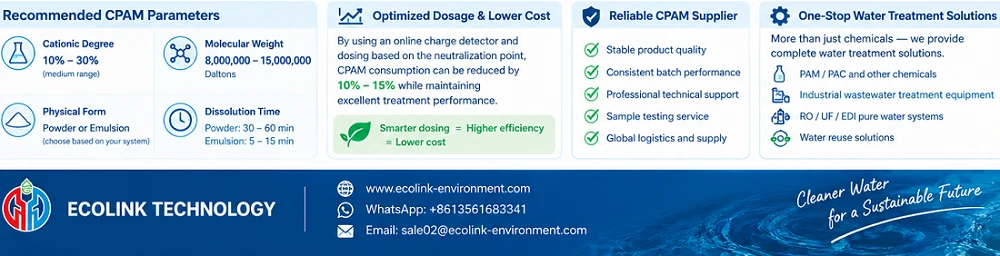
1. Cationicity: 10%–30%
Cationicity is one of the key parameters to focus on when selecting printing and dyeing wastewater flocculants.
According to supplementary data, textile wastewater can generally prioritize a medium cationicity range of 10%–30%.
Cationicity affects the interaction between CPAM and negatively charged pollutants. If cationicity is too low, it may fail to provide sufficient charge neutralization capacity; however, higher cationicity does not necessarily mean better treatment results.
Especially when wastewater conductivity changes, excessively high charge may lead to charge reversal, causing particles to re-stabilize.
Therefore, 10%–30% cationicity CPAM can serve as an important testing range during beaker/jar tests for textile wastewater projects.
The final model still needs to be determined based on specific water samples.
2. Molecular Weight: 8 Million–15 Million Daltons
In addition to cationicity, molecular weight also affects floc formation.
The reference range for textile wastewater applications given in supplementary data is: 8 million–15 million Daltons.
Higher molecular weight provides longer molecular chains, which favors bridging between particles and promotes the formation of larger flocs.
However, different treatment equipment has different requirements for floc characteristics.
For example:
Clarification and sedimentation systems usually focus on floc size and settling speed;
Sludge dewatering systems pay more attention to floc structure, bound water release, and drainage performance.
Therefore, products cannot be determined solely on the principle that "the higher the molecular weight, the better."
For textile wastewater treatment polymer, wastewater properties and subsequent solid-liquid separation equipment should be considered simultaneously.

V. Powder CPAM vs. Emulsion CPAM?
Currently, CPAM is mainly available in two forms: powder and emulsion.
Powder CPAM
Powder products are convenient to store and transport, and the transportation cost per unit of active content is relatively low.
Supplementary data shows that powder CPAM typically requires: 30–60 minutes dissolution time.
Therefore, plants using powder products need to configure appropriate automatic or manual preparation systems and ensure the polymer is fully matured.
Emulsion CPAM
Emulsion products feature faster dissolution and dispersion characteristics, making them particularly suitable for plants without independent powder preparation systems.
The reference dissolution time given in the attachment is: 5–15 minutes.
Therefore, for systems that require rapid chemical preparation or wish to reduce manual operations, emulsion CPAM serves as another viable option.
When making an actual choice, storage conditions, automatic dosing systems, transportation costs, and on-site operating habits should also be comprehensively considered.
VI. Why is Jar Testing an Important Step in CPAM Selection?
Wastewater quality across different textile mills is never identical.
Even if two factories produce the same type of textiles, their dye formulations, production loads, pH, conductivity, COD, and suspended solids concentrations may differ.
Therefore, suppliers cannot determine the final model and dosage solely based on the industry in which the customer operates.
Textile wastewater CPAM dosage optimization should generally start with jar testing.
Recommended testing procedure includes:
Step 1: Obtain Actual Wastewater Samples Try to use representative production wastewater rather than plain water or laboratory simulated water.
Step 2: Screen Different CPAM Models Focus on comparing:
Cationicity;
Molecular weight;
Product form;
Dissolution performance.
Step 3: Observe Floc Formation Focus on observing floc:
Formation speed;
Size;
Compactness;
Settling performance;
Supernatant clarity.
Step 4: Determine Suitable Dosage Range Do not directly adopt a single dosage; instead, find a relatively reasonable operating window through gradient testing.
Step 5: Perform On-Site Verification Laboratory jar test results ultimately need to be verified on actual equipment, as mixing intensity, retention time, sludge concentration, and equipment structure will all affect the final outcome.
VII. Evaluating CPAM Suppliers Beyond Product Price
For continuously operating textile wastewater treatment systems, chemical supply stability is as important as product performance.
If there are significant fluctuations in cationicity, molecular weight, or active content between different batches of CPAM, on-site operators may need to constantly adjust dosage.
This leads to several issues:
Fluctuating Treatment Results → Dosage Adjustments → Sludge Volume Changes → Increased Operational Costs
Therefore, when evaluating a CPAM supplier for the textile industry, it is recommended to focus simultaneously on:
Product quality stability;
Batch consistency;
Product testing capability;
Production capacity;
Quality control system;
Technical support capability;
Sample testing capability;
International logistics and delivery capabilities.
For long-term procurement customers, stable product performance is often more important than the lowest price in a single purchase.
VIII. How to Reduce CPAM Consumption and Operational Costs?
Transitioning from "Empirical Dosing" to "Data-Driven Dosing"
Many sewage treatment systems initially adopt relatively conservative dosing methods.
While this can lower the risk of insufficient treatment, long-term over-dosing of CPAM can increase chemical costs and increase the amount of polymer entering the sludge system.
Supplementary data indicates that by titrating with a Streaming Current Monitor (SCM) and optimizing dosage based on the charge neutralization endpoint, polymer usage can typically be reduced by 10%–15% while maintaining clarification performance.
Therefore, CPAM dosage for textile wastewater should not be fixed as a permanent static number.
A more reasonable approach is to dynamically adjust according to changes in influent water quality.
For example:
Influent Water Quality Monitoring → Charge Change Judgment → CPAM Dosage Adjustment → Flocculation Effect Monitoring → Further Optimization
This approach is particularly suitable for textile enterprises with obvious changes in production load and dye types.
IX. Mixing Intensity Also Affects Flocculation
After CPAM is added, it is not a case of "the stronger the mixing, the better."
The polymer needs to come into contact with wastewater rapidly and evenly, but excessive agitation can destroy the flocs that have already formed.
Therefore, in actual textile wastewater flocculation treatment processes, staged mixing can be adopted.
A typical approach is:
Rapid Mixing → Flocculation Reaction → Floc Growth → Sedimentation / Flotation Separation
Supplementary data suggests applying low-shear distribution after CPAM addition and gradually reducing mixing intensity through multiple flocculation chambers. In relevant schemes, 2–3 chambers can be set up, with the mixing intensity in each chamber reduced by approximately half.
This allows small flocs to grow gradually while reducing structural damage to flocs caused by strong shear forces.
This is especially important for textile wastewater, because if flocs formed by dye particles and colloidal pollutants are excessively sheared, they may re-enter the water body.
X. Application of CPAM in Textile Wastewater Sludge Dewatering
CPAM can be used not only for front-end flocculation, but also for subsequent sludge treatment.
In sludge dewatering equipment such as belt filter presses and centrifuges, appropriate CPAM can promote the aggregation of sludge particles and improve sludge filtration and dewatering performance.
It should be noted here that CPAM parameters used for sedimentation are not necessarily identical to those used for sludge dewatering.
Supplementary data notes that sedimentation applications can use higher molecular weight products, whereas in sludge dewatering scenarios, a slightly lower molecular weight can sometimes improve drainage performance.
Therefore, if a textile factory simultaneously involves:
Wastewater Flocculation + Sludge Thickening + Sludge Dewatering
It is recommended to conduct tests separately for different treatment stages, rather than defaulting to using the exact same CPAM grade.
XI. How ECOLINK TECHNOLOGY Helps Textile Enterprises with CPAM Selection
For textile wastewater projects, true value lies not in simply supplying a bag of polyacrylamide, but in helping customers find products that match their actual water quality and equipment.
ECOLINK TECHNOLOGY provides CPAM products and water treatment technical support centered around customer processes.
Our service methodology includes:
Product Screening Based on Actual Water Quality Screen suitable CPAM ranges by combining wastewater properties, pollutant characteristics, treatment processes, and downstream equipment.
Providing Sample Testing Conducting jar tests with actual wastewater is far more reliable than selecting models based solely on industry experience.
Assisting in Dosage Scheme Optimization Gradually determine a reasonable dosage window based on floc formation, settling speed, and supernatant condition.
Process Optimization in Alignment with Equipment The actual effectiveness of CPAM is closely related to coagulation, flocculation, sedimentation, flotation, and sludge dewatering equipment; thus product selection needs to integrate with the entire treatment process.
One-Stop Water Treatment Solutions In addition to water treatment chemicals such as PAM and PAC, ECOLINK TECHNOLOGY can also provide industrial wastewater treatment equipment, sewage treatment equipment, RO/UF/EDI pure water treatment systems, and water reuse solutions according to project needs.
This means customers can transition from purchasing standalone chemicals to obtaining one-stop services spanning chemical selection, experimental testing, water treatment processes, and equipment integration.
XII. Frequently Asked Questions (FAQ)
How soon can results be seen after switching to a suitable CPAM model?
According to supplementary data, if the product matches actual wastewater conditions, improvements can usually be observed within the clarifier's first full Solids Retention Time (SRT). Some systems may demonstrate noticeable changes in less than 2 hours, such as reduced overflow turbidity and accelerated settling speed.
However, actual results are still influenced by factors such as wastewater quality, equipment retention time, mixing conditions, and CPAM dosage.
Is CPAM effective for both reactive dye and disperse dye wastewater?
Yes.
Supplementary data explicitly indicates that CPAM holds application value for both reactive dye and disperse dye wastewater, though reactive dye wastewater typically has a higher charge demand. For mixed wastewater, products with medium cationicity and high molecular weight can be tested first; if reactive dyes account for the primary proportion, cationicity may need to be further increased and confirmed through jar tests.
Conclusion: Choosing the Right CPAM is More Important Than Simply Increasing Dosage
The core of textile wastewater treatment is not simply "adding more flocculant," but finding a balance among wastewater characteristics, CPAM parameters, dosage, mixing conditions, and solid-liquid separation equipment.
For most textile wastewater projects, product screening can begin within the range of 10%–30% cationicity and 8 million–15 million Daltons molecular weight, followed by jar testing on actual water samples to determine the final model and dosing plan.
At the same time, through online charge monitoring and reasonable mixing conditions, unnecessary polymer consumption can be further reduced. Supplementary data shows that after optimization, polymer usage can be reduced by 10%–15%.
ECOLINK TECHNOLOGY is committed to providing PAM, PAC, and supporting water treatment equipment and technical solutions for textile, printing/dyeing, and other industrial clients. For enterprises needing to solve problems with color, suspended solids, COD, flocculation, or sludge dewatering, it is recommended to test products on actual water samples first before large-scale application.