Technical Guide: How Degree of Hydrolysis Affects Anionic PAM's Charge Density, Viscosity, Salt Resistance, and Field Performance
In applications such as oilfield enhanced oil recovery (EOR), mining tailings treatment, industrial wastewater, and sludge dewatering, anionic polyacrylamide (APAM) is not a case of "the higher the molecular weight, the better" or "the higher the degree of hydrolysis, the better."
For practical users, a more critical question is:
Does the polymer's Degree of Hydrolysis (DH) match the actual water quality, salinity, pH, hardness, shear conditions, and treatment objectives?
Even within the same anionic polyacrylamide category, different degrees of hydrolysis alter the negative charge density, molecular chain conformation, and interaction with multivalent cations such as calcium and magnesium. Consequently, the resulting viscosity, flocculation efficiency, salt resistance, and stability can vary significantly.
For industrial users requiring long-term procurement of Anionic PAM, simply comparing the molecular weight and solid content on product specification sheets is insufficient to judge suitability. A more reliable approach is to conduct beaker tests, bottle tests, or core flooding tests tailored to actual operating conditions.
ECOLINK TECHNOLOGY focuses on more than just supplying standard chemicals; we also match the degree of hydrolysis, molecular weight, and application environment based on customer operating conditions, selecting the most appropriate Anionic Polyacrylamide grade for diverse industrial scenarios.
1. What Is the Degree of Hydrolysis of Anionic Polyacrylamide?
Anionic Polyacrylamide (Anionic PAM) is typically formed from components such as acrylamide and sodium acrylate.
Within the polymer structure, a portion of the amide groups is converted into negatively charged carboxylate groups. This transformation governs the overall anionic characteristics of the polymer.
Degree of Hydrolysis (DH) refers to the proportion of this conversion within the polymer.
According to the technical parameters in the reference material:
Partially Hydrolyzed Polyacrylamide: DH 10–35%
Fully Hydrolyzed Polyacrylamide: DH >35%
As the degree of hydrolysis increases, the polymer's negative charge density also increases. The electrostatic repulsion generated between negative charges causes the polymer chain to extend further, thereby altering its hydrodynamic performance in water.
Therefore, choosing between Partially Hydrolyzed PAM and Fully Hydrolyzed PAM is not a simple comparison of "low hydrolysis" versus "high hydrolysis," but rather a requirement to evaluate the specific application environment.
2. Why Does Degree of Hydrolysis Affect PAM Performance?
2.1 Charge Density and Chain Extension
When the degree of hydrolysis increases, the number of carboxylate groups on the polymer chain increases, leading to a higher negative charge density.
In low-ionic-strength water environments, the repulsion between negative charges helps the polymer chain maintain an extended conformation.
This chain extension has a major impact on the following performance metrics:
Apparent viscosity of the solution
Particle adsorption and bridging
Floc formation
Mobility control
Polymer transport through porous media
Therefore, the PAM degree of hydrolysis is one of the critical parameters linking polymer molecular structure to field performance.
However, it is important to note that higher hydrolysis does not translate to infinitely higher performance.
2.2 Influence of Multivalent Ions Such as Calcium and Magnesium
In real-world applications, industrial water is rarely pure water.
Produced water, mining tailings water, and certain industrial wastewaters may contain high concentrations of multivalent cations like calcium and magnesium.
When anionic polymers carry a high negative charge, these cations can interact with the carboxylate groups, causing the polymer chains to shrink or coil.
The sequence of effects can be expressed as:
Increased negative charge → Stronger cation interactions → Molecular chain coiling → Reduced effective hydrodynamic volume → Decreased viscosity
Therefore, in high-salinity or high-hardness environments, one should not blindly pursue higher DH.
This is why selecting a salt-resistant anionic polyacrylamide requires simultaneous evaluation of TDS, calcium, magnesium, and other ionic compositions in the water.
3. Key Technical Differences Between Partially Hydrolyzed and Fully Hydrolyzed PAM
Different degrees of hydrolysis result in distinct performance profiles.
| Technical Parameter | Partially Hydrolyzed PAM | Fully Hydrolyzed PAM |
| Degree of Hydrolysis (DH) | 10–35% | >35% |
| Charge Density | Moderate negative charge | High negative charge |
| Viscosity in Fresh Water | High, good chain extension | High sensitivity, but more sensitive to environmental changes |
| Brine/Salt Resistance | Better, lower sensitivity to cations | Lower, prone to molecular chain coiling |
| Dissolution Rate | Faster | Slightly slower |
| Typical Molecular Weight | 15–30×10⁶ | 15–30×10⁶ and above |
| Primary Applications | EOR, mining tailings, paper retention | Heavy-duty flocculation, sludge dewatering |
From a practical selection standpoint, partially hydrolyzed anionic polyacrylamide generally provides a balanced overall performance, whereas fully hydrolyzed products utilize higher charge density to meet specific heavy-duty flocculation demands.
Therefore, the proper question is not "Which one is superior?" but rather:
Which degree of hydrolysis delivers the lowest total operating cost under current water quality conditions?

4. Partially Hydrolyzed PAM: Why Is It Widely Used in Enhanced Oil Recovery?
In applications such as oilfield polymer flooding, one of the primary roles of the polymer is to improve the mobility control of injected water, enabling the water phase to displace residual oil in the reservoir more effectively.
During polymer flooding, beyond viscosity itself, several operational factors must be considered:
Reservoir temperature
Formation water salinity
Calcium and magnesium ion concentration
Injection shear rate
Polymer concentration
Core pore structure
Long-term stability
Reference data indicates that in polymer flooding applications, a hydrolysis degree of 25–30% typically achieves a favorable balance between mobility control and brine resistance, making it particularly suitable for medium-salinity reservoirs.
This demonstrates that in PAM for Enhanced Oil Recovery applications, the degree of hydrolysis must be tailored around actual reservoir conditions rather than simply selecting the highest DH product.
For oilfield clients comparing different grades, it is recommended to evaluate not only initial viscosity but also viscosity retention after exposure to actual brine conditions and shear forces.
5. Why Are High-Hydrolysis PAMs Not Always Suitable for High-Salinity Reservoirs?
This is a critical nuance frequently overlooked by procurement teams when selecting polyacrylamide for oilfields.
As the degree of hydrolysis rises, the polymer's negative charge density increases.
In low-salinity environments, this helps extend the molecular chain; however, in high-salinity environments, abundant cations shield the electrostatic repulsion between polymer chains and enhance inter-chain interactions.
This often leads to:
High DH ≠ High Viscosity Retention Capacity
Reference parameters provide the following benchmark:
When Total Dissolved Solids (TDS) exceed 50,000 ppm, partially hydrolyzed polyacrylamide with a hydrolysis degree of 20–28% generally maintains an optimal balance between viscosity and shear stability.
However, this range should still be verified through bottle tests using site water samples, as ionic composition varies across different reservoirs.
Therefore, clients requiring PAM for high-salinity reservoir polymer flooding are advised to provide site water samples or comprehensive water analysis reports rather than relying solely on TDS values.
6. Is Fully Hydrolyzed PAM Always Better for Mining Tailings Treatment?
The answer is: Not necessarily.
Fully hydrolyzed grades feature higher negative charge density, which can facilitate fine particle aggregation through strong electrostatic interactions and polymer bridging in certain heavy-duty flocculation environments.
Under appropriate pH and water quality conditions, high charge density can help:
Accelerate fine particle settling
Improve solid-liquid separation
Promote floc formation
Increase tailings thickening efficiency
However, if mining tailings water exhibits high hardness or acidic conditions, the dense negative charges can be adversely impacted by multivalent cations.
Consequently, selecting PAM for mining tailings should not follow the logic of "the higher the anionicity, the better."
Under conditions such as acidic leach solutions or high-hardness tailings water, partially hydrolyzed grades or even nonionic polyacrylamides may offer superior adaptability.
Field application data shows that adjusting the degree of hydrolysis and switching polyacrylamide grades allowed some operations to reduce chemical dosage by 15–20%. Comparative field trials also demonstrated that medium-hydrolysis products reduced flocculant consumption by 10–20% in specific applications.
This further proves:
Proper PAM selection is ultimately about finding the optimal balance between performance and dosage.
7. Sludge Dewatering Applications: Why Look Beyond Anionicity Alone?
In sludge dewatering processes, PAM performance relies heavily on particle adsorption, polymer bridging, and floc formation.
Because fully hydrolyzed grades carry a higher negative charge density, they can be utilized in specific heavy-duty flocculation scenarios.
However, actual sludge characteristics vary widely across industries:
Municipal sludge
Industrial sludge
Mining tailings
Papermaking sludge
Chemical sludge
These sludge types differ significantly in organic content, inorganic ratio, pH, salinity, and particle surface charges.
Therefore, when selecting anionic PAM for sludge dewatering, the most valuable evaluation parameters are rarely the degree of hydrolysis alone, but rather observing:
Floc size → Floc strength → Settling velocity → Supernatant clarity → Filtrate quality → Filter cake moisture content
This highlights why laboratory beaker tests and onsite trial runs are essential for final product selection.
8. How to Correctly Select the Degree of Hydrolysis for Anionic PAM?
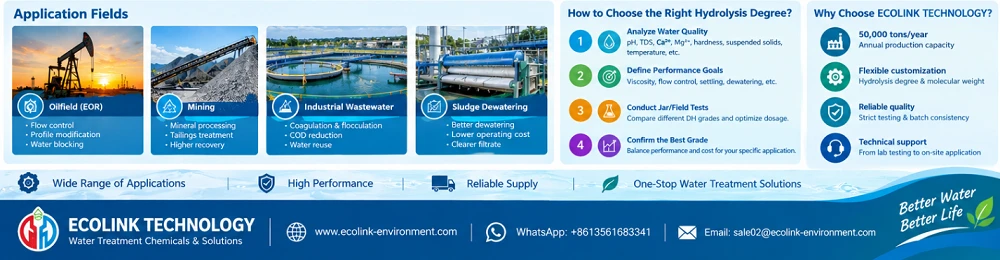
A reliable selection methodology follows a four-step process:
Step 1: Analyze Actual Water Quality
At a minimum, evaluate:
pH
TDS
Calcium ions
Magnesium ions
Total hardness
Suspended solids (SS)
Temperature
For oilfield applications, further details on reservoir temperature, injection water, and produced water characteristics are required.
For mining applications, examine slurry properties, mineral composition, tailings concentration, and processing workflows.
Step 2: Define Final Performance Objectives
Different applications target different outcomes:
Oilfield: Focus on Viscosity + Mobility Control + Shear Stability + Salt Resistance
Mining: Focus on Flocculation Rate + Settling Performance + Supernatant Quality + Solid-Liquid Separation Efficiency
Sludge Dewatering: Focus on Floc Strength + Dewatering Performance + Filtrate Quality + Chemical Consumption
Clients seeking guidance on selecting the proper degree of hydrolysis for anionic PAM should clear their final process targets first, then work backward to determine the appropriate polymer grade.
9. Why Are Laboratory Tests More Critical Than Specification Sheets Alone?
Specification sheets inform procurement teams of baseline parameters, but they cannot fully predict product performance in site-specific water conditions.
For instance, products with identical molecular weights and degrees of hydrolysis may exhibit vastly different viscosity and flocculation behavior across varying salinity, pH, and hardness levels.
Therefore, comparative testing is strongly recommended:
Option A: Select a lower degree of hydrolysis product.
Option B: Select a medium degree of hydrolysis product.
Option C: Select a higher degree of hydrolysis product.
Then, compare the following performance metrics side by side:
Dosage requirement
Solution viscosity
Dissolution rate
Floc size
Settling velocity
Supernatant clarity
Filtrate quality
Overall treatment cost
For oilfield applications, bottle tests or core flooding tests should be conducted.
This method ensures users identify the product best suited for actual field conditions rather than relying strictly on theoretical parameters supplied by manufacturers.
10. Batch Consistency: The Critical Factor Often Overlooked by Industrial Clients
For industrial clients purchasing Anionic Polyacrylamide in bulk over long periods, batch-to-batch variations represent a hidden cost.
If the degree of hydrolysis fluctuates-even within technical specifications-it can result in:
Variations in solution viscosity
Need for constant re-adjustment of flocculant dosage
Fluctuations in settling velocity
Increased operator manual intervention
Increased chemical consumption
Therefore, during large-scale procurement, clients are advised to request batch-specific analytical data from suppliers.
Key parameters to monitor include:
Degree of Hydrolysis, Molecular Weight, and Production Stability Data.
Reference documentation notes that the Degree of Hydrolysis can be determined via potentiometric titration, while Molecular Weight can be determined via viscometry.
For large industrial projects, robust manufacturing processes and raw material controls are equally essential.
11. How ECOLINK TECHNOLOGY Helps Clients Choose the Right PAM
ECOLINK TECHNOLOGY advises clients against selecting products based solely on "high molecular weight," "high hydrolysis," or "high anionicity."
A more practical approach is matching polymer specifications to actual application conditions.
Our anionic polyacrylamide products can be customized in degree of hydrolysis and molecular weight to suit varying operational demands.
With an annual production capacity of 500,000 metric tons as highlighted in our reference documentation, we ensure stable supply for large-scale industrial projects.
For long-term procurement partners, we assist through:
Product Grade Matching: Screening the optimal DH range based on water quality, pH, salinity, hardness, and process targets.
Sample Testing: Conducting sample testing under actual operating conditions prior to bulk ordering to mitigate operational risk.
Parameter Customization: Tailoring hydrolysis degree and molecular weight to application needs rather than locking clients into rigid standard specifications.
Technical Support: Recommending tailored product strategies designed around core process targets across oilfield, mining, and sludge dewatering applications.
Batch Quality Control: Providing batch-level analytical data to minimize performance fluctuations over long-term usage.
Clients seeking product selection assistance can provide water analysis reports, onsite water sample data, and existing chemical parameters to let ECOLINK TECHNOLOGY help narrow down the optimal product selection.
12. Frequently Asked Questions: 5 Key Questions About PAM Degree of Hydrolysis
Q1: Is higher degree of hydrolysis always better for Anionic PAM performance?
No.
Increasing the degree of hydrolysis raises negative charge density, but when high levels of multivalent cations are present in the water, excessive charge density causes the polymer chain to coil. Therefore, the optimal degree of hydrolysis depends on water quality and application conditions rather than striving for the highest DH.
Q2: What degree of hydrolysis should be selected when TDS exceeds 50,000 ppm?
Reference guidelines suggest that partially hydrolyzed polyacrylamide with a DH of 20–28% generally maintains a strong balance between viscosity and shear stability under high-salinity conditions. However, verification via site water bottle testing is recommended.
Q3: Can Fully Hydrolyzed PAM be used for all mining tailings?
Not across the board.
High-pH, low-hardness tailings may benefit from higher charge density products, whereas acidic or high-hardness tailings are often better suited to partially hydrolyzed or nonionic products. PAM selection for mining wastewater treatment should always be grounded in slurry and tailings water testing.
Q4: How can users verify batch-to-batch consistency in hydrolysis degree?
Clients are encouraged to request:
Batch Certificate of Analysis (COA)
Hydrolysis degree testing data
Molecular weight testing data
Production stability logs
This establishes a reliable quality tracking system across procurement batches.
Q5: Is Fully Hydrolyzed PAM worth paying a higher price for?
Evaluation should not be based solely on unit purchasing price per ton.
The true metric to evaluate is:
Treatment Cost Per Unit Volume of Water = Unit Product Price × Actual Required Dosage + Mixing & Operational Costs
If a higher grade significantly reduces the required dosage, a higher unit purchase price does not necessarily mean higher total operating costs. Conversely, if high hydrolysis yields no performance improvement on site, the extra purchase cost provides no practical value.
13. Conclusion: The Core of PAM Selection Is "Optimal Match," Not "Highest Specification"
Partially hydrolyzed and fully hydrolyzed anionic polyacrylamides each have distinct operational strengths.
Partially hydrolyzed PAM features a DH range of 10–35%, offering balanced performance suited for EOR, mining tailings, and paper retention.
Fully hydrolyzed PAM features a DH >35%, offering higher negative charge density suited for heavy-duty flocculation and sludge dewatering scenarios.
However, practical application requires comprehensive evaluation of hydrolysis degree, molecular weight, salinity, pH, hardness, temperature, and shear conditions together.
For high-salinity reservoirs, the recommended reference range is DH 20–28%; for polymer flooding in general, a medium hydrolysis degree of 25–30% typically provides an optimal balance between mobility control and salt resistance.
Therefore, the most reliable approach to selecting Anionic PAM is not comparing specification sheets, but following a structured process:
Water Quality Analysis → Product Screening → Laboratory Testing → Onsite Field Trials → Optimal Grade Determination → Bulk Procurement.
If you are looking for an anionic polyacrylamide supplier for oilfield, mining, sludge dewatering, or industrial wastewater applications, ECOLINK TECHNOLOGY can assist with product screening, sample testing, and technical support tailored to your operational conditions.