Anionic Polyacrylamide in Iron Ore Processing & Selection Guide
In iron ore processing, operations like crushing, grinding, classification, and separation generate a large volume of slurry containing fine mineral particles. As the mineral particle size continues to decrease, the difficulty of solid-liquid separation increases accordingly. Especially in thickening, tailings disposal, and filtration steps, if fine particles remain suspended for a long time, it not only reduces settling efficiency, but may also increase circulating water turbidity and affect the operation of downstream filtration equipment.
Under these circumstances, Anionic Polyacrylamide (APAM) is commonly used as an important polymeric flocculant. By properly selecting the molecular weight, degree of hydrolysis, and dosage, fine particles in the slurry can be promoted to form larger and denser flocs, thereby improving solid-liquid separation efficiency.
For iron ore processing enterprises, purchasing PAM is not simply a matter of "buying any flocculant." Ore type, particle size distribution, clay/slime content, slurry pH, thickening equipment, and tailings dewatering methods all affect the final results.
Therefore, a truly rational selection methodology should be:
Ore Characteristics → PAM Molecular Structure → Beaker Tests → Process Validation → Dosage Optimization → Stable Supply
ECOLINK TECHNOLOGY can provide corresponding PAM product selection, sample testing, and supply support for iron ore processing based on customers' slurry characteristics and existing processes.
1. What is the Role of Anionic Polyacrylamide in Iron Ore Processing?
In iron ore mineral processing, the slurry formed after grinding typically contains mineral particles of various sizes. Larger particles settle easily by gravity, while ultra-fine mineral particles may remain suspended in water for a long time due to their small size, surface charge, and Brownian motion.
If relying solely on natural settling, the solid-liquid separation efficiency of thickeners is often limited.
This is precisely where PAM flocculants play their primary role.
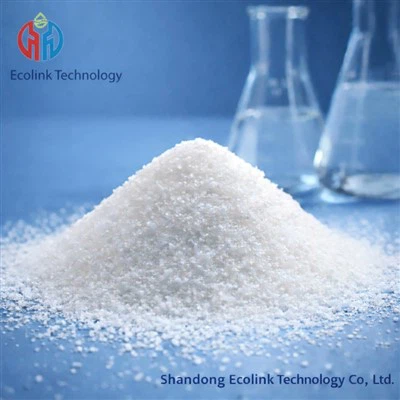
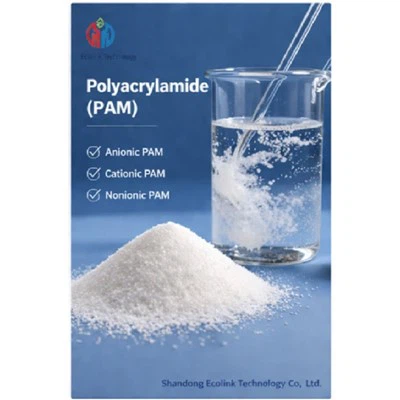
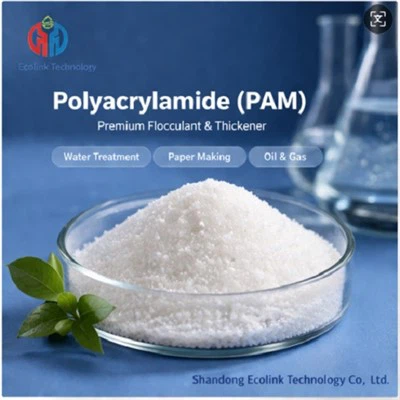
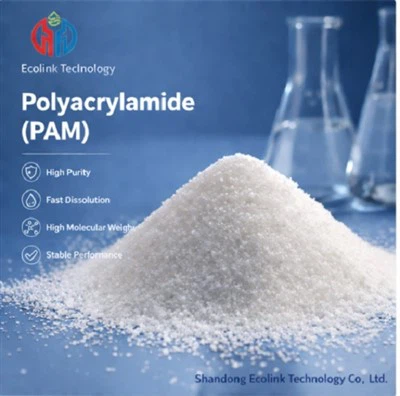
Anionic polyacrylamide is a water-soluble polymer material. Its long molecular chain can connect dispersed fine particles together through adsorption and bridging, gradually forming larger flocs.
Simply put, the process can be understood as:
Fine Particle Dispersion → PAM Adsorption → Polymer Chain Bridging → Floc Formation → Floc Settling → Solid-Liquid Separation
If the formed flocs possess good strength and compactness, they can settle more rapidly to the bottom of the thickener while helping the upper layer water achieve better clarification.
This has practical significance for iron ore thickening, tailings settling, slurry dewatering, and circulating water reuse.
2. Why Does Iron Ore Type Affect PAM Selection?
Different iron ores exhibit significant differences in mineral composition, particle size, and clay content; thus, it cannot be simply assumed that one single PAM is suitable for all iron ore processing flows.
Among them, magnetite and hematite are two common types of minerals in iron ore processing, and their slurry characteristics differ.
1. Magnetite Processing
Magnetite particles usually have a high density. When particle size is relatively coarse, the particles themselves possess good settling ability; therefore, PAM primarily needs to help particles aggregate quickly and form higher-density flocs. For fine magnetite powder, as the number of particles increases and particle size decreases, the bridging capability of the flocculant becomes more critical.
2. Hematite Processing
Hematite processing may generate more fine particles and argillaceous/clayey materials. Especially for slurry with high clay content, fine particles are more likely to cause a drop in settling speed and an increase in overflow turbidity. Therefore, under such working conditions, attention usually needs to be focused on the balance between PAM molecular weight and degree of hydrolysis.
Typical selection data in the attachment are as follows:
| Ore Type | Recommended Molecular Weight | Degree of Hydrolysis | Typical Dosage (g/t dry solids) |
| Magnetite (Coarse) | 28 to 35 million | Low (10–20%) | 10–30 |
| Magnetite (Fine Powder) | 30 to 38 million | Medium (20–30%) | 15–40 |
| Hematite (Coarse) | 25 to 32 million | Low to Medium (15–25%) | 10–30 |
| Hematite (High Clay) | 30 to 38 million | Medium-High (25–35%) | 20–50 |
It should be noted that the above data represent typical application ranges and cannot replace actual slurry tests. The optimal PAM grade and dosage may vary across different mining areas or even different sections within the same mining area.
Therefore, anionic PAM for iron ore processing should ultimately be determined through beaker tests and on-site validation using representative slurry.
3. Why Are PAM Molecular Weight and Degree of Hydrolysis So Important?
When selecting anionic polyacrylamide, many procurement personnel first focus on price, but from an actual process perspective, molecular weight and degree of hydrolysis are often more critical.
1. Molecular Weight
PAM molecular weight is closely related to polymer chain length. Generally speaking, polymers with higher molecular weights have longer molecular chains, which can form stronger particle bridging effects and facilitate the formation of larger flocs. However, higher molecular weight does not necessarily mean better results. Excessively high molecular weight may lead to:
Decreased dissolution speed
Higher sensitivity to mechanical shear
Overly large or unstable floc structure
Increased requirements for chemical preparation and conveyance
Therefore, a reasonable range should be determined based on slurry particle size and equipment conditions.
2. Degree of Hydrolysis
Degree of hydrolysis can be understood as the charge characteristics on the anionic PAM molecular chain. Different mineral particle surface states require different polymer charge densities. For iron ore slurry containing a large amount of fine particles, increasing aniconicity to a certain extent helps improve particle capture, but excessively high degree of hydrolysis may not necessarily yield the best results.
Therefore, PAM molecular weight and degree of hydrolysis must be considered in combination, rather than evaluating either indicator in isolation.
4. Where is PAM Typically Applied in Iron Ore Processing?
The application of PAM is not limited to thickeners. From slurry treatment to tailings dewatering, adjustments can be made according to different equipment and solid-liquid separation targets.
1. Primary Tailings Thickening
In primary thickeners, the main goal is to increase solid particle settling velocity and achieve good overflow clarification. Typical parameters given in the attachment:
Typical PAM dosage: 10–30 g/t dry solids
Target settling rate: 3–5 m/h
A suitable flocculant can help thickeners form a more stable settling interface and improve circulating water reuse conditions.
2. Slurry/Concentrate Thickening
For processes requiring further increase in underflow concentration, flocculants can continue to be used for thickening after primary clarification. Typical parameters:
Typical PAM dosage: 15–40 g/t dry solids
Target settling rate: 5–8 m/h
This stage requires attention not only to settling speed, but also to floc structure and underflow concentration.
3. Deep-Cone Tailings Dewatering
Deep-cone thickening equipment imposes higher requirements on flocculation performance because its goal is not only particle settling, but also forming underflow with high solid content. Typical ranges given in the attachment:
Typical PAM dosage: 20–50 g/t dry solids
Target settling rate: 2–4 m/h
During actual operation, further adjustments need to be made according to underflow concentration, torque, overflow quality, and other parameters.
4. Filtration Aid
In the filtration stage, PAM can help improve the aggregation state of solid particles, thereby affecting filter cake formation and moisture discharge. Typical dosage given in the attachment:
50–100 g/t dry solids
The filtration stage does not use settling rate as a primary evaluation index; hence, target settling rate is marked as "N/A".
5. How to Determine Optimal PAM Dosage via Beaker Tests?
The actual usage amount of PAM is not a case of "the more, the better." Excessive addition may cause:
Increased chemical cost
Increased risk of filter cloth or filter blinding
Overly loose flocs
Decreased supernatant clarity
Adverse impacts on downstream filtration
While insufficient addition may result in:
Reduced settling speed
Increased overflow turbidity
High underflow moisture content
Decreased water recycling efficiency
Therefore, in actual projects, it is recommended to establish a dosage curve through beaker tests.
The testing methodology recommended in the attachment: Add 0.1% PAM solution into a measuring cylinder containing 500 mL of slurry, set multiple different addition dosages, and find the optimal operating range by comparing settling rates and supernatant turbidity under different dosages.
During testing, focus observation on:
Floc formation speed
Floc size
Floc settling velocity
Supernatant clarity
Settling interface changes
Final underflow state
For continuously operating iron ore beneficiation plants, on-site dynamic testing should be conducted further, because laboratory conditions are not entirely identical to the shear, feed flow rate, and retention time in actual thickeners.

6. Powder PAM vs. Emulsion PAM: How Should Iron Ore Mines Choose?
Common supply forms of PAM include powder-type polyacrylamide and emulsion-type polyacrylamide. The two forms differ in product performance, dissolution method, storage, and on-site operation.
Powder PAM
Powder products typically feature high active content and good transportation economics, making them suitable for long-term, bulk usage. However, their preparation requires sufficient dissolution and maturation time. Attachment data shows:
When water temperature is below 10°C, powder may require 60–90 minutes to fully hydrate;
When water temperature is around 20°C, dissolution time is approximately 30–45 minutes.
Emulsion PAM
Emulsion products feature rapid dissolution characteristics. Attachment data shows that emulsion-grade PAM can typically dissolve within 5–15 minutes, offering certain advantages for low-temperature mining areas, scenarios with limited dosing tank volume, or applications requiring rapid chemical preparation.
Therefore, when selecting product form, one should not merely compare price per ton, but also consider: On-site water temperature + Dosing system + Operators + Chemical consumption + Storage conditions + Transport costs
7. How Does Slurry pH Affect Anionic PAM?
In addition to mineral type and particle size, pH is also an important factor in PAM selection for iron ore beneficiation. The flocculation action of anionic PAM is related to the ionized carboxylate groups on its molecular chain. When system pH is low, some carboxylate groups may undergo protonation, changing the charge density of the polymer and thereby affecting its interaction with mineral particles.
The attachment points out that when thickener feed pH is below 4, the bridging efficiency of anionic PAM may be affected; if acidic conditions are unavoidable, non-ionic PAM may be considered or pH adjustment performed.
Therefore, when selecting mining PAM flocculants, it is recommended to provide:
Slurry pH
Solid content
Mineral type
Particle size distribution
Clay/slime content
Processing capacity
Existing flocculant model
Current dosage
The more complete this information, the easier it is for suppliers to perform targeted product matching.
8. Will Residual PAM Affect Iron Concentrate and Pellet Quality?
This is a question frequently raised by iron ore processing enterprises. Under normal flocculant dosages, residual polymer in filter cakes usually remains at a low level and does not necessarily cause significant adverse effects on downstream pelletization.
What truly warrants attention is over-dosing. If PAM addition is significantly higher than actual demand, unreacted polymer that did not participate in effective flocculation may enter downstream processes; thus, rational dosage control is more important than simply choosing "higher grade" products.
For iron concentrate production lines that are highly sensitive to product quality, further verification can be conducted through beaker tests, filter cake tests, and on-site pelletization trials.
9. Why Shouldn't Iron Ore Enterprises Choose PAM Suppliers Based Solely on Price?
For continuously operating mine beneficiation plants, PAM is an ongoing consumable chemical. If a supplier encounters:
Batch quality fluctuations
Delivery delays
Temporary stockouts
Product parameter shifts
Insufficient technical support
Even with lower procurement unit prices, higher actual costs may arise due to reduced thickener efficiency or production interruptions.
Therefore, when selecting an iron ore PAM supplier, comprehensive evaluation is recommended across these dimensions:
Product Quality Stability
Molecular weight, degree of hydrolysis, dissolution performance, and flocculation effect across different batches should remain relatively stable.
Supply Capacity
For instance, a mining customer consuming 200 tons of PAM per month requires a supplier with continuous production and reliable delivery capabilities.
Technical Support
An excellent supplier provides not only products, but can also participate in: Sample Testing → Product Screening → Dosage Optimization → On-site Feedback → Product Adjustment
Long-term Supply Solutions
For continuously operating mining projects, supply plans can be formulated in advance according to customer monthly or annual consumption, reducing spot procurement risks.
ECOLINK TECHNOLOGY provides not only anionic PAM, but can also supply other water treatment chemicals and water treatment equipment according to project requirements, delivering one-stop solutions around solid-liquid separation needs of mining customers.

10. Why Might PAM Formulations Need Adjustment Even Within the Same Mine?
Mine production conditions are not completely fixed. As mining areas shift, ore grade, mineral composition, clay content, and particle size distribution can all change.
This means: A PAM grade that performs well today may not necessarily remain the optimal choice indefinitely.
For example, when the proportion of ultra-fine particles in slurry increases, re-evaluation may be needed for:
Molecular Weight
Degree of Hydrolysis
PAM Dosage
Dosing Concentration
Dosing Point
Flocculation Time
Therefore, establishing an ongoing technical communication mechanism with the supplier is far more important than a one-time purchase.
For large mining customers, regular slurry sampling and bench-scale testing are recommended to detect process variations in a timely manner.
11. Frequently Asked Questions about Anionic PAM in Iron Ore Processing
1. Can anionic PAM dissolve quickly in cold water?
Yes, but water temperature affects dissolution and hydration speed. Below 10°C, powder PAM may require 60–90 minutes to fully hydrate; around 20°C, it typically requires 30–45 minutes. Emulsion-type PAM can usually dissolve within 5–15 minutes. Therefore, mines in cold regions should pay special attention to chemical preparation systems and dissolution time.
2. How long can dry powder anionic PAM be stored?
Under sealed original packaging, protected from moisture and direct sunlight, the attachment indicates a shelf life of at least two years. Moisture is the primary concern during PAM storage. Once water vapor enters the packaging, product caking may occur, further impairing dissolution performance. First-in, first-out inventory management is recommended, along with avoiding direct placement on the floor.
3. Can anionic PAM still be used when pH is below 4?
Caution is required. When pH is below 4, the ionization degree of anionic PAM may be affected, thereby reducing flocculation efficiency. If slurry remains in a strongly acidic environment long-term, non-ionic PAM or pH optimization may be considered.
12. ECOLINK TECHNOLOGY: Providing Complete Solid-Liquid Separation Solutions for Iron Ore
For iron ore processing enterprises, PAM is only one component of the overall solid-liquid separation system. Final separation performance depends not only on the product itself, but is also influenced by slurry characteristics, equipment design, dosing points, agitation intensity, retention time, and operating parameters.
ECOLINK TECHNOLOGY focuses on water treatment chemicals and solutions, supplying PAM, PAC, and related equipment based on distinct application scenarios, assisting customers with product selection and process optimization.
For iron ore processing projects, we recommend providing the following information when inquiring:
Iron ore type: Magnetite / Hematite, etc.
Slurry pH
Solid content
Particle size
Clay/slime content
Thickener type
Tailings disposal method
Current PAM model
Current PAM consumption
Monthly demand volume
Based on this data, anionic polyacrylamide specifications, molecular weight, degree of hydrolysis, and recommended operating ranges can be determined with greater accuracy.
If you are currently seeking PAM for iron ore processing, tailings dewatering flocculants, or slurry thickening flocculants, feel free to send your existing product specifications, slurry data, and monthly usage to ECOLINK TECHNOLOGY. We can provide tailored product recommendations and sample testing plans based on your actual operating conditions.