In Enhanced Oil Recovery (EOR) projects, polymer flooding is a vital chemical flooding technology. For oilfields that require increasing injected water viscosity and improving the water-oil mobility ratio to expand volumetric sweep efficiency, polymer selection directly impacts injection pressure, displacement efficiency, field operational stability, and long-term chemical costs.
During actual procurement, many oilfields first focus on a seemingly simple question: Should anionic polyacrylamide used for EOR be selected in powder or emulsion form?
In fact, there is no absolute superiority or inferiority between the two product forms. Powder and emulsion are simply different physical forms of polyacrylamide; the factors that truly determine EOR performance also include molecular weight, degree of hydrolysis, salinity, hardness, target viscosity, injection rate, surface pressure, and field preparation conditions.
For long-term, large-scale polymer flooding projects, powder products usually offer superior transportation economics; whereas for remote oilfields, mobile injection units, or pilot projects requiring rapid startup, emulsion products may offer greater field advantages. As noted in the original context, the final choice between the two forms depends more on the field team's operational approach rather than the polymer itself.
Part 1: How Does Anionic Polyacrylamide Work in EOR Polymer Flooding?
1. Why Can Polymer Flooding Improve Crude Oil Recovery?
In traditional waterflooding development, injected water tends to flow preferentially along high-permeability channels. Due to the mobility contrast between water and crude oil, a portion of the injected water may break through rapidly, leaving a significant amount of unswept crude oil in the reservoir.
The core principle of polymer flooding is to increase the aqueous phase viscosity and reduce water mobility by adding high-molecular-weight polymers to the injection water, thereby enabling the injected water to enter different reservoir zones more uniformly.
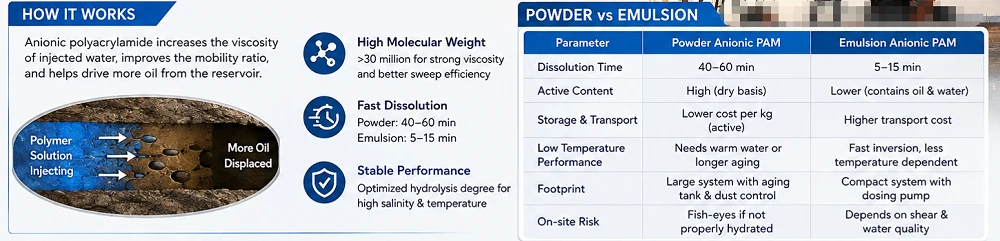
After entering the aqueous phase, anionic polyacrylamide forms a macromolecular chain structure with viscoelastic properties, increasing flow resistance in the aqueous phase. This improves the mobility ratio between injected water and crude oil, stabilizes the displacement front, and expands the reservoir sweep area.
For EOR projects, the key control mechanism is not "the more polymer, the better," but rather achieving the target viscosity and appropriate injection resistance based on specific reservoir conditions.
It is explicitly noted that if the polymer solution is too dilute, water fingering may persist; conversely, excessive viscosity leads to increased injection pressure and may cause near-wellbore shear degradation.
Therefore, an EOR polymer flooding scheme must strike a balance among viscosity, injection pressure, and reservoir adaptability.
2. Why Does Molecular Weight Affect EOR Performance?
Polymers for EOR typically require high molecular weight to achieve the target solution viscosity at lower operational concentrations.
The catalog-grade anionic polyacrylamide provided by ECOLINK TECHNOLOGY features a molecular weight exceeding 30 million, with product design emphasizing rapid dissolution and adaptability to continuous injection.
From a mechanism perspective, molecular weight influences the spatial conformation of polymer chains in water as well as solution viscosity. Longer polymer chains more readily create higher flow resistance under suitable water quality conditions.
However, in actual reservoir environments, product suitability cannot be judged solely by "high molecular weight."
If the reservoir exhibits high salinity, especially with high concentrations of divalent ions such as calcium and magnesium, the extended conformation of polymer chains may alter. Consequently, when high-molecular-weight polyacrylamide is used for EOR, it must be evaluated in conjunction with produced water analysis, temperature, and target viscosity.
3. Why Is Degree of Hydrolysis an Easily Overlooked Parameter in EOR Procurement?
When selecting oilfield displacement polymers, the degree of hydrolysis is often more critical than many procurement personnel anticipate.
The degree of hydrolysis dictates the anionic charge density along the polymer chain, which in turn governs the extension state of polymer chains in brine, viscosity at specific concentrations, and sensitivity to calcium and magnesium ions.
This implies that even if two products are labeled as the same type of anionic polyacrylamide, distinct actual injection performance may occur if their degrees of hydrolysis fall at different positions within the specification range.
For water sources with low-to-medium salinity, a higher degree of hydrolysis can yield higher unit viscosity under certain conditions; however, for high-salinity produced water, excessive anionic charge can be negatively impacted by divalent cations.
Therefore, polymer selection for high-salinity reservoirs should not rely simply on product names, but must integrate:
Produced water salinity;
Water hardness;
Calcium and magnesium ion concentration;
Reservoir temperature;
Target solution viscosity;
Injection rate;
Maximum allowable surface pressure.
In other words, chemical specifications for polymer flooding should be built upon actual water quality and reservoir parameters, rather than product grade labels on packaging.
Part 2: Powder vs. Emulsion: Which Is Better Suited for EOR Field Applications?
4. Field Characteristics of Powdered Anionic Polyacrylamide
Powder products are dry solid polymers. Field usage generally requires processes such as wetting, dispersion, dissolution, and aging.
According to product data, powdered products usually require 40 to 60 minutes or longer for full preparation after proper aging; insufficient field mixing energy may cause "fish eyes" (un-dissolved gel lumps), thereby impairing effective concentration and downstream pipeline operations.
Thus, powder products are better suited for the following types of field sites:
First, long-term operational oilfields. If a project has entered long-term field development with extended polymer injection duration, the transportation cost advantages of powder products gradually become evident.
Second, projects with well-developed surface infrastructure. If the site is equipped with polymer dissolution units, aging tanks, metering systems, and dust control facilities, powder products can operate stably.
Third, projects with stable water sources, power supply, and operational staff. Mature field management reduces operational errors during powder wetting and dissolution processes.
5. Why Are Emulsion Anionic Polyacrylamides Suited for Rapid Deployment?
Emulsion products utilize a feeding method distinct from dry powders. The emulsion anionic polyacrylamide described in the text is a water-in-oil emulsion, with product data indicating a dissolution time of approximately 5 to 15 minutes.
Compared with powder products, its prominent advantages include:
Faster field startup. For temporary injection skids, small-scale EOR trials, or mobile skid-mounted units, there is no need to wait extended periods for large aging systems to prepare, thus shortening project startup timelines.
Better fit for compact footprints. Where field space is constrained, large dry powder preparation systems and aging tanks become design bottlenecks. Emulsion schemes can be integrated with compact dosing pumps and static mixers.
Reduced manual labor requirements. Powders require stringent wetting and dispersion procedures, whereas emulsions focus primarily on inversion quality, water quality, and shear conditions.
Consequently, emulsion-type polyacrylamide EOR solutions are especially applicable to remote oilfields, pilot projects, mobile equipment, and application environments requiring rapid commissioning.
6. Key Differences Between Powder and Emulsion
| Comparison Factor | Powdered Anionic Polyacrylamide | Emulsion Anionic Polyacrylamide |
| Dissolution Time | Typically 40 to 60 minutes after proper aging | 5 to 15 minutes based on product data |
| Active Ingredient | High dry solid content | Lower percentage of active polymer per product weight due to oil and water content |
| Storage & Transport | Dry bags or bulk bags; lower freight cost per kg of active ingredient | Liquid or IBC totes; relatively higher freight cost |
| Low-Temperature Conditions | May require warm water or extended aging time | Faster inversion rate with relatively less dependency on temperature |
| Footprint Area | Usually requires dissolution, aging, and dust control equipment | Can utilize compact dosing pumps and static mixers |
| Field Operational Risks | Inadequate wetting may form "fish eyes" | Inversion efficiency depends on shear conditions and water quality |
The above parameters and comparative details are sourced from the original document.
It should be emphasized that this does not imply emulsion is inherently "better performing" than powder, nor that powder is universally suitable for all large oilfields. The true core of EOR polymer supply remains matching product chemical properties with field process requirements.
Part 3: From Transport Costs to Vendor Audits: How to Determine the Final Solution?
7. Do Not Compare Only the Per-Ton Price of Polymers
When procuring oilfield EOR chemicals, comparing only the "price per ton" easily leads to overlooking actual project costs.
Powder polymers are transported essentially in dry polymer form; hence, the transport cost per kilogram of active ingredient is generally lower.
Emulsion products contain continuous oil and water phases, meaning that for the same quantity of active polymer, additional non-polymer components must be transported, resulting in higher overall logistics expenses.
However, emulsions reduce certain surface infrastructure investments.
For example:
Powder schemes may require preparation equipment;
Aging tanks are needed;
Dust control is required;
Trained field operators are required;
Warm water or heating equipment may be required in cold conditions.
Emulsions, on the other hand, reduce upfront equipment and startup costs through rapid inversion.
Therefore, procurement evaluations should not be concluded simply with "powder is cheap, emulsion is expensive."
For short-term trial projects, minimizing field equipment and staffing investments may be more vital than lowering freight costs; for long-term, large-scale field developments, lower transport costs for active ingredients yield far greater economic benefits. The original document advises evaluating economic performance by separating the initial 90 days from the subsequent 5 years.
8. Why Are Remote Oilfields Better Suited for Considering Emulsions?
When EOR projects are located in remote areas, logistics, space, power supply, and field personnel often present major constraints.
In such scenarios, polymer flooding for remote fields places greater weight on equipment footprint and startup speed rather than unit product price alone.
For mobile water treatment or injection skids, emulsions leverage fast inversion characteristics to establish stable polymer injection within a short timeframe.
In cold environments, the wetting and aging rates of dry powders can slow down further. The text points out that when makeup water approaches freezing point, powders may require water heaters or heated tanks; while emulsions also demand freeze-protection measures, their rapid inversion trait provides greater operational flexibility on site.
Therefore, for EOR polymer injection projects in cold regions, emulsions merit evaluation as a field deployment option.
9. Why Might "Emulsion First, Powder Later" Be a More Logical Project Pathway?
For certain EOR projects, powder and emulsion do not have to be a binary choice.
A more flexible project model is: Emulsion during the pilot phase → Validate reservoir response → Switch to powder upon commercial expansion.
One of the primary objectives of the pilot phase is to rapidly acquire data regarding injection pressure, solution viscosity, and reservoir response.
Emulsions offer fast startup and compact equipment footprints, making them ideal for small-scale pilot trials.
Once the project is proven and moves into long-term commercial development, as polymer consumption grows, the lower active-ingredient transport cost of powder products delivers superior long-term economics.
However, this transition hinges on one critical prerequisite: The supplier must maintain consistency in core chemical parameters between different physical product forms.
Particular attention must be paid to consistency in degree of hydrolysis and molecular weight. If polymer properties alter significantly after switching from emulsion to powder, variations in injection viscosity, pressure, and field operational parameters will follow.
ECOLINK TECHNOLOGY possesses supply capabilities for both powder and emulsion products, offering structured supply strategies tailored to pilot and full-scale commercial stages. The original document underscores that supplying from a unified platform helps safeguard consistency in degree of hydrolysis and molecular weight across product forms.
10. What Should Be Priority Checked When Selecting an EOR Supplier?
For EOR polymer suppliers, providing a Certificate of Analysis (COA) alone does not signify the completion of product vetting.
The feedback loop for EOR projects is inherently long. Changes in injection pressure, produced water cut, and oil recovery response can take weeks to materialize, meaning significant quantities of polymer have already been consumed once introduced into the field.
Consequently, prior to formal procurement, it is recommended to verify at least the following five categories of information:
① Produced Water Salinity and Hardness
Salinity as well as divalent ions like calcium and magnesium impact polymer chain extension and viscosity performance.
② Target Viscosity at Reservoir Temperature
Do not evaluate ambient temperature viscosity alone. The essential concern is whether the polymer can achieve project targets under actual reservoir conditions.
③ Injection Rate and Maximum Allowable Surface Pressure
Excessive viscosity does not guarantee superior displacement efficiency. Overly high injection pressure risks inducing shear degradation in the near-wellbore zone.
④ Available Makeup Water Temperature
Particularly for powder products, water temperature influences wetting, dissolution, and aging processes.
⑤ Project Phase
Clarify whether the current stage is a pilot trial or full-field commercial development.
This information assists suppliers in recommending whether to employ powder, emulsion, or a phased combination approach.
11. Powder or Emulsion? How to Make the Final Selection
Integrating field operations and long-term economic logic, the following decision pathway can be applied:
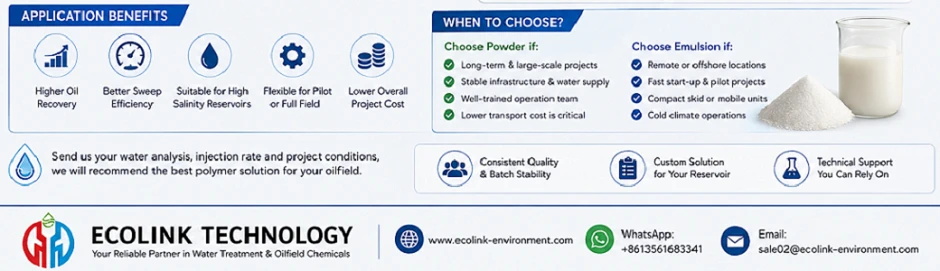
Long-term, stable, large-scale EOR projects:
If the field possesses reliable power, water, operations teams, and complete polymer dissolution facilities, powder products are typically better suited as the long-term solution.
Remote oilfields or mobile projects:
If plot space is limited, infrastructure is sparse, or rapid deployment is paramount, emulsion products deserve primary consideration.
Cold climate regions:
Focus evaluations on water temperature, dissolution time, and field anti-freeze conditions; emulsion can be tested as a rapid deployment solution.
Pilot projects:
Emulsions can be prioritized to quickly validate reservoir response, with potential conversion to powder evaluated based on logistics and cost factors once moving to commercial expansion.
Thus, a truly professional anionic polymer flooding strategy does not begin with "what products we have," but starts with "what product the reservoir requires."
12. How ECOLINK TECHNOLOGY Supports EOR Polymer Projects
ECOLINK TECHNOLOGY focuses not merely on polymer products, but on matching product specifications with field process conditions.
For EOR projects, technical evaluations prior to product determination can be structured around the following sequence: Produced Water Analysis → Salinity & Hardness → Reservoir Temperature → Target Viscosity → Injection Rate → Max Surface Pressure → Field Water Temperature → Project Lifecycle → Powder/Emulsion Selection.
For long-term development projects, active ingredient transportation economics of powder products can be prioritized; for pilot, mobile, or remote projects, rapid dissolution and rapid deployment advantages of emulsions take priority.
Crucially, when product physical forms change, consistency in core polymer parameters should be preserved to minimize operational risks during transition from pilot trials to full-scale production.
If your project involves high-salinity produced water, compact injection skids, or plans to expand from small trials to full field production, you can share water quality analyses, injection rates, and project timelines with ECOLINK TECHNOLOGY to evaluate powder, emulsion, or phased combination options.
13. FAQ: Key Questions Frequently Asked by EOR Procurement Personnel
Are powdered and emulsion polyacrylamides directly interchangeable?
They cannot be assumed to be fully interchangeable.
Although both product lines can utilize anionic polymer chemistry, their field preparation, dissolution, storage, transport, and injection operations differ.
The final selection must be evaluated based on site infrastructure, field personnel, water quality, and project lifecycle.
Are emulsion products inherently more resistant to high salinity?
Not necessarily.
Polymer performance in high-salinity water depends fundamentally on the degree of hydrolysis, molecular weight, and concentration of calcium/magnesium ions in brine, rather than whether the physical form is powder or emulsion.
Therefore, polymer selection for high-salinity reservoirs should be founded on water analysis and experimental testing rather than physical form.
Do emulsions always dissolve faster than powders?
Based on product data in the text, emulsion dissolution takes 5 to 15 minutes, whereas powder typically requires 40 to 60 minutes or longer after proper aging.
However, field equipment, mixing conditions, and water temperature all impact actual performance. If an oilfield already features complete powder hydration systems, suitable warm water, and experienced operators, the deployment gap between the two options narrows.
Can an EOR project start with emulsion and later switch to powder?
Yes, a phased approach can be considered.
The pilot stage can utilize emulsion to rapidly establish injection conditions and collect early data; once reservoir response is confirmed and full development begins, powder options can be evaluated based on logistics, equipment, and chemical consumption.
The key requirement is that the supplier must ensure excellent consistency in core chemical parameters between the two product forms.
Conclusion: The Core of EOR Polymer Selection Is Not "Powder vs. Emulsion", But "Field Conditions vs. Product Specifications"
For enhanced oil recovery projects, powder and emulsion are simply different product forms.
Powdered anionic polyacrylamide is better suited for projects with mature infrastructure, stable logistics, and long-term operations; emulsion offers clear operational advantages in rapid deployment, space-constrained, remote, and pilot project settings.
What truly dictates project success are molecular weight, degree of hydrolysis, water quality compatibility, target viscosity, injection pressure, and batch-to-batch stability.
Therefore, prior to procurement, rather than simply asking "how much per ton for powder" or "how much per ton for emulsion," it is far more valuable to provide comprehensive reservoir and water quality data.
ECOLINK TECHNOLOGY can assist in evaluating product forms and specifications based on project conditions, discussing optimal EOR polymer supply strategies tailored to either pilot trials or commercial developments.