How Slurry Properties, Molecular Weight, and Preparation Conditions Affect Flocculation Performance
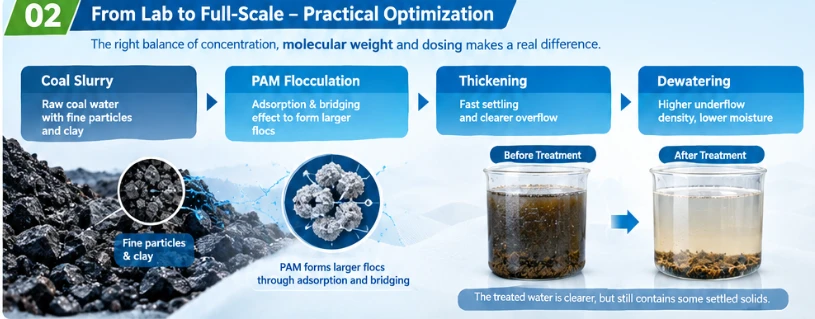
In coal preparation processes, slime water treatment is directly related to clean coal recovery, circulating water utilization, and tailings thickening efficiency. For most coal preparation plants, anionic polyacrylamide (Anionic Polyacrylamide, referred to as PAM) is one of the commonly used high-molecular-weight flocculants. It can promote the rapid formation of larger flocs by fine particles through adsorption and bridging, thereby improving slime sedimentation, thickening, and solid-liquid separation.
However, in actual production, a common problem is: while laboratory beaker tests show good results, after scaling up to the thickener, the overflow turbidity, underflow density, or chemical consumption changes.
The reason is usually not simply a matter of "whether the chemical is good or not," but rather that slurry properties, polymer molecular weight, degree of hydrolysis, dosage, mixing shear, and dissolution conditions jointly determine the final performance.
Therefore, when selecting a flocculant for coal preparation, rather than blindly pursuing a higher molecular weight, it is better to start from actual slurry conditions and equipment operating methods to establish product parameters suitable for your own process.
I. Slurry Characteristics Are the Basis for Selecting Anionic PAM
Coal slurry is not a material of fixed composition.
Coal slurries produced from different mining areas, different coal seams, or even different production times may differ in fine particle proportion, clay content, mineral composition, and circulating water ion concentration.
The surfaces of pulverized coal and some clay minerals usually carry a negative charge, while anionic polyacrylamide contains functional groups capable of interacting with the particle surfaces. After the polymer is adsorbed onto the particle surface, it can use its long molecular chains to connect multiple micro-particles, forming larger flocs.
This process is commonly known as adsorption and bridging.
For the coal preparation process, ideal flocs need to simultaneously possess:
Good settling velocity;
Sufficient floc strength;
Good shear resistance;
Good compression and dewatering performance;
No excessive residual polymer generation.
This is also why the selection of PAM molecular weight for coal preparation cannot be discussed in isolation from specific slurry conditions.
1. Clay Content Alters Actual Chemical Demand
In low-rank coal or coal slurries with high fine slime content, clay minerals may be present in large quantities.
When the proportion of fine particles increases, the polymer not only needs to act with the target slime particles, but may also be largely consumed by clay particles.
The reference materials indicate that when the clay content in particles with a particle size of less than 45 microns exceeds 15%, products with a hydrolysis degree of 25% may find it difficult to obtain ideal floc strength. One of the reasons is that clay particles compete with pulverized coal for the adsorption sites of the polymer.
Therefore, in practical applications, if the properties of raw coal change significantly, simply increasing the flocculant dosage may not necessarily solve the problem.
A more reasonable approach is to re-evaluate:
Slurry particle size → Clay content → Water quality → Molecular weight → Degree of hydrolysis → Dosage.
This set of thinking is more important for determining the actual specifications of anionic polyacrylamide used in coal preparation.
II. Why Circulating Water Quality Affects PAM Performance
Many coal preparation plants adopt a circulating water system.
With the increase of recycling times, dissolved solids as well as calcium, magnesium, and other ions in the water may gradually accumulate.
These ions will change the charge state and chain conformation of the polymer in water, causing the degree of extension of the polymer chain to change, thereby affecting the bridging ability between particles.
Therefore, the fact that the same anionic PAM performs well under fresh water conditions does not mean that it can maintain exactly the same effect under high circulating water proportion conditions.
This is also one of the reasons why the site often experiences "good results at first, but increased chemical consumption after operating for a period of time."
When encountering this situation, you should first check:
Whether the circulating water quality has changed;
Whether the feed concentration has increased;
Whether the proportion of fine slime has increased;
Whether the polymer is fully dissolved;
Whether the prepared solution has degraded;
Whether the shear conditions at the actual dosing point have changed.
Rather than continuously increasing the chemical dosage directly.
III. How to Select the Molecular Weight of Anionic Polyacrylamide
Molecular weight is a very important indicator when selecting PAM, but a higher molecular weight does not necessarily mean better performance.
From a mechanistic perspective, a higher molecular weight means longer polymer chains, which can cover more particles and form larger flocs.
However, an excessively high molecular weight may also bring some practical problems:
Increased dissolution time;
Higher requirements for the preparation system;
More sensitivity to mixing shear;
If dissolution is insufficient, the advantage of high molecular weight cannot be brought into play;
Under certain thickener conditions, large flocs may be subjected to strong shear.
Therefore, the dosage and molecular weight of coal preparation flocculants need to be determined in conjunction with thickening equipment.
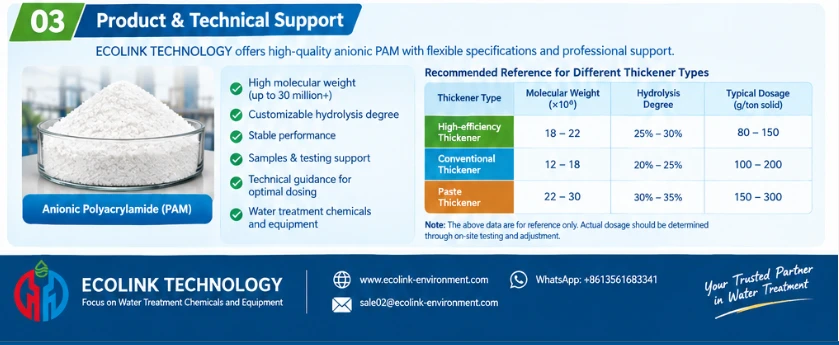
The reference ranges for different thickener configurations given in the attachment materials are as follows, and actual factory applications still need to be verified through tests.
| Thickener Type | Recommended Molecular Weight Range | Degree of Hydrolysis | Typical Dosage |
| High-Rate Thickener | 18 million to 22 million | 25-30% | 80-150 g/tonne solids |
| Conventional Thickener | 12 million to 18 million | 20-25% | 100-200 g/tonne solids |
| Paste Thickener | 22 million to 30 million | 30-35% | 150-300 g/tonne solids |
It needs to be specially explained that these parameters belong to the initial reference range of factory tests, rather than a fixed standard that all coal mines must follow.
For example, under some operating conditions, a 15-million molecular weight product may outperform a 22-million product, possibly because the former can achieve more thorough hydration within a limited preparation and mixing time.
Therefore, when selecting the molecular weight of coal preparation PAM, sedimentation velocity, floc strength, dissolution performance, and equipment shear conditions should be investigated simultaneously.

IV. Different Thickening Equipment Require Different Floc Characteristics
1. High-Rate Thickener
High-rate thickening equipment with a deeper feed zone and a steeper cone angle has higher requirements for floc settling velocity and structural stability.
Under appropriate molecular weight and dosing conditions, larger flocs can be formed, enabling fine coal slime to quickly enter the underflow.
For this type of equipment, field screening can start from a molecular weight range of 18 million to 22 million, and be tested in combination with a hydrolysis degree of 25-30% and a typical dosage range of 80-150 g/tonne solids.
2. Conventional Thickener
The mixing and rake operation modes of conventional equipment may subject flocs to certain mechanical shear.
Therefore, simply increasing the molecular weight does not necessarily lead to better results.
A molecular weight of 12 million to 18 million, a hydrolysis degree of 20-25%, and 100-200 g/tonne solids can serve as test starting points.
3. Paste Thickener
The goal of paste thickening is different from simply pursuing rapid sedimentation, placing more emphasis on final underflow concentration and moisture release.
The reference range given in the attachment for paste thickeners is 22 million to 30 million molecular weight, 30-35% hydrolysis degree, and a typical dosage of 150-300 g/tonne solids.
A higher molecular weight can form a more complete floc structure, but attention must also be paid to the fact that excessive dosage may increase floc water retention.
Therefore, the ultimate goal is not the "largest floc," but a stable floc that is settable, compressible, and dewaterable.
V. Coal Preparation Flocculant Dosage: Why Is More Dosing Not Always Better?
During on-site commissioning, many operators form an intuition:
Turbidity rises → Increase PAM dosage.
This method is sometimes effective, but not suitable for all situations.
There is a reasonable working window for flocculants.
Below this range, sufficient bridging structures cannot be formed between particles; after reaching a reasonable range, sedimentation and clarification effects gradually stabilize; continuing to increase the dosage may lead to over-flocculation.
Excessive polymer may form a viscous structure on the periphery of the flocs, making it difficult for moisture to be discharged from the interior of the flocs, ultimately impairing the underflow concentration instead.
Therefore, when optimizing the dosage of coal preparation flocculants, it is recommended to simultaneously record:
Overflow turbidity;
Underflow concentration;
Sedimentation interface velocity;
Floc size;
Floc shear resistance;
Chemical consumption per tonne of solids.
You cannot observe only a single indicator.
VI. From Beaker Tests to Industrial Thickeners: Why Results May Differ
Laboratory beaker tests can help determine products and approximate dosing ranges, but they cannot completely replicate operating conditions in industrial equipment.
Actual thickeners have:
Feed residence time;
Feed well mixing;
Local shear;
Floc transportation;
Thickening bed compression;
Circulating water changes;
Continuous feed fluctuations.
Therefore, the same product that performs well in a beaker may show different results upon entering the field.
A more reasonable testing method is to establish the relationship curve of "Dosage - Overflow Clarity - Underflow Density."
It is particularly important to note that if the overflow has already reached an acceptable level, continuing to increase chemicals does not necessarily continue to increase the underflow density.
VII. Feed Dilution Is Sometimes More Effective Than Increasing PAM
This is an easily overlooked optimization direction in the coal preparation process.
Test data in the attachment materials show that prior to polymer injection, if the feed solid concentration is reduced from 8% to 4%, under the condition that the absolute dosage of flocculant remains unchanged, the sedimentation velocity can be increased by 40-60%.
The core reason is:
Lower feed concentration can improve the dispersion of polymer between particles, giving the polymer more opportunities to fully contact fine particles.
Therefore, when the thickener itself has sufficient processing capacity, rather than directly increasing PAM usage, it is better to first evaluate feed concentration and dilution conditions.
This is also one of the important ideas for reducing the unit consumption of anionic polyacrylamide in coal preparation.
VIII. PAM Dissolution System: Why High-Molecular-Weight Products Require More Attention to Preparation
Many plants focus their attention on the PAM product itself, while ignoring the preparation of the polymer.
In fact, if PAM is not fully dissolved, it cannot exert its designed molecular weight and charge characteristics.
Insufficient dissolution may produce:
Unstable metering pump flow rate;
Dosing concentration fluctuations;
Pipeline blockage;
Unstable flocculation performance;
A decrease in the actual effective chemical dosage.
Therefore, the application of anionic polyacrylamide is not only about "what product to buy," but also about "how to properly prepare the product."
1. Recommended Attention to Make-up Water Temperature
Attachment data shows that when the water temperature is 20-30°C, most anionic PAMs can obtain a better dissolution rate.
When the water temperature is lower than 15°C, the dissolution rate may decrease significantly, and in some cases, complete hydration may take 90 minutes or longer.
Therefore, coal preparation plants operating in cold environments should pay special attention to:
Make-up water temperature + Maturation time + Mixing intensity.
2. Avoiding the "Fish Eye" Phenomenon
After PAM dry powder enters water, if it contacts water in large quantities at once, a hydration layer is easily formed rapidly on the particle surface, while the interior remains dry.
Such insufficiently dissolved agglomerates are commonly known as "fish eyes."
Once large gel clumps are formed, it may take a long time to fully hydrate, and they may enter subsequent pipelines.
Therefore, the PAM dosing system should try to achieve uniform dispersion, allowing dry powder particles to fully contact water in the initial stage of entering the water body.
3. Avoiding Excessive Shear During the Hydration Stage
PAM belongs to long-chain high-molecular materials.
During the hydration stage, if excessively strong mechanical shear is adopted, it may cause polymer chain breakage, leading to a decrease in effective molecular weight.
Therefore, PAM dissolution is not "the faster the stirring, the better."
A more reasonable approach is:
Rapid and uniform wetting → Gentle mixing → Full maturation → Stable dosing.
This is particularly important for high-molecular-weight coal preparation PAM products.
IX. On-Site Fault Diagnosis: Deducing Causes from Phenomena
When the flocculation performance of the coal preparation system declines, judgments can be made from the following three directions.
Situation 1: Dosing Amount Unchanged, but Overflow Turbidity Rises
First check the coal slurry and water quality, rather than immediately increasing PAM.
Possible causes include:
Increased clay content;
Increased proportion of fine particles;
Changes in raw coal properties;
Increased dissolved solids in circulating water;
Changes in water hardness.
The attachment materials also point out that under the condition of a stable dosing amount, changes in overflow turbidity often need to be investigated from changes in feed properties first.
Situation 2: Overflow Is Clear, but Underflow Density Drops
This may mean that the flocculant is being over-dosed.
Although flocs can capture fine particles, they retain too much moisture inside.
At this time, you can try:
Gradually reducing the dosage;
Re-finding the optimal dosing window;
Testing products with appropriately reduced molecular weight.
In some operating conditions, reducing chemicals may actually improve the final underflow density.
Situation 3: To Maintain Original Performance, Chemical Consumption Keeps Increasing
This situation requires checking the PAM preparation system.
Focus on:
Whether it is completely dissolved;
Whether excessive shear has occurred;
Whether the maturation time is reasonable;
Whether the prepared solution has been stored for too long;
Whether the viscosity of the solution at the injection point has dropped significantly.
The attachment materials suggest that comparing the viscosity of the solution at the injection point with that of a freshly prepared solution can help judge whether there is a degradation problem in the polymer preparation system.
X. Why Seasonal Changes Affect PAM
In actual coal preparation production, different flocculation effects may appear in winter and summer.
Winter mainly requires attention to the impact of low-temperature water on PAM dissolution and hydration speed.
If the make-up water temperature is too low, the polymer may not be fully hydrated before entering the dosing point.
In summer, attention needs to be paid to the biological activity of circulating water and the storage time of the prepared solution.
Therefore, for plants with obvious seasonal changes, it is recommended to continuously record:
Water temperature;
Slurry concentration;
Circulating water quality;
PAM solution age;
Actual dosage;
Overflow turbidity;
Underflow concentration.
When these data form continuous records, it is possible to more accurately judge whether it is slime changes, equipment changes, or PAM preparation condition changes.
XI. Can Thickening and Filtration Use the Same PAM?
This is a question of concern to many coal preparation engineers.
Theoretically, the same product may meet both thickening and filtration requirements, but the goals of the two processes are not completely identical.
Thickening pays more attention to:
Sedimentation velocity;
Floc size;
Overflow clarity;
Underflow density.
While filtration pays more attention to:
Filter cake formation;
Moisture release;
Filter cake detachment;
Final moisture content.
Therefore, if the plant performs both thickening and filtration simultaneously, it is recommended to evaluate the performance of both links separately.
For systems with higher filtration requirements, lower-molecular-weight products may sometimes be more suitable for filter media conditioning.
This means that PAM product selection should revolve around the ultimate process goals, rather than blindly pursuing the highest molecular weight.
XII. How ECOLINK TECHNOLOGY Helps Select Coal Preparation PAM
For the coal preparation industry, a truly valuable flocculant supply is not just providing a bag of product.
ECOLINK TECHNOLOGY, under Shandong Ecolink Technology Co., Ltd., focuses on the one-stop supply of water treatment chemicals and equipment, and can provide product matching, technical support, sample testing, and related technical data around specific applications.
Our anionic PAM products have a molecular weight of over 30 million, and the degree of hydrolysis can be customized according to specific applications. The attachment materials also suggest that for plants with different coal seams and different slurry properties, product screening should be combined with molecular weight, degree of hydrolysis, and thickener configuration, rather than simply adopting a single specification.
For coal preparation plants that need product screening, the following basic information can be provided:
Slurry concentration;
Particle size distribution;
Clay content;
Circulating water quality;
Thickener type;
Current PAM molecular weight;
Current degree of hydrolysis;
Current dosage;
Overflow turbidity;
Underflow concentration.
Based on this information, suitable anionic polyacrylamide specifications and on-site testing plans can be further discussed.
If product evaluation is needed, please contact:
Email: sale02@ecolink-environment.com
XIII. Core Principles of Coal Preparation PAM Selection
For the coal preparation industry, choosing the right PAM does not have a fixed answer applicable to all plants.
A truly effective selection usually needs to consider simultaneously:
Slurry properties
Pulverized coal, clay, fine particle proportion, and water quality determine the actual demand of the polymer.
Molecular weight
A higher molecular weight is conducive to forming a larger bridging structure, but it must be ensured that it can be fully dissolved and withstand actual shear.
Degree of hydrolysis
The degree of hydrolysis affects the charge characteristics of the polymer and the interaction with particles.
Dosage
It cannot be simply understood as "the more, the better"; a balance between sedimentation, clarification, and dewatering should be sought.
Preparation conditions
Water temperature, wetting, mixing, and maturation time directly affect the final effective performance.
Equipment conditions
High-rate thickeners, conventional thickeners, and paste thickeners have different requirements for floc performance.
Therefore, the final selection of anionic polyacrylamide for coal preparation should be established on the comprehensive judgment of "Slurry + Water Quality + Equipment + Preparation System + Operating Objectives."
Conclusion
Coal preparation flocculation is not a simple chemical dosing problem, but a comprehensive process involving particle surface chemistry, polymer adsorption bridging, solid-liquid separation, thickening equipment, and on-site operation control.
When moving from laboratory beaker tests to industrial applications, what really needs attention is not the absolute value of a certain parameter, but whether the product parameters match the on-site conditions.
For coal preparation plants that need to optimize PAM consumption, improve overflow clarity, or improve underflow concentration, items can be checked one by one from several links: slurry properties, molecular weight, degree of hydrolysis, feed concentration, and PAM dissolution system.
ECOLINK TECHNOLOGY can provide polyacrylamide product matching, sample testing, and water treatment technical support around different slurry conditions and thickening equipment, helping customers shift from simply "purchasing flocculants" to more systematic solid-liquid separation optimization.