Cationic Polyacrylamide Can Improve Sludge Dewatering Efficiency
Systematically optimizing the sludge dewatering performance of PAM, from sludge characteristics and charge density to dosage and preparation
In municipal wastewater treatment, industrial wastewater treatment, and mixed wastewater treatment, sludge dewatering performance depends not only on the dewatering equipment itself, but also closely on the selection of Cationic Polyacrylamide (CPAM), sludge properties, charge density, molecular weight, preparation method, and dosing conditions.
In actual operation, even when using the same brand or the same type of polymer, different sludge systems may still exhibit significant differences in filter cake solids content, filtrate/centrate clarity, and polymer consumption. Attached data shows that under certain operating conditions, filter cake dryness may differ by 16% and 22%, whereas optimizing product matching through beaker tests provides an opportunity to reduce polymer usage by 10% to 15%.
Therefore, sludge dewatering is not simply a matter of "increasing the PAM dosage," but rather a process of systematic optimization centered around charge neutralization, floc formation, mechanical dewatering, and operational condition matching.
I. Why Can Cationic Polyacrylamide Improve Sludge Dewatering?
Sludge particles typically carry a certain net negative surface charge, which causes fine particles to easily maintain a dispersed state, making them difficult to settle naturally or dewater effectively through mechanical equipment.
During the sludge conditioning process, the cationic groups in cationic PAM can interact with the negative charges on the surface of the sludge particles, thereby reducing the electrostatic repulsion between particles.
This process can be simply understood as:
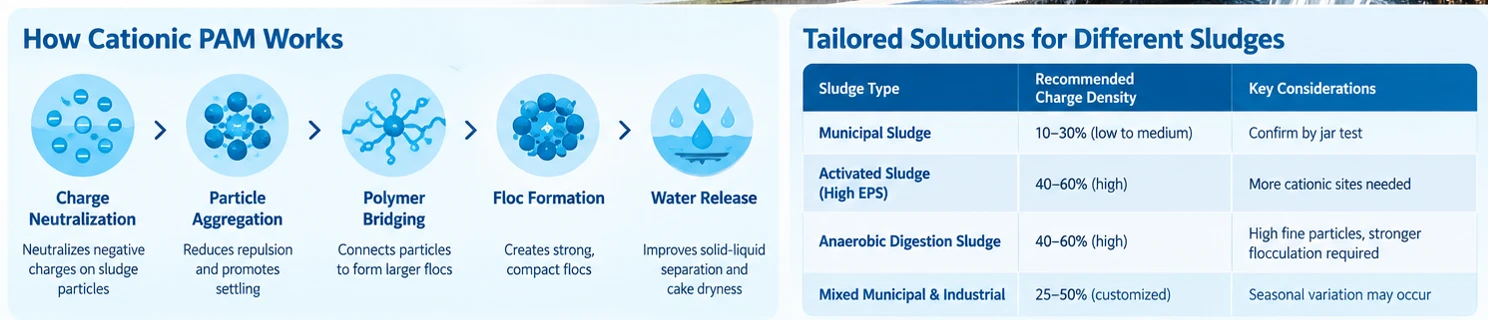
Charge Neutralization → Particle Aggregation → Polymer Bridging → Floc Formation → Water Release → Mechanical Dewatering
Cationic polymers not only reduce the electrostatic stability between sludge particles, but their polymer chains can also simultaneously connect multiple particles, causing originally fine and dispersed sludge particles to form larger flocs.
Larger flocs typically exhibit more distinct solid-liquid separation interfaces, allowing free water to be released more easily from the sludge structure, thereby improving filtration or centrifugation dewatering efficiency.
For cationic polyacrylamide sludge dewatering, what truly matters is not simply pursuing a higher degree of cationic charge, but rather finding a product that matches the sludge surface charge and organic composition.
II. Charge Density is a Key Parameter in Selecting Cationic PAM
Different sludge requires different degrees of cationicity
The charge density of cationic polyacrylamide can be understood as the proportion of cationic monomer units within the polymer chain.
According to the attached data, cationic PAM can generally be broadly classified by cationicity into:
Low Charge: 10–20%
Medium Charge: 20–40%
High Charge: 40–60% or higher
However, these ranges cannot be used directly as the sole basis for final product selection. During actual use, validation should be conducted in combination with sludge origin, solid composition, EPS content, equipment type, and operating conditions.
For example, in municipal wastewater treatment, the properties of different sludges may show distinct differences.
Primary sludge typically contains more settleable solids, possesses a relatively different organic composition, and may respond well to medium-charge polymers with a 25–35% cationicity.
In contrast, waste activated sludge contains more microbial cells and extracellular polymeric substances (EPS), and the negative charge on the particle surface may be more pronounced, thus typically requiring a cationicity higher than 40%.
For anaerobically digested sludge, due to the higher proportion of fine particles and colloidal substances, products with a higher charge density may likewise be required, though the final selection should still be determined via beaker tests.
III. PAM Selection for Different Types of Sludge Cannot Be a "One-Size-Fits-All" Approach
Different sludge origins feature different chemical compositions and particle structures.
| Sludge Type | Recommended Charge Density | Key Considerations |
| Primary Municipal Sludge | Low to Medium (10–30%) | Beaker testing recommended for confirmation |
| Waste Activated Sludge | High (40–60%) | High EPS typically requires more cationic sites |
| Anaerobically Digested Sludge | High (40–60%) | Higher fine powder content requires stronger flocculation |
| Mixed Municipal-Industrial Sludge | Customized (25–50%) | Sludge properties may exhibit seasonal variations |
For industrial sludge, selection is even more complex.
For example, proteins, fats, and organic matter in food processing wastewater may alter the interaction between the polymer and sludge particles; whereas mineral-type sludge generated by the metal processing industry may possess a completely different particle composition.
Therefore, in the process of selecting PAM for industrial sludge dewatering, merely referring to products currently used by other plants does not necessarily yield identical results.
Especially in mixed municipal-industrial wastewater, sludge properties may fluctuate with seasons, production loads, and the proportion of industrial wastewater.
The attached case study indicates that under certain operating conditions, a polymer with a 30% charge density may perform well, but when summer food processing wastewater discharge increases and the organic load changes, the dewatering performance of the original polymer may decline.
This is precisely why cationic PAM charge density matching must be verified using actual sludge samples.
IV. Why Are Beaker Tests Recommended?
Moving from "supplier recommendation" to "actual sludge validation"
There is no single fixed PAM model applicable to all plants in a sludge treatment system.
Even if two wastewater treatment plants treat the same type of sludge, differences in influent water quality, sludge concentration, sludge age, inorganic content, EPS, and dewatering equipment can lead to different optimal polymer programs.
Therefore, prior to finalizing a product, multiple products with different charge densities and molecular weights can be selected for beaker testing.
Key observations to focus on:
Floc formation speed
Floc size
Floc strength
Supernatant clarity
Filtrate or centrate quality
Filter cake solids content
PAM consumption per ton of dry sludge
The ideal product is not "the bigger the flocs, the better," but rather one that can form flocs under a reasonable dosage that are structurally stable, have good drainage properties, and can withstand subsequent mechanical shear.
Attached data shows that by optimizing charge density and actual operating conditions through beaker tests, some plants can achieve a 10% to 15% reduction in polymer usage.
V. How to Choose Between Powder and Emulsion Cationic PAM?
In addition to charge density, product form also affects the daily operation of the sludge dewatering system.
1. Powder Cationic Polyacrylamide
Powder products feature compact storage and convenient transportation. Under dry, cool storage conditions, the shelf life can reach up to two years.
However, powder PAM requires the following sequence before use:
Wetting → Dispersion → Dissolution → Aging → Dosing
If the wetting and dispersion processes are poorly controlled, undissolved polymer particles may form, resulting in a decline in effective chemical utilization and potentially increasing operational issues in the dosing system.
The attached data indicates that in some plants, due to incomplete powder dissolution, undissolved particles may appear in the metering pipelines, causing the actual effective polymer concentration to drop by 20% or even more.
Therefore, a lower purchase price for powder products does not necessarily mean the overall system operating cost is lower; preparation systems, labor, and dissolution efficiency must also be taken into account.
2. Emulsion Cationic Polyacrylamide
Emulsion PAM utilizes a water-in-oil polymerization process, where the polymer is dispersed in a hydrocarbon carrier in the form of micron-sized droplets.
Compared to powder products, an obvious advantage of emulsion products is their faster preparation speed.
Under normal conditions:
Emulsion PAM: Hydration and readiness for use take only about 5–15 minutes.
Powder PAM: Typically requires 30–60 minutes.
Therefore, in systems with limited aging tank capacity, large fluctuations in sludge load, or the need for rapid adjustment of chemical concentrations, emulsion products can be more convenient.
However, emulsion products generally require attention to low-temperature antifreeze protection, and their storage stability time is relatively short, typically 6–12 months.
Consequently, choosing between powder or emulsion cationic polyacrylamide should take into account procurement costs, transportation conditions, equipment configuration, labor costs, and on-site preparation capabilities simultaneously, rather than simply comparing the price per kilogram of product.
VI. What Impact Does PAM Molecular Weight Have on Sludge Flocculation?
The molecular weight of cationic PAM used for sludge dewatering typically ranges from 6 million to 12 million.
Molecular weight relates to the length of the polymer chain, and chain length affects the polymer's ability to bridge multiple sludge particles.
Generally speaking, longer polymer chains can form larger flocs, but this does not mean that higher molecular weight is always better.
If the flocs are overly loose, they may break apart upon entering high-shear equipment such as centrifuges; if the mixing intensity is too high, it may also lead to mechanical degradation of the polymer chains.
Therefore, when selecting polymers for sludge dewatering, it is necessary to consider:
Charge Density + Molecular Weight + Sludge Properties + Mixing Conditions + Dewatering Equipment
rather than looking at a single technical parameter in isolation.
VII. Why Can PAM Dosage Not Be Fixed?
Different dewatering equipment requires different optimal dosages
The optimal dosage of cationic polyacrylamide is closely related to sludge solids concentration, particle surface area, mixing intensity, and mechanical dewatering equipment.
Belt filter presses and centrifugal dewatering machines operate under different mechanisms.
The shear action of a belt filter press is typically lower than that of a centrifuge, allowing the formed flocs to be relatively larger and looser.
In contrast, centrifuges generate stronger mechanical shear and centrifugal force during high-speed operation, placing higher demands on floc strength.
Attached data shows that for systems treating the same sludge, the polymer dosage for a centrifuge is typically 10% to 20% higher than that of a belt filter press, primarily used to enhance the floc structure so it can withstand the centrifugation process.
Therefore, one cannot simply assume that "the exact same sludge should use the exact same PAM dosage."
VIII. Proper PAM Preparation Concentration is Equally Important
Even if the chemical is correctly selected, if the preparation process is unreasonable, the ultimate sludge dewatering effect may still be adversely affected.
Typical preparation ranges provided in the attached data are:
Powder PAM: 0.25% to 0.5%
Emulsion Active Ingredient: 0.1% to 0.5%
During preparation, ensure that the polymer is fully wetted, dispersed, and hydrated, and allow sufficient aging time for the polymer chains to fully unfold.
For the preparation of PAM sludge dewatering agents, high-shear pumping must be specifically avoided.
Centrifugal pumps, high-shear pumps, or unreasonable pipeline designs can cause polymer chain breakage, thereby reducing the actual effective molecular weight.
Therefore, a more rational approach is:
Full Dissolution → Proper Aging → Low-Shear Transfer → Uniform Dosing
rather than simply increasing mechanical agitation intensity.
IX. How to Determine Whether PAM Dosing is Appropriate?
After the polymer and sludge are thoroughly contacted, floc formation should generally be observable relatively quickly.
The attached data indicates that if flocs appear only after 10–15 seconds, it may imply an insufficient dosage or that the PAM is not fully dissolved.
However, over-dosing must also be avoided.
Under-dosing may cause:
Fine particles failing to flocculate adequately
Turbid filtrate or centrate
Higher moisture content in the filter cake
Decreased solid-liquid separation performance
Over-dosing may cause:
Excessively bulky flocs
Flocs trapping more water internally
Paradoxically decreased sludge dewatering performance
Increased PAM consumption
Therefore, the optimal cationic PAM dosage should be determined through a combination of beaker tests and on-site equipment testing.

X. Why Is the Filter Cake Still Wet After Adding PAM?
This is a very common issue at sludge dewatering sites.
If the dewatered filter cake still contains excessive moisture, it cannot be directly judged as "poor PAM performance."
Inspection is required from at least the following directions:
1. Insufficient Dosage
If PAM is inadequate, fine particles cannot form stable flocs; they will enter the filter cake voids and retain more moisture.
At this point, the dosage can be gradually increased while observing the filter cake solids content and filtrate quality.
2. Excessive Dosage
Excessive PAM may form oversized, overly bulky flocs.
Although the flocs look large, they may contain a large amount of water internally, which is not easily released under mechanical pressure.
3. Incomplete PAM Dissolution
If a portion of the polymer is not fully dissolved, the actual effective chemical dosage participating in flocculation may be lower than the theoretical dosage.
At this time, the preparation system, wetting process, and aging time should be inspected.
4. Make-up Water Quality Issues
Hard water with high calcium or magnesium levels can affect the polymer hydration process.
Therefore, when abnormal dewatering results occur, inspections should simultaneously cover chemicals, sludge, make-up water, and equipment, rather than only adjusting the PAM dosage.
XI. How Long Can Prepared Cationic PAM Solutions Be Stored?
For prepared PAM solutions, storage time is also an important factor affecting operational stability.
The attached data points out that cationic PAM solutions at a concentration of 0.25%–0.5% may begin to show performance degradation within 24 hours.
After 48 hours, viscosity loss typically exceeds 10%.
Therefore, a more rational operational approach is not to prepare large quantities in advance, but rather to design the preparation and aging systems based on the actual consumption of a single shift.
For a stably running sludge dewatering system, the capacity can be determined based on:
Hourly PAM Requirement × Operating Time per Shift
to determine a reasonable preparation and aging tank capacity.
If a plant needs to store prepared polymer solutions for extended periods, its activity must be verified through actual beaker tests, and one should not simply assume that longer storage times will have no effect on performance.
XII. How ECOLINK TECHNOLOGY Helps Optimize Sludge Dewatering Solutions
For wastewater treatment plants and industrial clients, a truly valuable PAM supply goes beyond merely providing a product model.
ECOLINK TECHNOLOGY specializes in water treatment chemicals and water treatment equipment, offering comprehensive considerations ranging from product matching, technical support, and sample testing to equipment design based on the client's actual sludge characteristics and treatment processes.
In cationic polyacrylamide sludge dewatering projects, we recommend that clients provide operating information that is as complete as possible, such as:
Sludge origin
Sludge type
Sludge solids content
Current PAM type
Current charge density
Current molecular weight
Current dosage
Belt filter press or centrifuge type
PAM preparation concentration
Aging time
Current filter cake solids content
Filtrate/centrate conditions
Building upon this foundation, different product options can be further compared through samples and beaker tests.
For clients requiring further upgrades to their water treatment systems, ECOLINK TECHNOLOGY can also provide one-stop solutions encompassing both water treatment chemicals and equipment, such as wastewater treatment systems, STP/ETP, RO, UF, and EDI pure water systems.
This combined "chemicals + equipment" service helps clients extend their scope from mere chemical procurement to the optimization of the entire water treatment process.
XIII. Summary: The Core of Efficient Sludge Dewatering is "Matching," Not Simply Adding More Chemicals
Efficient sludge dewatering is typically not determined by any single parameter in isolation.
Factors that truly influence the ultimate performance include:
Sludge Properties → Charge Density → Molecular Weight → PAM Form → Preparation Concentration → Aging Time → Dosage → Mixing Conditions → Dewatering Equipment
For municipal sludge, medium-charge products at 25%–35% may be suitable for some primary sludges; for waste activated sludge with stronger negative charges, higher cationicity above 40% may be required.
Concurrently, powder products generally require 30–60 minutes of preparation time, whereas emulsion-type products can achieve rapid hydration within 5–15 minutes; powder preparation concentration is typically 0.25%–0.5%, while the active ingredient concentration for emulsions is 0.1%–0.5%.
For centrifugal dewatering systems, polymer consumption is typically 10% to 20% higher than that for belt filter presses; by optimizing products and preparation conditions, some operational projects can achieve a 10% to 15% polymer savings.
Therefore, rather than relying long-term on fixed models and fixed dosages, finding a better-matched polymer program through actual sludge testing is far more effective.
ECOLINK TECHNOLOGY can provide wastewater treatment plants and industrial clients with more comprehensive solution concepts centering around water treatment chemicals, technical support, sample testing, and water treatment equipment.