Best Practices for Combined Application of PAC and PAM: Key Methods to Enhance Water Treatment Coagulation Effects and Wastewater Treatment Efficiency
In modern water treatment processes, relying solely on a single coagulant often makes it difficult to meet increasingly stringent water quality standards. Whether in municipal drinking water treatment, industrial wastewater treatment, or wastewater treatment in industries such as mining, coal washing, and paper manufacturing, improving pollutant removal efficiency, reducing chemical consumption, and enhancing sludge treatment performance have become important subjects in water treatment engineering.
Polyaluminum Chloride (PAC) and Polyacrylamide (PAM), as two commonly used water treatment chemicals, work synergistically through different mechanisms of action to effectively improve coagulation and flocculation performance. Reasonable application of the PAC + PAM combined treatment process can form larger floc structures, increase settling speed, lower effluent turbidity, and optimize subsequent sludge dewatering processes.
ECOLINK TECHNOLOGY focuses on water treatment chemicals and environmental protection solutions, providing customers with professional products including industrial-grade PAC, drinking water-grade PAC, anionic PAM, cationic PAM, and non-ionic PAM, as well as providing PAC and PAM matched application recommendations according to different water quality conditions.
I. Why Does Combining PAC and PAM Yield Better Results?
In the water treatment process, coagulation and flocculation belong to two continuous stages.
Among them, Polyaluminum Chloride (PAC) is mainly responsible for the coagulation stage. Through charge neutralization, it destabilizes colloidal particles in water, enabling tiny pollutant particles to form initial micro-flocs.
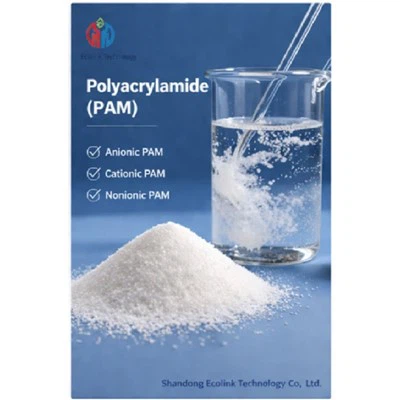
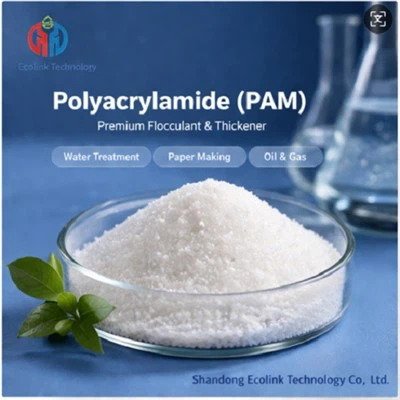
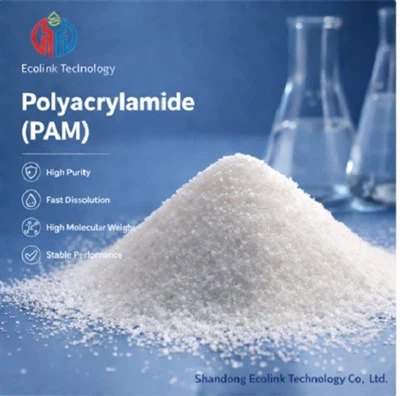
Polyacrylamide (PAM) mainly acts in the flocculation stage. Through the adsorption bridging effect of polymer chains, it further connects the micro-flocs that have already formed to create larger, denser, and more easily settleable flocs.
Simply put:
PAC is responsible for "destroying stable structures"
PAM is responsible for "connecting particles to form large flocs"
When the two are combined, a better treatment effect can be achieved than using either chemical alone.
According to practical application data, compared with using PAC alone, the floc size formed after the combined use of PAC and PAM can typically be increased by 3–10 times, while the settling speed is significantly accelerated and sludge compaction performance is also improved.
II. Mechanism of Action of PAC in the Coagulation Process
Polyaluminum Chloride (PAC) is a highly efficient inorganic polymer coagulant widely used in drinking water purification, industrial wastewater treatment, and municipal sewage treatment.
Suspended particles and colloidal substances in water usually carry negative charges. Due to electrostatic repulsion between particles, they maintain a stable dispersed state over a long period and are difficult to settle naturally.
After PAC is added to the water body, the aluminum polymers within it can rapidly neutralize the negative charges on particle surfaces, causing colloids to lose stability and gradually form tiny flocs.
This process mainly includes:
1. Charge Neutralization
The aluminum ions in PAC hydrolyze to form multinuclear hydroxy-aluminum structures, which can reduce the electrostatic repulsion between particles and cause pollutants to begin aggregating.
2. Micro-floc Formation
After rapid mixing, a large number of fine particles combine to form primary micro-flocs.
However, because these micro-flocs are small in size, their settling speed relying solely on their own weight is limited; therefore, further addition of PAM is usually required for enhanced flocculation.
III. How PAM Enhances the Flocculation Effect of PAC
Polyacrylamide (PAM) is a high-molecular-weight polymer flocculant. Depending on charge properties, it is mainly divided into:
Anionic Polyacrylamide (APAM)
Cationic Polyacrylamide (CPAM)
Non-ionic Polyacrylamide (NPAM)
Different types of PAM have different applicable scenarios.
The biggest feature of PAM is its long polymer chain structure, which can adsorb multiple micro-flocs simultaneously, linking dispersed small particles into large flocs through "bridging action".
For example, the molecular weight of PAM can usually reach 10 million to 20 million Daltons. The polymer chain can span between multiple particles to form connections and increase floc strength.
PAC forms "small and dense micro-flocs", while PAM further connects these micro-flocs into "large flocs".
The final effects include:
Increased floc size
Accelerated settling speed
Reduced effluent turbidity
Improved sludge dewatering performance
Therefore, in many industrial wastewater treatment projects, the combination of PAC coagulant and PAM flocculant has become an important solution to improve treatment efficiency.
IV. What Are the Advantages of PAC + PAM Combined Treatment Compared to Using PAC Alone?
Many water treatment systems initially use only PAC, but as environmental standards become stricter, the following problems are often discovered:
Small flocs
Slow settling speed
High sludge moisture content
Heavy pressure on subsequent filtration
Adding an appropriate amount of PAM can effectively improve these issues.
1. Formation of Larger Flocs
When PAC acts alone, the micro-flocs formed are usually limited in size. After adding PAM, polymer chains can promote particle aggregation.
Typically:
PAC used alone: Floc size approx. 0.5–2 mm
PAC + PAM combined use: Floc size approx. 2–8 mm
Floc size can be increased by about 3–5 times.
2. Improvement of Settling Efficiency
Larger flocs possess better settling performance, which can shorten sedimentation time and improve the operational efficiency of clarification tanks.
In practical applications:
Compared to PAC treatment alone, the PAC + PAM system achieves:
Settling speed increased by approx. 40%–70%
Effluent turbidity reduced by 20%–50%
This has significant value for large-scale sewage treatment systems that require continuous operation.
3. Improvement of Sludge Dewatering Results
In the sludge treatment process, PAM can enhance the binding between sludge particles, making sludge form a more stable flocculent structure.
Advantages include:
Reduced sludge volume
Increased filter pressing efficiency
Reduced transportation and disposal costs
For municipal sludge, industrial sludge, and mining tailings treatment projects, proper selection of the PAM type is critical.
V. Which Industries Are Suitable for the Combined Application of PAC and PAM?
Due to the excellent synergistic effects of PAC and PAM, they are currently widely applied across multiple industries.
1. Municipal Sewage Treatment
In secondary clarifiers, advanced treatment, and sludge dewatering sections of urban sewage treatment plants, PAC is used to remove suspended solids and colloidal pollutants, while PAM is used to reinforce flocculation and sludge treatment.
2. Industrial Wastewater Treatment
Including:
Chemical wastewater
Food processing wastewater
Textile dyeing wastewater
Pharmaceutical wastewater
Electroplating wastewater
Industrial wastewater usually contains complex pollutants, requiring selection of the appropriate PAC model and PAM type based on water quality.
3. Mining and Coal Washing Industries
Mineral pulp, tailings water, and coal washing wastewater usually contain a large amount of fine particulate matter.
By using PAC to rapidly destroy particle stability, and then using PAM to form large flocs, solid-liquid separation efficiency can be improved.
4. Drinking Water Treatment
For drinking water projects, PAC and PAM products that comply with relevant standards must be selected.
ECOLINK TECHNOLOGY can provide recommendations for drinking water-grade PAC and low-residual PAM product selection based on customer raw water conditions.

VI. Correct Dosing Sequence for Combined PAC and PAM Use: The Key Factor Determining Treatment Effect
In practical water treatment projects, when PAC and PAM are used in combination, besides product quality and model selection, the dosing sequence (PAC PAM dosing sequence) is an important factor affecting the final treatment effect.
Many engineering cases demonstrate that even if suitable PAC and PAM products are selected, an incorrect dosing sequence may result in PAM failing to function, or even increasing chemical consumption.
The correct process flow should follow:
Dosing PAC first for coagulation → Then dosing PAM for flocculation enhancement
Namely:
PAC → Rapid mixing → Micro-floc formation → PAM → Slow flocculation → Large floc settling
This is also the PAC and PAM combined water treatment process currently more commonly adopted in industrial wastewater treatment and municipal sewage treatment.
VII. Prior PAC Dosing: Completing Charge Neutralization to Form Micro-flocs
The first stage after PAC dosing belongs to the coagulation process.
In the rapid mixing zone, higher intensity stirring is required to rapidly and evenly disperse PAC so that it makes full contact with colloidal particles in the water.
Recommended operating parameters:
Rapid mixing velocity gradient (G value): 200–400 s⁻¹
Mixing time: 30–60 seconds
In this stage, PAC mainly accomplishes:
1. Neutralizing Surface Charges of Particles
Suspended particles in water usually carry negative charges. The aluminum polymers in PAC can reduce electrostatic repulsion between particles, causing pollutants to lose stability.
2. Forming Initial Micro-flocs
Under the action of PAC, fine pollutant particles begin to combine, forming micro-flocs that are smaller in size and unstable in structure.
Although these micro-flocs have formed, their settling speed remains limited due to their small volume, so subsequent PAM is required for further reinforcement.
VIII. Second Stage PAM Dosing: Enhancing Flocculation Through Bridging Action
When PAC completes the coagulation process, entry into the flocculation stage is required.
At this point, adding PAM leverages its polymer chain structure to connect multiple micro-flocs, enabling small particles to rapidly grow into large flocs.
Recommended parameters:
PAM dosing location: After rapid mixing ends, at the entrance of the flocculation tank
Slow mixing conditions:
G value: 20–40 s⁻¹
Time: 15–25 minutes
This PAC followed by PAM treatment method can maximize the synergistic effect of the two chemicals.
IX. Why Can't PAM Be Added Before PAC?
This is a problem easily overlooked by many water treatment operators.
If PAM is added first:
Particles in water remain in a stable state;
PAM polymer chains will adsorb on particle surfaces;
Because electrostatic repulsion still exists between particles;
PAM cannot effectively connect particles;
Ultimately leading to increased PAM consumption with unimpressive flocculation results.
In other words:
PAM can only exert its best bridging effect after particles lose stability.
When PAC completes charge neutralization:
Micro-flocs have already begun to form;
Distance between particles is shortened;
PAM polymer chains can connect multiple micro-flocs;
Eventually forming larger settleable flocs.
Therefore, when designing a PAC PAM wastewater treatment solution, chemical sequence must be prioritized.
X. How to Select the Right PAM Type?
Not all PAM products are suitable for all water treatment scenarios.
PAM selection mainly depends on:
Raw water pollutant properties
Particle surface charge
pH conditions
Industry application
ECOLINK TECHNOLOGY provides different types of polyacrylamide products, including:
Cationic Polyacrylamide (CPAM)
Non-ionic Polyacrylamide (NPAM)
Selecting the appropriate model according to different applications can significantly improve the PAC+PAM combined treatment performance.
1. Anionic Polyacrylamide (Anionic PAM)
Anionic PAM carries a slight negative charge and mainly enhances flocculation through adsorption bridging action.
Applicable fields:
Drinking water clarification
Industrial wastewater treatment
Mining wastewater
Coal washing wastewater
After PAC completes charge neutralization, anionic PAM can connect neutral micro-flocs, reducing electrostatic interference.
2. Cationic Polyacrylamide (Cationic PAM)
Cationic PAM carries a positive charge and possesses additional charge neutralization capability in addition to bridging action.
Main applications:
Sludge dewatering
Municipal sludge treatment
Certain industrial wastewater
Since sludge particles usually carry residual negative charges, cationic PAM can further improve sludge flocculation performance.
3. Non-ionic Polyacrylamide (Nonionic PAM)
Non-ionic PAM has a low charge level and relies mainly on molecular chain adsorption.
Applicable to:
Low pH environments
Special mineral processing
Certain industrial applications
When selecting a PAM model, judgment should not be based solely on price, but should be tested in combination with:
Molecular weight
Degree of ionization
Dissolution rate
Raw water properties
XI. Dosage Optimization Methods for PAC and PAM Combined Treatment
Correct chemical dosage is an important factor in ensuring treatment performance and reducing operational costs.
Please note:
PAM cannot replace PAC.
PAC is mainly responsible for charge neutralization, while PAM is mainly responsible for reinforcing flocculation.
Therefore, in combined use:
PAC dosage should be maintained within the optimal coagulation range;
PAM only requires a small addition to improve flocculation performance.
PAC Dosage Determination Method
The optimal PAC dosage is typically determined through Jar Tests.
During testing, the following need to be observed:
Floc formation rate
Floc size
Settling time
Supernatant turbidity
After determining the optimal PAC dosage, PAM is added for optimization.
Typical PAM Dosing Ranges
Under different application scenarios, PAM dosages are typically as follows:
| Application Field | Typical PAM Dosage |
| Municipal Drinking Water Clarification | 0.5–1.5 mg/L |
| Industrial Wastewater Clarification | 1.0–3.0 mg/L |
| Mining & Mineral Processing | 1.0–5.0 mg/L |
| Coal Washing & Thickener Feed | 2.0–8.0 mg/L |
| Sludge Dewatering Treatment | 3.0–10.0 mg/L |
The above data needs to be adjusted according to actual water quality.
XII. Preparation of PAM Solution and Precautions for Use
PAM usually needs to be prepared into a solution before use.
Recommended preparation concentration:
0.1%–0.5% (w/v)
Precautions during preparation:
1. Add PAM Powder Slowly
Avoid rapid dosing which causes clumping and produces undissolved particles.
2. Gentle Agitation
Avoid high-speed shearing which destroys PAM polymer chains.
3. Ensure Full Dissolution
Recommended:
Mixing time: 30–60 minutes
Ensure PAM is fully hydrated to improve practical usage performance.
XIII. Determining the Optimal PAC/PAM Combination Through Jar Tests
Prior to official application, laboratory jar testing is recommended.
Recommended process:
Step 1: Determine Optimal PAC Dosage
Test PAC alone first.
Determine:
Optimal dosage
Optimal mixing conditions
Optimal settling effect
Step 2: Prepare PAM Solution
Prepare according to 0.1%–0.5% concentration.
Step 3: Gradually Increase PAM Dosage
Under fixed PAC dosage conditions:
Test: 0 mg/L, 0.5 mg/L, 1.0 mg/L, 1.5 mg/L, 2.0 mg/L, 3.0 mg/L
Observe:
Floc size
Settling speed
Effluent turbidity
Step 4: Determine On-site Operational Parameters
Apply the optimal PAM dosage to the actual system.
Simultaneously monitor continuously:
Floc size
Effluent turbidity
Sludge volume
Ensure long-term stable operation.
XIV. Typical Performance Enhancements After Combined PAC and PAM Use
In actual water treatment systems, PAC mainly completes the initial aggregation of pollutants, while PAM further reinforces the flocculation process. By properly matching PAC model, PAM type, and dosage, system operating performance can be significantly improved.
It should be noted that actual treatment effects will be influenced by the following factors:
Raw water quality
Pollutant type
PAC dosage
PAM molecular weight and degree of ionization
pH conditions
Mixing and flocculation equipment parameters
Therefore, before official application, determining optimal operating conditions through jar tests is very important.
According to typical application data, compared with using PAC alone, the PAC+PAM combined process can usually achieve the following improvements:
| Parameter | Using PAC Alone | Combined PAC + PAM Treatment | Typical Improvement Effect |
| Floc Size | 0.5–2 mm | 2–8 mm | Increased by 3–5 times |
| Settling Speed | Medium | Fast | Increased by 40–70% |
| Effluent Turbidity | Baseline value | Reduced | Reduced by 20–50% |
| Sludge Volume | Baseline value | Reduced | Reduced by 10–30% |
| Filtration Run Cycle | Baseline value | Extended | Extended by 15–30% |
These advantages make PAC PAM water treatment chemicals an important choice for improving treatment efficiency in many industrial wastewater and municipal water treatment projects.

XV. Applications of PAC + PAM in Different Water Treatment Industries
Because the properties of pollutants in different industrial wastewater vary greatly, appropriate combinations of PAC and PAM need to be selected according to actual applications.
ECOLINK TECHNOLOGY provides targeted water treatment chemical solutions according to different customer needs, including:
Industrial Grade PAC
Drinking Grade PAC
Anionic PAM
Cationic PAM
Nonionic PAM
1. PAC and PAM Application in Municipal Sewage Treatment
In urban sewage treatment processes, it is usually necessary to remove:
Suspended Solids (SS)
Colloidal particles
Organic pollutants
Phosphorus elements
PAC can rapidly reduce colloidal stability in water, while PAM can promote sludge particles to form larger flocs.
In the sludge dewatering section, selecting the right cationic PAM can improve:
Sludge filtration performance
Cake solid content
Dewatering efficiency
Therefore, PAM for sludge dewatering is one of the important products for sewage treatment plants to reduce sludge treatment costs.
2. PAC PAM Combination Schemes in Industrial Wastewater Treatment
Industrial wastewater usually features high pollutant concentrations and large water quality fluctuations.
Common applications include:
Chemical wastewater
Food processing wastewater
Pharmaceutical wastewater
Textile dyeing wastewater
Paper manufacturing wastewater
Electroplating wastewater
Wastewater in these industries often contains large amounts of:
Suspended solids
Colloidal substances
Organic particles
Through the PAC coagulation and PAM flocculation process, pollutant removal efficiency can be improved and subsequent treatment pressure reduced.
3. Application in Mining and Coal Washing Industries
Mining wastewater and coal washing wastewater usually contain a large amount of fine mineral particles.
Because these particles:
Have small particle size
Possess slow settling speed
Are charge-stabilized on surfaces
Using PAC alone often makes rapid separation difficult.
Adopting:
PAC destroys particle stability ↓ PAM promotes particle aggregation ↓ Forming large settleable flocs
Can effectively improve:
Solid-liquid separation efficiency
Thickener operating performance
Tailings water reuse capability
4. Drinking Water Treatment Application
In drinking water treatment, greater attention needs to be paid to:
Chemical safety
Residual aluminum control
Product standard compliance
PAM used for drinking water treatment needs to meet relevant food-grade chemical requirements, such as complying with NSF/ANSI 60 or local equivalent standards.
ECOLINK TECHNOLOGY can provide according to customer project requirements:
Product technical data
COA (Certificate of Analysis)
SDS (Safety Data Sheet)
Sample testing support
Helping customers perform actual water quality verification.
XVI. Frequently Asked Questions (FAQ) on Combined PAC and PAM Use
Q1: Can any PAM be used together with PAC?
No.
Different PAM products vary in the following aspects:
Molecular weight
Degree of ionization
Charge density
Dissolution rate
All these factors will affect the synergistic effect between PAC and PAM.
It is recommended to use the specific PAM model planned for procurement to conduct jar tests, rather than simply assuming all PAM products have the same effect.
Q2: Can PAC dosage be reduced after adding PAM?
Possibly, but verification through testing is required.
In some applications, reasonable PAM bridging action can reduce PAC dosage by approximately 10%–20% while maintaining the same effluent quality.
However, not all systems are suitable for reducing PAC.
The reason is: PAC is responsible for charge neutralization, while PAM is responsible for flocculation enhancement. The two have different roles and cannot simply replace each other.
Q3: Is PAM safe for use in drinking water?
PAM that meets standard requirements can be used in drinking water treatment.
However, confirmation is required regarding:
Product grade
Residual acrylamide monomer content
Compliance with relevant certification requirements
In drinking water applications, complete compliance documents should be confirmed with the supplier.
Q4: Why are my PAC and PAM producing poor results?
Common reasons include:
1. Incorrect Dosing Sequence
Incorrect: PAM → PAC
Correct: PAC → PAM
2. Incorrect PAM Model Selection
For example:
Using the wrong type of PAM for sludge dewatering
Using products with unmatched ionization degrees for industrial wastewater
3. Excessive Dosage
PAM is not better in larger quantities.
Excessive PAM may cause particle re-stabilization, leading to decreased treatment performance.
Therefore, optimal dosage needs to be determined through experiment.
XVII. Why Choose ECOLINK TECHNOLOGY as Your PAC and PAM Supplier?
ECOLINK TECHNOLOGY focuses on environmental protection water treatment products and solutions, providing high-performance water treatment chemicals to global customers.
Our products cover:
Water Treatment Coagulants
Polyaluminum Chloride (PAC)
Industrial Grade PAC
Water Treatment Flocculants
Anionic PAM
Cationic PAM
Nonionic PAM
PAM Emulsion
Supporting Services
ECOLINK TECHNOLOGY not only provides product supply, but also pays attention to practical application performance for customers.
We can provide:
✔ PAC/PAM model recommendations based on raw water conditions
✔ Technical parameter matching recommendations
✔ Sample testing support
✔ Jar test guidance
✔ COA, SDS, technical documentation support
✔ Export services tailored to different country markets
Whether your project belongs to:
Municipal sewage treatment
Industrial wastewater treatment
Mining wastewater treatment
Coal washing water treatment
Sludge dewatering
ECOLINK TECHNOLOGY can help you find a more economical and efficient treatment solution.
XVIII. Conclusion: Correctly Combine PAC and PAM to Achieve More Efficient Water Treatment Results
The combined use of PAC and PAM is not simply adding two chemicals simultaneously, but a systematic treatment method that requires comprehensive consideration of:
Chemical types
Dosing sequence
Dosage proportion
Water quality conditions
Operational parameters
Correct process flow:
PAC charge neutralization → Micro-floc formation → PAM bridging flocculation → Large floc settling
Compared with using PAC alone, a reasonable PAC+PAM combined process can:
Form larger flocs
Increase settling speed
Reduce effluent turbidity
Improve sludge dewatering performance
Optimize overall operational costs
If you are looking for a PAC and PAM flocculation solution suitable for industrial wastewater, municipal sewage, mining water treatment, or sludge dewatering projects, ECOLINK TECHNOLOGY can provide professional advice based on your water quality conditions.
Welcome to contact us to obtain:
PAC/PAM product information
Technical parameters
Sample testing support
Customized water treatment solutions