How to Scientifically Select the Right PAC Product via Jar Test?
For water treatment plants, wastewater treatment plants, and various industrial wastewater treatment systems, Polyaluminium Chloride (abbreviated as PAC) is one of the most widely used inorganic polymer coagulants. Whether in drinking water purification, municipal wastewater treatment, or industries such as papermaking, printing and dyeing, mining, and food processing, the choice of PAC product directly impacts coagulation efficacy, floc formation speed, sedimentation efficiency, and ultimate operational costs.
However, when purchasing PAC products, many enterprises primarily refer to technical parameters, test reports, or other customer case studies provided by suppliers. While these materials possess certain reference value, they fail to accurately reflect the actual treatment performance of a specific PAC product under their own raw water conditions.
Evident differences exist in raw water quality across different regions, for example:
Varying fluctuations in raw water turbidity;
Differences in organic matter content;
Distinct pH ranges;
Pronounced seasonal temperature variations;
Differing alkalinity and ionic compositions.
These factors all influence the hydrolysis reaction and coagulation performance of PAC; therefore, the exact same PAC product may exhibit entirely different treatment results in different water plants.
Precisely because of this, the Jar Test has become the globally recognized standard for PAC screening within the water treatment industry, and it is also an essential experimental method for determining the Optimal PAC Dosage, optimizing coagulation processes, and evaluating the performance of new suppliers' products.
For enterprises preparing to change PAC suppliers, optimize chemical costs, or elevate effluent water quality, executing a standardized Jar Test not only mitigates procurement risks but also provides reliable data support for subsequent process optimization.
As a professional water treatment solution provider, ECOLINK TECHNOLOGY has long provided global customers with Industrial Grade PAC, Drinking Water Grade PAC, as well as comprehensive technical support services. Our engineering team can assist in formulating scientific Jar Test schemes based on customers' actual water quality conditions, and recommend more closely matched PAC models in combination with experimental results, helping customers achieve comprehensive optimization of chemical costs and operational costs while guaranteeing treatment efficacy.
Why is the Jar Test the Most Reliable Method for Selecting PAC Products?
During the PAC product selection process, the following questions are frequently encountered:
Both suppliers claim their PAC delivers the best coagulation performance; whom should we believe?
The product testing indicators are basically identical, so why is there a distinct difference in actual operational performance?
Why has the dosage increased for the newly procured PAC product, yet it failed to achieve the expected treatment efficacy?
How can we determine whether the current PAC has already reached its optimal dosage?
Is it necessary to simultaneously add PAM (Polyacrylamide) to further enhance the flocculation effect?
These questions generally cannot be accurately answered by relying solely on product datasheets or historical operational experience.
The core value of the Jar Test lies in its ability to simulate the entire coagulation, flocculation, and sedimentation process under laboratory conditions, allowing different PAC products to undergo horizontal comparison under identical experimental conditions, thereby yielding comparable experimental data.
Compared to empirical judgment, the Jar Test offers the following advantages:
1. Rapid Determination of the Optimal PAC Dosage
By setting multiple different PAC dosing concentrations, a complete PAC Dose Response Curve can be established, helping technical personnel find the optimal chemical dosage corresponding to the lowest effluent turbidity, rather than relying on empirical estimation. This not only reduces PAC waste but also helps lower operational costs and improve overall treatment efficiency.
2. Objective Comparison of Different PAC Products' Performance
When an enterprise plans to change PAC suppliers, merely comparing the product's alumina content or price is far from sufficient. Through the Jar Test, parallel testing can be conducted on different brands or models of PAC under the same raw water, same temperature, and same stirring conditions to evaluate product performance across multiple dimensions, such as:
Effluent turbidity variations;
Floc formation speed;
Floc particle size;
Sedimentation velocity;
Supernatant transparency;
Dosage adaptability range.
This testing method prevents misjudgments brought about by changes in on-site operating conditions, improving the accuracy of procurement decisions.
3. Optimization of Coagulation Process Parameters
The treatment performance of PAC is not only related to product quality but is also influenced by various factors such as mixing intensity, reaction time, raw water pH, and water temperature. Standardized execution of the Jar Test can further evaluate:
Whether PAC coagulation efficiency shifts under different pH conditions;
Whether the PAC dosage needs to be increased under low-temperature winter conditions;
Whether the flocculation reaction time needs to be extended;
Whether it needs to be used in conjunction with Polyacrylamide (PAM) to further improve floc structure and sedimentation performance.
For industrial wastewater treatment systems, these experimental results can directly guide the optimization of on-site operational parameters.
4. Mitigation of Risks Brought by Changing PAC Suppliers
Many enterprises change PAC suppliers and procure products based solely on price quotes or product parameters, only to discover later:
Elevated effluent turbidity;
Increased sludge volume;
Significantly higher PAC consumption;
Increased load on subsequent filtration systems.
These issues often mean that actual operational costs rise instead of fall. Verifying the actual performance of different PAC products in advance via the Jar Test can effectively avoid operational risks brought by blind procurement, and can also help the procurement department establish a more scientific supplier evaluation system.
What Key Indicators Can the Jar Test Actually Evaluate?
A standardized Jar Test is not merely about observing whether flocs form; more importantly, it is about establishing a comprehensive data analysis system to provide a quantitative basis for PAC product selection. Generally, a standard PAC Jar Test can help engineers obtain the following key information:
① Optimal PAC Dosage
This is the most central testing objective of the Jar Test. Through multiple dosage gradient tests, the dosing range at which PAC achieves its best coagulation performance can be determined, while avoiding incomplete coagulation due to insufficient chemical addition, or charge reversal caused by overdosing, which leads to a decline in treatment efficacy.
② PAC Dose–Response Relationship
As the PAC dosage is step-by-step increased, the effluent turbidity typically undergoes the following evolutionary process:
Coagulation performance progressively improves;
The optimal treatment effect is reached;
Performance begins to decline after exceeding the optimal dosage;
The phenomenon of overdosing occurs.
A complete dose-response curve can help operators establish a more stable dosing control strategy, rather than relying on fixed empirical values.
③ Comprehensive Performance Comparison Among Different PAC Products
For procurement departments, merely comparing prices can no longer satisfy modern water treatment operational demands. The Jar Test can comprehensively evaluate different PAC products under the same operating conditions regarding their:
Coagulation efficiency;
Floc quality;
Sedimentation velocity;
Water quality stability;
Dosage adaptability range;
Process operational safety margin.
These indicators collectively determine whether a PAC product is truly suitable for long-term operation.
Standard Operational Procedure for PAC Jar Test: How to Obtain Accurate and Repeatable Experimental Results?
After completing the preliminary screening of PAC products, the next step is to conduct the Jar Test according to a unified and standardized experimental procedure. Whether the experimental design is scientific directly determines whether the test results possess reference value.
For the evaluation of Polyaluminium Chloride (PAC) products, all variables must be kept completely identical during the experimental process, including raw water samples, PAC dosing methods, stirring speed, reaction time, and analytical methods. Only in this way can the performance differences between different PAC products be truly reflected.
ECOLINK TECHNOLOGY recommends establishing a Standard Operating Procedure (SOP) for the Jar Test before formally procuring new products or optimizing dosing schemes, ensuring that every experiment possesses good repeatability and comparability.
What Laboratory Equipment is Needed for the Jar Test?
To ensure that experimental data is accurate and reliable, it is recommended to equip the following basic apparatus:
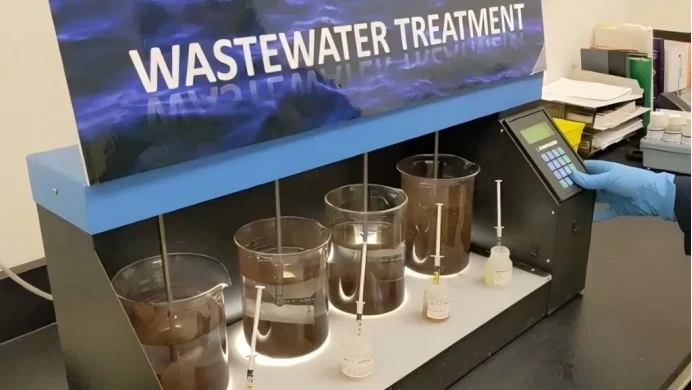
Six-paddle Jar Test stirrer (with variable speed control)
Six 1000 mL beakers or transparent square reaction jars
Calibrated Turbidity Meter
pH Meter
Pipette guns, pipettes, and graduated cylinders
Precision electronic balance
Stopwatch or timer
Data recording sheet
Among these, the six-paddle Jar Test equipment can ensure that all samples are tested under completely identical stirring conditions, making it the most important experimental apparatus for evaluating the performance of PAC Coagulant.
Raw Water Sample Collection Requirements
The reason why many enterprises' Jar Test results deviate from on-site operations is not an issue with the PAC product itself, but rather a lack of representativeness in the raw water sample. Therefore, before conducting a PAC Jar Test, priority should be given to ensuring that the collected raw water can truly reflect current treatment operating conditions.
It is recommended to adhere to the following principles:
1. Choose Representative Raw Water
Different operating conditions can be selected based on the enterprise's actual needs, such as:
Routinely stable operational water quality;
High-turbidity raw water during the rainy season;
Low-temperature raw water in winter;
Special operating conditions with highly fluctuating water quality.
If the enterprise wishes to optimize the PAC dosing scheme year-round, data profiles should be established separately for different seasons, rather than relying solely on a single experimental result.
2. Minimize Testing Delay
To ensure the stability of the water sample's chemical properties, it is recommended to:
Complete the Jar Test experiment within 30 minutes after sampling.
If immediate testing is impossible:
Store the sample in a refrigerated environment at 4°C;
Complete the experiment within 24 hours;
Freezing storage is prohibited, as it avoids alterations in the colloidal structure which would affect the PAC coagulation efficiency.
3. Ensure an Adequate Sample Quantity
It is recommended to prepare at least:
≥ 8 L of raw water sample per test
This not only allows for the completion of a full round of Jar Tests but also enables repeated verification, increasing the credibility of the experimental results.
How to Prepare the PAC Stock Solution?
To ensure that the PAC dosage across all beakers is accurate and consistent, it is recommended to first prepare a standard stock solution.
Recommended concentration:
1% (w/v) PAC stock solution
That is:
Weigh 1.0 g of powder PAC (liquid PAC should be converted based on equivalent content);
Add distilled water;
Bring to a volume of 100 mL;
Stir thoroughly until completely dissolved.
The greatest advantage of this preparation method lies in its computational simplicity:
Adding 1 mL of stock solution to 1000 mL of raw water = PAC dosage of 10 mg/L
This conversion relationship can significantly reduce manual calculation errors, improve experimental efficiency, and is the standard method adopted by most laboratories.
How to Design the PAC Dosing Gradient?
Under different water quality conditions, the optimal PAC dosage varies greatly; therefore, it is recommended to adopt a gradient dosing approach to establish a complete dose-response curve.
(I) Low-Turbidity Raw Water (< 20 NTU)
Recommended PAC dosing range:
2 mg/L
5 mg/L
10 mg/L
15 mg/L
20 mg/L
30 mg/L
Applicable to:
Surface water
Drinking water pretreatment
Certain groundwater purifications
(II) Moderate-Turbidity Raw Water (20–100 NTU)
Recommended PAC dosing range:
5 mg/L
10 mg/L
20 mg/L
30 mg/L
50 mg/L
70 mg/L
Applicable to:
Municipal wastewater
Industrial circulating water
General industrial wastewater treatment
This stage is typically also the operating condition where Industrial Grade PAC is most widely applied.
(III) High-Turbidity Raw Water (> 100 NTU)
Recommended PAC dosing range:
10 mg/L
20 mg/L
40 mg/L
60 mg/L
80 mg/L
100 mg/L
Applicable to:
River flooding periods
Sand-washing wastewater
Mining wastewater
Construction site wastewater
As turbidity rises, the PAC dosage range should be appropriately expanded to ensure that the true optimal dosing point can be found.
Standard Jar Test Mixing Procedure
A standardized mixing procedure is crucial for the formation of stable flocs. It is recommended to carry out the experiment according to the following steps:
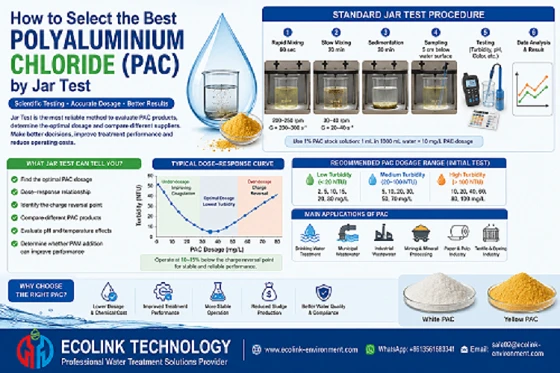
Step 1: Add Raw Water
Add to each of the six beakers:
1000 mL of raw water sample
Ensure that all beakers utilize the exact same batch of water sample.
Step 2: Rapid Mixing
Set the stirring speed:
200–250 rpm
Corresponding approximately to a mixing gradient of:
G = 200–300 s⁻¹
Subsequently:
Simultaneously add the PAC stock solution;
Immediately start timing;
Stir rapidly for 60 seconds.
The objective of this stage is to allow the Polyaluminium Chloride (PAC) to rapidly and uniformly disperse, and to complete the initial charge neutralization reaction.
Step 3: Slow Flocculation
Subsequently reduce the rotation speed:
30–40 rpm
Corresponding to:
G = 20–40 s⁻¹
Stir continuously for:
20 minutes
Slow stirring can promote mutual collisions among micro-particles, forming flocs with larger particle sizes and improving subsequent sedimentation efficiency. For certain high-concentration industrial wastewaters, the flocculation time can also be appropriately adjusted based on actual conditions, but it is recommended to keep the experimental conditions identical for all samples.
Step 4: Quiescent Sedimentation
After stopping the stirring:
Let stand for 30 minutes
During sedimentation:
Do not move the beakers;
Avoid vibrations;
Prevent re-disturbance of the flocs.
A good sedimentation environment can truly reflect the settling performance of the PAC product.
Step 5: Collect Supernatant
Utilize a pipette or sampler to:
Take a sample at approximately 5 cm below the liquid surface.
This position can avoid:
Interference from floating flocs;
Influence from bottom sediments;
Guaranteeing that the analytical data is more stable.
Step 6: Test Key Indicators
After completing sedimentation, the main indicators of the supernatant in each beaker should be tested respectively, including:
Effluent Turbidity
pH value
Water sample Color
Floc size
Floc compactness
Sedimentation velocity
For drinking water treatment projects, it is also recommended to add:
Residual Aluminum
As one of the crucial indicators for evaluating Drinking Water Grade PAC.
Why Must Experimental Conditions Be Kept Strictly Identical?
During the PAC product comparison process, a change in any single variable could cause the experimental results to lose their reference significance. Therefore, throughout the entire Jar Test process, it should be ensured that the following conditions remain perfectly consistent:
Consistent raw water source;
Consistent water sample volume per jar (1000 mL);
Consistent PAC stock solution concentration;
Synchronized dosing time;
Consistent rapid mixing speed (200–250 rpm);
Consistent rapid mixing time (60 seconds);
Consistent slow stirring speed (30–40 rpm);
Consistent slow stirring time (20 minutes);
Consistent sedimentation time (30 minutes);
Analytical instruments fully calibrated.
Only under identical experimental conditions will the performance comparison results of different PAC products, polyaluminium chloride coagulants, or different suppliers' Water Treatment Coagulants possess scientific validity and credibility.
How to Correctly Interpret PAC Jar Test Results?
After completing the experiment, what truly determines whether a PAC product is suitable for actual application is not which beaker has the largest flocs, but rather a systematic analysis of the entire experimental dataset. For the selection of Polyaluminium Chloride (PAC), it is recommended to conduct a comprehensive evaluation combining turbidity, floc characteristics, sedimentation performance, and operational stability, rather than making a judgment based on a single indicator.
ECOLINK TECHNOLOGY recommends organizing all experimental data into a table and plotting a PAC Dose–Response Curve, which allows for a more intuitive determination of the optimal dosing range and performance differences between different products.
How to Plot the PAC Dose–Response Curve?
It is recommended to plot the variation curve with:
X-axis: PAC Dosage (mg/L)
Y-axis: Effluent Turbidity (NTU)
A typical and ideal PAC dose-response curve usually goes through three stages:
Stage 1: Dosage increases, turbidity continuously declines
As the PAC dosage is progressively raised, colloidal particles continuously undergo charge neutralization, forming more and larger flocs, and thus the effluent turbidity gradually decreases. This stage indicates that the PAC has not yet reached its optimal coagulation state.
Stage 2: Minimum turbidity is reached
When PAC is dosed up to a certain amount, the effluent turbidity reaches its lowest value, which typically signifies:
The most complete coagulation reaction;
The best floc formation effect;
The highest sedimentation efficiency;
The optimal chemical utilization rate.
This dosage can generally serve as the laboratory-recommended Optimal PAC Dosage.
Stage 3: Turbidity rises again after continuing to increase PAC
Many users mistakenly believe that the more PAC is added, the better the result will be; in reality, this is not the case. When PAC exceeds the optimal dosage, the particle surfaces may become charged again, and the already formed flocs re-disperse, giving rise to the phenomenon known as Charge Reversal.
Its typical manifestations include:
Effluent turbidity rising again;
Flocs becoming smaller and looser;
Sedimentation velocity declining;
Supernatant transparency reducing.
Therefore, PAC is not a case of "the more the better," and reasonably controlling the dosage is the key to obtaining the best treatment efficacy.
How to Determine the PAC Dosage in Actual Operation?
It is not recommended to directly apply the optimal dosage obtained from the Jar Test as the on-site operational dosage. In actual production, raw water quality, water temperature, and flow rate will all fluctuate; hence, a safety margin should be appropriately reserved.
It is recommended to set the actual operational PAC dosage to:
10% to 15% lower than the charge reversal point.
This can effectively reduce the risk of chemical overdosing caused by water quality fluctuations, enhancing operational stability.
For example:
If the Jar Test results show:
The optimal performance appears at 30 mg/L;
Charge reversal begins to appear at 35 mg/L;
Then on-site operation is recommended to give priority to dynamic adjustments around 30 mg/L, rather than adopting a dosage above 35 mg/L for the long term.
How to Compare Two PAC Products?
When an enterprise changes PAC suppliers, they cannot merely compare the lowest turbidity; they should also comprehensively analyze product performance. ECOLINK TECHNOLOGY recommends utilizing parallel Jar Tests to test two PAC products synchronously, while keeping all experimental conditions perfectly identical, including:
Same raw water;
Same dosing gradient;
Same stirring program;
Same testing times.
Subsequently, focus on comparing the following indicators.
1. Dose-Response Curve
Do not just look at the lowest turbidity, but rather observe the entire curve. If a certain PAC exhibits:
A wider optimal dosage range;
A flatter curve;
It indicates that it possesses better adaptability to raw water fluctuations, and the on-site operational fault tolerance is higher. Conversely, if the curve is very steep, it means that slightly increasing or decreasing the PAC dosage could cause an obvious shift in treatment efficacy, placing higher demands on operational management.
2. Floc Formation Quality
High-quality PAC can typically form flocs that have:
Larger particle sizes;
Tight structures;
Higher strength;
Resistance to breakage.
Such flocs can improve sedimentation efficiency and alleviate the load on subsequent filtration systems.
3. Sedimentation Velocity
In addition to observing the final turbidity, one should also record:
The time required for the clear liquid to first distinctly appear;
Floc sedimentation velocity;
Supernatant clarification speed.
Faster sedimentation typically means that the PAC coagulation performance is more stable, which is beneficial for improving the operational efficiency of the treatment system.
4. Effluent pH Variations
The addition of PAC will affect the system pH. Therefore, one should simultaneously record:
Raw water pH;
pH after dosing;
pH variation trends under different dosages.
If a certain PAC causes smaller pH fluctuations, it will be easier to maintain stable system operation and reduce subsequent adjustment costs.
5. Drinking Water Projects Must Also Test Residual Aluminum
For Drinking Water Grade PAC, it is recommended to add:
Residual Aluminum
As a product evaluation indicator. Lower residual aluminum typically means that PAC hydrolysis is more complete, which is more favorable for drinking water treatment.
What Impacts Does pH Have on PAC Coagulation Efficacy?
PAC belongs to the category of coagulants that are relatively sensitive to pH. In order to find the optimal operational conditions, Jar Tests under different pH conditions can be designed.
For example:
pH 5.5
pH 6.5
pH 7.0
pH 7.5
pH 8.0
pH 8.5
Each experiment maintains the optimal PAC dosage unchanged, adjusting only the raw water pH. Subsequently compare:
Effluent turbidity;
Floc size;
Sedimentation velocity;
Supernatant transparency.
Through this experiment, the optimal operational range of the current PAC product under different pH conditions can be determined, providing a basis for on-site process optimization.
Why Must Low-Temperature Conditions Also Be Separately Subjected to Jar Tests?
Winter low temperatures lower the PAC hydrolysis speed and particle collision efficiency, thereby affecting coagulation efficacy. Therefore, in regions with winter operations, it is recommended to use refrigerated raw water to conduct low-temperature Jar Tests and compare them with ambient-temperature experiments.
Focus on observing:
Whether the PAC dosage needs to be increased;
Whether the slow stirring time needs to be extended;
Whether the flocculation time needs to be increased;
Whether it needs to be used in combination with PAM.
Grasping low-temperature operational data in advance can help water plants formulate seasonal operational schemes, reducing the impacts brought by winter water quality fluctuations.
How to Use the Jar Test to Optimize the PAC+PAM Combination?
After completing the test for the optimal PAC dosage, joint experiments with PAC and Polyacrylamide (PAM) can be further carried out. It is recommended to keep the optimal PAC dosage constant and step-by-step increase the PAM dosage, for example:
0.5 mg/L
1.0 mg/L
1.5 mg/L
2.0 mg/L
3.0 mg/L
Focus on comparing:
Whether the flocs are larger;
Whether the sedimentation velocity is elevated;
Whether the effluent turbidity is further lowered;
Whether sludge dewatering performance is improved.
For municipal wastewater, industrial wastewater, mining wastewater, and papermaking wastewater treatment, using PAC and PAM in combination can typically obtain more stable coagulation and flocculation effects.
How to Apply Jar Test Results to Actual Engineering?
The Jar Test can provide crucial references for engineering operations, but certain discrepancies still exist between laboratory conditions and on-site systems, for example:
| Item | Jar Test | Actual Engineering |
| Rapid Mixing | 200–250 rpm, corresponding to a G value of approx. 200–300 s⁻¹ | Recommended target G value: 200–400 s⁻¹ |
| Slow Flocculation | 30–40 rpm, corresponding to a G value of approx. 20–40 s⁻¹ | Recommended target G value: 20–60 s⁻¹ |
| Flocculation Time | 20 minutes | Generally 15–30 minutes, can be appropriately extended when cold |
| Sedimentation Time | 30 minutes | Determined based on clarifier structure and retention time |
Therefore, in on-site applications, laboratory data should be appropriately corrected in combination with equipment structures, hydraulic conditions, and raw water variations, and operational parameters should be continuously optimized through online monitoring.
Frequently Asked Questions (FAQ)
Before changing PAC suppliers, how many Jar Tests need to be done?
It is recommended to conduct tests under at least three different raw water operating conditions, such as routine water quality, high turbidity, and low-temperature conditions. Data obtained this way is more representative and can prevent misjudgments caused by a single operating condition.
The Jar Test result is inconsistent with the supplier's recommended dosage; which one should be referred to?
Priority should be given to referencing the Jar Test results completed based on your own raw water. The supplier's recommended dosage typically belongs to a generalized empirical value, whereas the Jar Test provides data obtained under actual water quality conditions, reflecting on-site operational demands more accurately.
Can the Jar Test directly determine the long-term operational dosage of PAC?
The Jar Test can serve as a vital reference, but formal operation still requires dynamic adjustments in combination with online monitoring, water quality variations, and equipment operating status to obtain long-term stable treatment results.
Conclusion
The Jar Test is not merely an experiment; it is an important tool for optimizing coagulation processes, lowering operational costs, and scientifically selecting Polyaluminium Chloride (PAC). Through standardized experimental procedures and systematic data analysis, enterprises can accurately evaluate the performance of different products, reasonably determine the optimal dosage, and provide reliable bases for actual engineering operations.
As a professional water treatment solution provider, ECOLINK TECHNOLOGY can supply global customers with Industrial Grade PAC, Drinking Water Grade PAC, PAM series products, and complete Jar Test technical support services, including product selection, experimental guidance, sample testing, and process optimization recommendations, helping customers achieve more efficient, stable, and economical water treatment operations.