From Pretreatment to Advanced Treatment: A Comprehensive Understanding of the Principles, Processes, and Applications of Different Wastewater Treatment Technologies
Wastewater may simultaneously contain suspended solids, colloids, organic matter, grease, salts, heavy metals, and pollutants such as nitrogen and phosphorus. Since the properties of different pollutants vary significantly, it is rare for a single standalone process to resolve all water quality issues.
The core of wastewater treatment is not simply about "making the water clear," but rather combining different processes rationally based on the influent water quality, pollutant composition, treatment objectives, and final discharge or reuse requirements, so that pollutants are gradually separated, degraded, or transformed from the water.
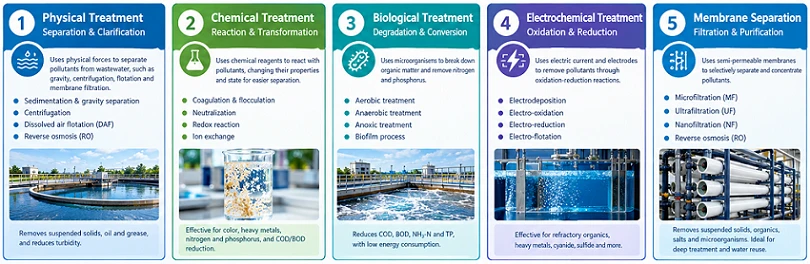
From the perspective of engineering applications, common wastewater treatment methods mainly include physical methods, chemical methods, biological methods, electrochemical methods, and membrane separation methods. Different technologies play different roles in the pretreatment, primary treatment, and advanced treatment stages. The attached materials also introduce these five major categories as the primary technical systems.
For industrial enterprises, a rational industrial wastewater treatment solution typically consists of multiple units combined into a process train rather than a single piece of equipment. ECOLINK TECHNOLOGY can match water treatment chemicals and equipment according to water quality characteristics, treatment objectives, and project requirements, providing clients with solution concepts ranging from product selection to process integration.
I. Why Do Wastewater Treatment Systems Need to Use Combined Processes?
Different pollutants possess different physical and chemical properties.
For example:
Large particulate suspended solids can be removed through sedimentation, screening, and other methods;
Colloidal particles typically require destabilization and aggregation through coagulation and flocculation;
Biodegradable organic matter is suitable for degradation using microorganisms;
Refractory organic matter may require intensified treatment such as oxidation and electrochemistry;
High-salinity wastewater may require advanced treatment technologies such as membrane separation;
Certain heavy metal pollutants need to be treated through chemical reactions, precipitation, ion exchange, or other methods.
Therefore, in actual wastewater treatment technology design, it is generally necessary to first determine the pollutant types and then decide the treatment sequence.
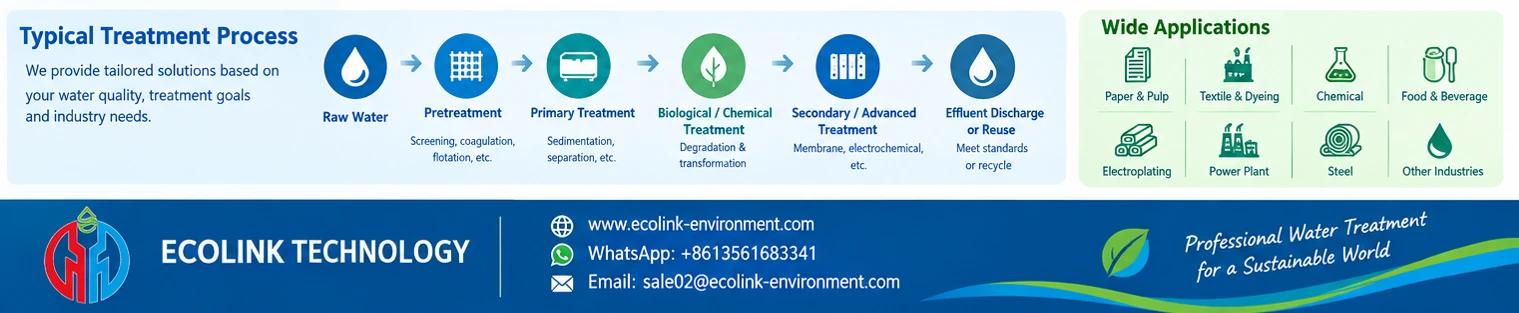
A typical industrial wastewater treatment approach can be summarized as: Raw Water $\rightarrow$ Pretreatment $\rightarrow$ Solid-Liquid Separation $\rightarrow$ Chemical Treatment / Biological Treatment $\rightarrow$ Advanced Treatment $\rightarrow$ Discharge to Standards or Reuse
The actual process flow is not fixed and must be adjusted according to specific water quality.
II. Physical Wastewater Treatment: Suitable as Pretreatment and Solid-Liquid Separation Stages
1. Basic Principles of Physical Methods
Physical methods primarily utilize differences in density, particle size, and solubility between pollutants and water, achieving pollutant separation through physical actions.
Common technologies include:
Gravity separation
Centrifugal separation
Air flotation
Reverse osmosis
The attached documents indicate that physical methods can target suspended solids, colloids, grease, and salinity pollutants, and can be applied in either pretreatment or advanced treatment.
2. Typical Treatment Steps
Step 1: Pretreatment First, set up necessary bar screens, meshes, or other solid-liquid separation equipment according to the raw water conditions to remove larger debris and particles.
Step 2: Gravity Sedimentation For suspended particles with a density greater than water and good settling performance, sedimentation tanks can be utilized for gravity separation. For example: Wastewater- Grit removal / Sedimentation- Supernatant enters subsequent processes - Bottom sludge discharged
Step 3: Air Flotation For light suspended solids, grease, and fine particles whose density is close to water and difficult to settle naturally, air flotation technology can be adopted. Air bubbles combine with pollutants to form scum, which is then separated using a scum-skimming device.
Step 4: Advanced Membrane Treatment When treatment objectives involve salinity, organic matter, or reclaimed water quality, membrane separation technology can be further applied.
Therefore, physical methods do not necessarily operate independently; a more common application mode is serving as a front-end or back-end unit within the entire wastewater treatment process.
3. Advantages and Disadvantages of Physical Methods
Advantages:
Operation is relatively simple;
Solid-liquid separation effects are stable;
Some valuable substances can be recovered;
Can serve as pretreatment for other treatment processes.
Limitations:
Physical methods have limited removal capacity for dissolved organic matter and microorganisms; hence, in many industrial projects, they need to be combined with chemical, biological, or membrane separation methods. The attached materials likewise point out that physical methods possess certain limitations in treating dissolved pollutants.
III. Chemical Wastewater Treatment: Targeting Colloids, Chroma, Heavy Metals, and Other Pollutants
1. Working Principles of Chemical Methods
Chemical methods primarily utilize chemical reagents to react with pollutants in wastewater, altering the properties, states, or existing forms of pollutants to convert them into easily separable substances.
Common chemical wastewater treatment technologies include:
Coagulation method
Neutralization method
Oxidation-reduction method
Ion exchange method
The attached documents show that chemical methods can be used for the treatment of suspended solids, colloids, chroma, heavy metals, and nitrogen and phosphorus pollutants, and can reduce indicators such as COD, BOD, and SS.
2. Coagulation-Flocculation Treatment Steps
Coagulation is a very common chemical pretreatment method in industrial wastewater treatment.
The basic process can be understood as: Raw Water - Coagulation-Flocculation -Sedimentation / Air Flotation -Sludge Separation- Subsequent Treatment
The coagulation stage primarily destabilizes stable colloidal particles; the coagulation stage promotes micro-particles colliding with each other to form larger flocs.
In actual operation, the selection of coagulants and flocculants requires testing combined with water quality. For example, polyaluminum chloride (PAC) can be used for coagulation, while polyacrylamide (PAM) can be used as a flocculation aid according to water quality and process requirements.
It should be noted that PAM does not use the same model for all types of wastewater. Cationic, anionic, and non-ionic PAMs differ in charge characteristics and applicable scenarios; thus, industrial wastewater treatment projects typically require determining the appropriate model and dosage through beaker tests or on-site pilot tests.
3. Neutralization Treatment
For wastewater with distinct acidity or alkalinity, neutralization is an important pretreatment step.
The basic approach is: Detecting pH-Dosing and adjusting- Thorough mixing -pH stabilization- Entering subsequent treatment
Neutralization not only reduces the impact of acidity and alkalinity on equipment, but also creates more suitable conditions for subsequent biological treatment or chemical reactions.
4. Oxidation-Reduction Treatment
When refractory organic matter, cyanides, sulfides, and other pollutants exist in wastewater, oxidation or reduction treatment can be selected based on pollutant properties.
The basic process typically involves: Water quality analysis - Determining oxidation/reduction route - Reagent dosing -Reaction - Solid-liquid separation -Subsequent treatment
The attached materials list oxidation-reduction as an important component of chemical methods, citing application directions such as chemical wastewater, pesticide wastewater, and dye wastewater.
IV. Biological Wastewater Treatment: Utilizing Microorganisms to Reduce Organic Matter and Nitrogen-Phosphorus Loads
1. Basic Principles of Biological Treatment
Biological methods primarily utilize the metabolic action of microorganisms to degrade and transform biodegradable organic matter and some nitrogen and phosphorus pollutants in wastewater.
Common biological treatment methods include:
Aerobic method
Anaerobic method
Anoxic method
Biofilm method
The attached materials indicate that biological methods can reduce indicators such as COD, BOD, $\text{NH}_3\text{--}\text{N}$, and TP, and can serve as the primary treatment process or be combined with other technologies.
2. Aerobic Treatment Steps
The typical flow can be understood as: Pretreatment - Water quality adjustment -Aeration - Microbial degradation - Secondary sedimentation - Sludge return / discharge
Aerobic microorganisms decompose biodegradable organic matter under sufficient oxygen conditions. Common processes include the activated sludge process, biological aerated filter (BAF) process, and rotating biological contactor (RBC) process.
3. Anaerobic Treatment
For certain industrial wastewater containing higher concentrations of organic matter, anaerobic treatment can be considered.
Typical process: Pretreatment $\rightarrow$ Anaerobic reaction $\rightarrow$ Solid-liquid separation $\rightarrow$ Subsequent aerobic treatment or advanced treatment
Common technologies include anaerobic digestion, anaerobic filters, and UASB. The attached materials explicitly list these processes as anaerobic treatment applications.
4. Anoxic Treatment and Biological Nitrogen Removal
For wastewater requiring the control of nitrogen indicators, nitrogen removal can be achieved through microbial reactions in an anoxic environment. A/O and $\text{A}^2\text{/O}$ are common biological treatment routes.
In actual design, whether to adopt biological nitrogen removal and what combination to use should be judged based on influent $\text{NH}_3\text{--}\text{N}$, total nitrogen, COD, biodegradability, and discharge requirements.
5. What Needs Attention in Biological Methods?
Biological systems are sensitive to operating conditions.
Key factors requiring focus include:
pH;
Temperature;
Dissolved oxygen;
Sludge status;
Organic load;
Toxic inhibitory substances.
The attached documents also point out that factors such as temperature, pH, and toxic substances may affect biological treatment performance, while biological treatment generates biological sludge that requires further handling.
V. Electrochemical Wastewater Treatment: For Intensified Treatment of Refractory Pollutants
1. Electrochemical Treatment Principles
Electrochemical methods utilize electric current passing through electrodes and wastewater to trigger oxidation-reduction reactions on electrode surfaces, and react with pollutants via generated related substances to achieve pollutant removal.
Main technologies include:
Electrodeposition method
Electro-oxidation method
Electro-reduction method
Electro-flotation method
The attached documents show that electrochemical methods can be used for treating heavy metals, organic matter, cyanides, sulfides, and nitrogen and phosphorus pollutants.
2. Basic Steps of Electrochemical Treatment
A typical flow is: Wastewater pretreatment - Entering electrochemical reactor - Electrode reaction -Pollutant transformation/separation - Solid-liquid separation- Subsequent treatment
Different pollutants correspond to different electrochemical mechanisms. For example:
Electrodeposition: Suitable for certain wastewater containing heavy metals, making target metals deposit on electrodes via electrochemical action.
Electro-oxidation: Primarily targets certain refractory organic matter, cyanides, and sulfides.
Electro-reduction: Applicable to the treatment of wastewater containing chlorine, nitrates, sulfates, etc.
Electro-flotation: Generates bubbles via electrolysis, making suspended solids, grease, and chroma pollutants form scum for separation.
The attached materials list wastewater application directions including electroplating, printing and dyeing, papermaking, chemical engineering, pesticides, dyes, food, and slaughtering.
VI. Membrane Separation Method: An Important Technology for Industrial Wastewater Advanced Treatment and Reuse
1. What is Membrane Separation Technology?
Membrane separation utilizes the selective permeability characteristics of semi-permeable membranes to intercept, separate, or concentrate different pollutants.
Common membrane technologies include:
Microfiltration (MF)
Ultrafiltration (UF)
Nanofiltration (NF)
Reverse osmosis (RO)
The attached materials indicate that membrane separation can be used to remove suspended solids, colloids, organic matter, salinity, and microorganisms, and can be applied in advanced treatment and wastewater reuse.
2. Microfiltration (MF)
Microfiltration is primarily used to remove larger particulate matter and partial colloids. Typical applications include food, pharmaceutical, and papermaking wastewater.
3. Ultrafiltration (UF)
Ultrafiltration exhibits good interception performance for small particulate suspended solids and partial macromolecular organic matter. Suitable for dairy, dye, and oil-water emulsion wastewater treatment scenarios.
4. Nanofiltration (NF)
Nanofiltration lies between ultrafiltration and reverse osmosis, capable of separating certain small-molecule organic matter and multivalent ions. The attached documents list pesticide wastewater, dye wastewater, and sugar solution as nanofiltration application cases.
5. Reverse Osmosis (RO)
Reverse osmosis is typically used for deeper desalination and water quality enhancement, applicable to scenarios such as high-salinity wastewater, industrial wastewater reuse, and seawater desalination.
A typical membrane treatment approach is: Pretreatment - UF- RO - Permeate reuse
However, not all projects must adopt a complete membrane combination. Whether the front-end pretreatment of the membrane system is sufficient directly affects membrane fouling, cleaning frequency, and operational stability.
Therefore, when performing industrial wastewater reuse treatment, water quality, membrane fouling risk, concentrated water treatment, and final reuse purpose must be considered simultaneously.
VII. How Should the Five Wastewater Treatment Methods Be Selected?
There is no absolute "best" among different technologies; the key lies in pollutant characteristics and final treatment objectives.
| Treatment Method | Primary Role | Common Application Directions | Common Process Position |
|
Physical Method |
Solid-liquid separation, oil-water separation, turbidity reduction, etc. |
Suspended solids, grease, particulates |
Pretreatment / Advanced Treatment |
|
Chemical Method |
Coagulation, neutralization, oxidation-reduction, etc. |
Colloids, chroma, heavy metals, etc. |
Pretreatment / Primary / Advanced |
|
Biological Method |
Degrade biodegradable organics, nutrient removal |
COD, BOD, NH3-N, TP |
Primary Treatment |
|
Electrochemical Method |
Oxidation, reduction, deposition, electro-flotation |
Refractory pollutants, heavy metals, etc. |
Pretreatment / Intensified Treatment |
|
Membrane Separation |
Interception, separation, desalination, reuse |
Salinity, organics, colloids, etc. |
Advanced Treatment / Reuse |
It requires special emphasis that the attached materials also indicate that various technical types can be combined with other methods to improve overall treatment efficiency.
VIII. Design Steps for Actual Wastewater Treatment Solutions
Step 1: Analyze Raw Water Quality
Before designing a wastewater treatment solution, it is necessary to clarify as much as possible:
COD
BOD
SS
NH3-N
TP
pH
Conductivity
Chroma
Grease
Heavy metals
Salinity
Water volume and flow fluctuations
If critical water quality data is missing, it is difficult to accurately determine the final process.
Step 2: Determine Treatment Objectives
It must be clear whether the final wastewater is for: Discharge to standards, production reuse, recycling, or further entry into an advanced treatment system. Different objectives correspond to different process depths.
Step 3: Determine Pretreatment Route
If the raw water contains high suspended solids, grease, or colloids, technologies such as sedimentation, air flotation, and coagulation can be prioritized. The goal of this stage is not only to remove pollutants, but also to protect subsequent biological systems, membrane systems, and other equipment.
Step 4: Determine Primary Treatment Process
If the main pollutants are biodegradable organic matter, biological treatment can be considered. If it contains large amounts of refractory pollutants, it needs to be combined with chemical, electrochemical, or other intensified treatment technologies.
Step 5: Determine Advanced Treatment
When the effluent requires higher water quality or production reuse, advanced treatment units such as membrane separation can be further configured.
Step 6: Perform Sludge Treatment
Chemical, physical, and biological methods may all generate sludge during operation. Sludge needs to undergo concentration, dewatering, and subsequent disposal stages; hence, attention cannot be solely paid to water treatment itself, but must also encompass the sludge management of the entire system.
IX. Why Do Water Treatment Chemicals and Equipment Need to Be Matched?
In many industrial projects, simply purchasing a chemical or a piece of equipment cannot solve all problems. For example, the performance of a coagulation-sedimentation system is related not only to the structure of the sedimentation tank, but also to coagulants, flocculants, water quality, mixing conditions, and dosing volume.
PAM, as a common polymer flocculant, can be selected with different types and specifications according to different wastewater characteristics; PAC is commonly used in the coagulation process.
Therefore, actual projects require confirming chemical adaptability through water sample tests, beaker tests, or on-site tests rather than directly determining models simply by industry names.
For projects requiring advanced treatment, chemical pretreatment and membrane equipment also need to be matched.
A rational water treatment solution should simultaneously consider: Water Quality- Process - Chemicals - Equipment -Operation - Sludge - Effluent
This is also the focus of attention for ECOLINK TECHNOLOGY when providing water treatment products.
X. ECOLINK TECHNOLOGY: From Water Treatment Chemicals to Equipment Solutions
ECOLINK TECHNOLOGY focuses on the supply of water treatment chemicals and related equipment products, providing product matching and technical support tailored to different industrial wastewater treatment requirements.
In terms of chemicals, PAM, PAC, and other water treatment products can be provided according to specific project requirements, and customers can be assisted in determining appropriate product directions based on wastewater properties.
In terms of equipment and systems, project requirements may involve:
RO reverse osmosis systems;
UF ultrafiltration systems;
EDI systems;
STP domestic sewage treatment systems;
ETP industrial wastewater treatment systems;
Seawater desalination systems;
Industrial wastewater advanced treatment systems.
For projects requiring simultaneous procurement of chemicals and equipment, rationally matching chemicals with equipment can reduce the workload for clients who would otherwise have to search for separate suppliers, repeatedly communicate technical parameters, and coordinate different supply chains.
The service philosophy of ECOLINK TECHNOLOGY is to perform product matching based on the client's actual water quality and application scenarios, providing technical support, sample testing, documentation support, and supply coordination, rather than simply selling a single product.
XI. Why Do Different Industrial Wastewaters Require Different Treatment Solutions?
Papermaking Wastewater
Papermaking wastewater typically involves suspended solids, colloids, and organic pollutants; thus, combined processes such as coagulation, flocculation, sedimentation, air flotation, biological treatment, and advanced treatment can be adopted according to water quality. PAM can play a flocculation role in the solid-liquid separation stage, while specific models must be determined through water sample tests.
Printing and Dyeing Wastewater
Printing and dyeing wastewater typically requires a focus on issues such as chroma, organic pollutants, and biodegradability. Chemical treatment, biological treatment, electrochemical treatment, and membrane separation technologies can be combined based on actual water quality.
Chemical Wastewater
Chemical industry wastewater composition varies significantly, and some wastewater may contain refractory organic matter or other special pollutants. Therefore, water quality analysis must be conducted first, followed by decisions on routes such as oxidation-reduction, chemical treatment, biological treatment, or advanced treatment.
Food Wastewater
Food wastewater typically contains more biodegradable organic matter; hence, biological treatment holds significant application space, while pre-treatment methods such as air flotation and sedimentation can be combined to reduce the pollution load entering the biological system.
Electroplating and Heavy Metal-Bearing Wastewater
For wastewater containing heavy metals, focus should be placed on metal ion types and concentrations; technologies such as chemical precipitation, ion exchange, and electrochemistry can be adopted according to pollutant characteristics.
XII. How to Determine Whether a Wastewater Treatment Technology is Suitable?
Judging whether an industrial wastewater treatment solution is appropriate should not rely solely on individual equipment prices or single-item removal rates, but rather on a comprehensive consideration of:
Water Quality Adaptability: Whether the technology can target and act on target pollutants.
Effluent Requirements: Discharge or reuse? Different final water quality requirements demand different treatment depths.
Operating Costs: Comprehensive consideration of power consumption, chemicals, membrane consumables, sludge disposal, and maintenance costs.
System Stability: Water volume and quality in industrial production may fluctuate, requiring consideration of the system's adaptability to water quality variations.
Sludge and Concentrated Water Treatment: No solution should focus solely on "whether the water has become clean"; it must also consider where the pollutants ultimately go.
Later Maintenance: Equipment maintenance, membrane cleaning, electrode replacement, chemical storage, and sludge treatment all affect long-term operation.
XIII. Summary: Rational Combination is More Important Than a Single Technology
There is no fixed method in wastewater treatment that applies to all industries and all water qualities.
Physical methods excel at pollutant separation; chemical methods are suitable for coagulation, neutralization, and some refractory pollutants; biological methods utilize microorganisms to degrade biodegradable organics and partially remove nitrogen and phosphorus; electrochemical methods can serve as an intensification means for certain refractory pollutants; membrane separation plays an important role in advanced treatment, desalination, and reuse.
The attached materials similarly emphasize that different treatment methods differ in principles, effects, costs, and application ranges, requiring a comprehensive selection based on wastewater characteristics, treatment purposes, and economic conditions.
Therefore, a rational wastewater treatment system typically needs to undergo: Water Quality Analysis - Pretreatment -Targeted Pollutant Treatment -Solid-Liquid Separation - Biological / Chemical / Electrochemical Treatment - Advanced Treatment -Discharge to Standards or Reuse
ECOLINK TECHNOLOGY can provide clients with product matching, technical support, sample testing, and supply coordination services centering on water treatment chemicals and equipment. For specific projects, it is recommended to conduct solution design combined with raw water quality, water volume, target effluent indicators, and final uses.