Comprehensive understanding of wastewater total nitrogen removal methods, from sources and hazards to treatment processes
Nitrogen in wastewater does not exist in a single form; rather, it is composed of various nitrogen-containing substances. Depending on the wastewater source and water quality characteristics, nitrogen may exist in forms such as organic nitrogen, ammonia nitrogen, nitrite nitrogen, and nitrate nitrogen. Therefore, total nitrogen removal from wastewater is not simply about reducing the concentration of a single type of nitrogen, but requires designing a reasonable treatment process based on pollutant composition, influent water quality, and discharge requirements.
With the continuous improvement of industrial wastewater treatment, domestic sewage treatment, and resource utilization requirements, total nitrogen removal technology has become a crucial link in wastewater treatment systems.
Starting from the sources and hazards of total nitrogen, this article will introduce physical methods, chemical methods, and biological methods, and further analyze how to achieve stable total nitrogen control through rational wastewater treatment processes.
I. What is Total Nitrogen in Wastewater?
Wastewater Total Nitrogen (TN) refers to the total amount of nitrogen elements contained in various nitrogen compounds in wastewater, mainly including:
Organic nitrogen
Ammonia nitrogen
Nitrite nitrogen
Nitrate nitrogen
The total nitrogen concentration can reflect the degree of wastewater pollution and the operating effect of the treatment system to a certain extent, making it one of the important indicators for evaluating wastewater water quality.
In actual projects, focusing solely on ammonia nitrogen cannot fully represent the entire nitrogen pollution status. After nitrification, ammonia nitrogen may be further converted into nitrite nitrogen and nitrate nitrogen. Therefore, in projects requiring stricter discharge requirements, it is usually necessary to design wastewater total nitrogen treatment schemes starting from the entire nitrogen cycle process.
II. Where Does Total Nitrogen in Wastewater Mainly Come From?
For different types of wastewater, their total nitrogen sources and concentrations vary greatly. Understanding pollutant sources is an important basis for designing total nitrogen wastewater treatment processes.
1. Industrial Wastewater
During industrial production processes such as chemical engineering, pesticides, dyes, papermaking, and pharmaceuticals, different types of nitrogen-containing wastewater may be generated.
The characteristics of industrial wastewater are usually closely related to the production process. Therefore, when actually carrying out industrial wastewater total nitrogen removal, treatment methods need to be selected according to the specific industry, water quality composition, and influent concentration.
2. Agricultural Wastewater
Nitrogen pollutants are also generated during livestock and poultry breeding, farmland irrigation, and chemical fertilizer application.
Nitrogen from agricultural sources may exist in the form of organic nitrogen, ammonia nitrogen, and other forms, which may further affect the aquatic ecological environment after entering natural water bodies.
3. Domestic Sewage
Nitrogen in domestic sewage is mainly related to human excreta, domestic garbage, and kitchen wastewater.
For domestic sewage and some municipal wastewater, biological treatment is usually an important component of the wastewater total nitrogen removal process.
III. Why Must Total Nitrogen Removal Be Performed?
If the nitrogen in wastewater is not effectively controlled, it may produce a series of environmental impacts after being discharged into natural water bodies.
1. Promoting Eutrophication of Water Bodies
Excessive nitrogen entering water bodies may promote algae blooms, affect the aquatic ecological balance, and reduce the self-purification capacity of water bodies.
2. Affecting Dissolved Oxygen in Water Bodies
The conversion process of nitrogen-containing pollutants in water bodies may consume dissolved oxygen. When water bodies remain in a low dissolved oxygen state for a long time, the survival of aquatic organisms will be affected.
3. Affecting Sensory Quality of Water Bodies
Nitrogen pollution is correlated with indicators such as water color, transparency, and odor, thereby affecting the use value of water bodies.
4. Bringing Health Risks
Different nitrogen-containing compounds have different environmental and health impacts. For example, attachment data indicates that ammonia nitrogen may irritate human respiratory tracts, eyes, and skin, while nitrate nitrogen may lead to thyroid dysfunction and blue baby syndrome.
Therefore, rationally selecting wastewater total nitrogen removal methods is related not only to meeting discharge standards, but also to water environmental protection and water resource utilization.
IV. What Are the Common Methods for Total Nitrogen Removal in Wastewater?
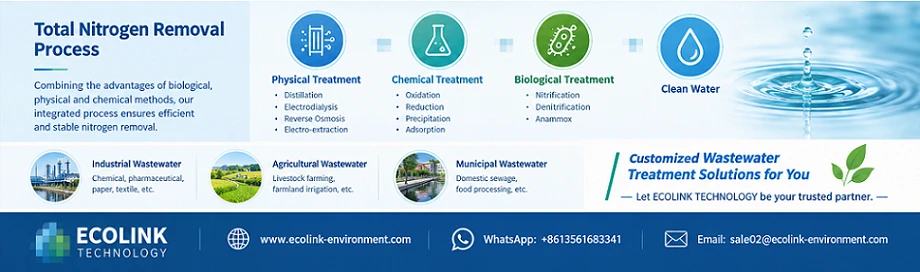
Currently, total nitrogen treatment can be carried out mainly from three directions: physical, chemical, and biological.
Different technologies have different applicable conditions, and there is no single process suitable for all wastewater. Actual projects require comprehensive design based on water quality, treatment scale, discharge standards, and operating costs.
1. Physical Methods
Physical treatment methods mainly achieve pollutant separation through physical actions, such as:
Distillation
Electrodialysis
Reverse osmosis
Electro-osmosis, etc.
These methods can achieve the separation of some nitrogen-containing substances, but usually suffer from high costs, high operating condition requirements, and potential issues such as producing concentrated liquid or other subsequent treatment requirements.
Therefore, in a complete wastewater total nitrogen treatment system, physical methods usually need to be selected according to specific water quality rather than being used alone as a universal solution for all projects.
2. Chemical Methods
Chemical methods mainly change the form of nitrogen-containing pollutants through chemical reactions, such as:
Oxidation
Reduction
Precipitation
Adsorption
Their advantage lies in that some pollutants can be treated through targeted chemical reactions, while factors such as reagent consumption, reaction conditions, operating costs, and by-products need to be considered simultaneously.
For certain special water qualities, chemical treatment can serve as an auxiliary process in the overall total nitrogen wastewater treatment scheme.
V. Why Has the Biological Method Become an Important Technology for Total Nitrogen Treatment?
Compared with physical and chemical methods, biological methods convert nitrogen-containing pollutants in wastewater through microbial metabolic processes.
Common processes include:
Aerobic ammonia oxidation
Aerobic nitrification
Denitrification
During these biological reaction processes, different forms of nitrogen in wastewater can be gradually converted, ultimately achieving the removal of nitrogen pollutants.
Attachment data indicates that biological methods have characteristics such as low cost, high efficiency, and no secondary pollution, making them currently one of the widely applied total nitrogen removal technologies.
However, biological methods do not mean that water quality conditions can be ignored.
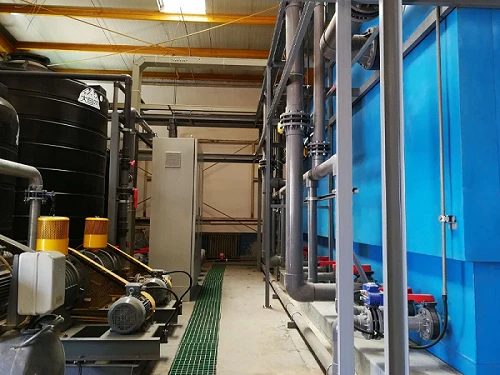
VI. What Factors Need to Be Paid Attention to When Treating Total Nitrogen by Biological Methods?
Microorganisms in biological treatment systems have certain requirements for the operating environment. Therefore, when performing efficient total nitrogen removal, comprehensive attention needs to be paid to the following conditions:
Temperature: Temperature changes may affect microbial activity, thereby affecting biological reaction rates.
pH: Suitable pH conditions play an important role in biological reaction processes.
Dissolved Oxygen: Aerobic processes such as nitrification require reasonable dissolved oxygen conditions, while the denitrification process requires a corresponding anoxic environment.
Carbon Source: Some denitrification processes require a sufficient carbon source as an electron donor. When wastewater itself lacks biodegradable carbon sources, carbon source allocation needs to be considered in combination with specific water quality.
Reaction Time and Space: Attachment data points out that traditional biological methods require longer reaction times and larger reaction spaces. For special types of wastewater such as high concentration, high temperature, and high salinity, their applicability may be limited.
Therefore, a truly effective wastewater total nitrogen removal process requires not only selecting biological methods, but also optimizing reactors, process parameters, and operational control according to actual project conditions.
VII. How to Improve the Total Nitrogen Removal Efficiency of Wastewater?
In view of problems such as footprint, reaction time, and operational control in traditional biological treatment processes, physical and chemical treatment concepts can be combined on the basis of biological methods, and system operating efficiency can be improved through reactor design, process control, and automated management.
This comprehensive wastewater treatment scheme can combine different treatment links according to actual water quality rather than simply adopting a single technology.
ECOLINK TECHNOLOGY can provide corresponding solutions around wastewater treatment equipment, process matching, and technical support according to customers' wastewater types, treatment objectives, and project conditions.
VIII. Application of Biofilm Technology in Total Nitrogen Treatment
In the process of enhanced biological treatment, biofilm carriers can provide attachment and growth space for microorganisms.
According to the attachment scheme, it adopts high-efficiency biofilm carriers to enhance microbial attachment and growth, thereby improving reaction speed and treatment efficiency. In this scheme, the total nitrogen removal rate of wastewater reaches over 90%.
For projects requiring total nitrogen control, biofilm systems can be combined with other treatment units according to specific process conditions.
It should be noted that the treatment effect of actual projects will be affected by factors such as influent water quality, pollutant concentration, temperature, pH, dissolved oxygen, carbon source, and operation management. Therefore, the final scheme should still be designed and verified according to actual water quality.
IX. Stable Operation Is an Important Goal of Total Nitrogen Treatment
For industrial enterprises and wastewater treatment facilities, achieving treatment targets in just a single test does not mean that the entire system is operating well.
Stability is also a factor that total nitrogen removal systems need to focus on.
Reasonable reactor structure, process control, and operation management can help reduce operational problems such as clogging and scaling, enabling the treatment system to maintain a relatively stable operating state.
The scheme in the attachment data emphasizes ensuring smooth system operation and maintaining continuous total nitrogen treatment effects through a stable reactor structure.
Therefore, when selecting wastewater total nitrogen treatment equipment, one should not only compare the equipment purchase price, but also comprehensively consider operational stability, maintenance requirements, and long-term operating costs.
X. How to Reduce the Operating Cost of Total Nitrogen Treatment?
The long-term cost of wastewater treatment systems includes not only equipment investment, but also:
Energy consumption
Reagent consumption
Sludge treatment
Equipment maintenance
Manual management
Reasonable reactor design can reduce equipment quantity and reaction space while improving system load and operational efficiency.
According to the attachment data, this scheme reduces operating energy consumption through reactor design, reducing the total nitrogen removal energy consumption in wastewater by more than 50%.
For long-running industrial wastewater projects, reducing energy consumption can not only reduce operating costs, but also help improve the economic efficiency of the entire total nitrogen wastewater treatment system.
XI. How Automated Control Helps Total Nitrogen Treatment?
Modern wastewater treatment systems pay increasing attention to automation and online monitoring.
For total nitrogen treatment, if operational parameters change and cannot be adjusted in time, microbial activity and the stability of the entire treatment system may be affected.
Through online monitoring and automatic adjustment, the operating status of the reactor can be grasped more timely, and corresponding adjustments can be made according to process conditions.
The attachment data proposes achieving online monitoring and adjustment of reactors through automated management, and ensuring system operation combined with technical support and after-sales service.
Therefore, for industrial wastewater total nitrogen removal projects requiring long-term stable operation, automated control is also a component worthy of attention during scheme design.
XII. How ECOLINK TECHNOLOGY Provides Total Nitrogen Wastewater Treatment Support?
The wastewater sources, treatment scales, water quality indicators, and discharge requirements of different customers are not completely identical, so total nitrogen treatment cannot simply copy fixed equipment or fixed processes.
ECOLINK TECHNOLOGY mainly provides product matching, technical support, sample testing, and one-stop services around water treatment chemicals and water treatment equipment.
For wastewater treatment projects involving total nitrogen control, we can conduct a preliminary analysis of treatment needs based on the basic water quality information provided by customers, and match corresponding wastewater treatment equipment and treatment schemes according to actual project conditions.
During the project advancement process, support can be provided around the following links:
Wastewater water quality and treatment requirement communication
Process scheme matching
Water treatment equipment selection
Water treatment chemicals matching
Sample and testing support
Technical data support
Technical communication during project implementation
Operation and after-sales technical support
For customers requiring comprehensive solutions, water treatment equipment and related water treatment chemicals can also be matched according to specific projects.
XIII. When Selecting Total Nitrogen Removal Methods, Do Not Look Only at a Single Indicator
So, which method is most effective for wastewater total nitrogen removal?
There is no universal answer to this question that applies to all projects.
Physical methods, chemical methods, and biological methods have different characteristics respectively. Biological methods are more widely applied, but their treatment effects are affected by water quality and operating conditions; physical methods and chemical methods can play auxiliary or targeted roles in specific projects.
Therefore, a reasonable wastewater total nitrogen removal scheme should be established based on actual water quality and project objectives.
Usually, it is necessary to comprehensively consider:
Influent total nitrogen concentration;
Ammonia nitrogen and other nitrogen forms;
COD and biodegradability;
Temperature;
pH;
Salinity;
Treatment scale;
Discharge requirements;
Site conditions;
Investment and long-term operating costs.
Only after fully understanding these conditions can treatment processes and equipment be selected more reasonably.
XIV. Conclusion: Choosing Appropriate Total Nitrogen Treatment Schemes Starting from Water Quality Analysis
Wastewater total nitrogen removal is an important subject in the field of wastewater treatment. With the continuous improvement of industrial wastewater and domestic sewage discharge requirements, relying solely on traditional treatment methods may make it difficult to meet the needs of some complex projects.
Physical methods, chemical methods, and biological methods each have their own characteristics, and through reasonable process combinations, reactor design, and automated control, the treatment efficiency and operational stability of the system can be further enhanced.
According to the attachment scheme, its comprehensive treatment concept achieved a total nitrogen removal rate of over 90% through biofilm carriers, reactor design, process control, and automated management, while reducing total nitrogen removal energy consumption by more than 50%.
For different industrial wastewaters, domestic sewages, and other nitrogen-containing wastewaters, actual treatment effects still need to be evaluated in combination with specific water quality and project conditions.
ECOLINK TECHNOLOGY focuses on water treatment chemicals and water treatment equipment, and is committed to providing customers with water treatment solutions suitable for specific application scenarios through product matching, technical support, and one-stop services.
If you are looking for wastewater total nitrogen removal technology, total nitrogen wastewater treatment schemes, or wastewater treatment equipment, you can provide us with influent water quality, treatment volume, and target discharge indicators, and we can further perform scheme matching according to project conditions.