What is COD? Why is COD an Important Indicator in Wastewater Treatment?
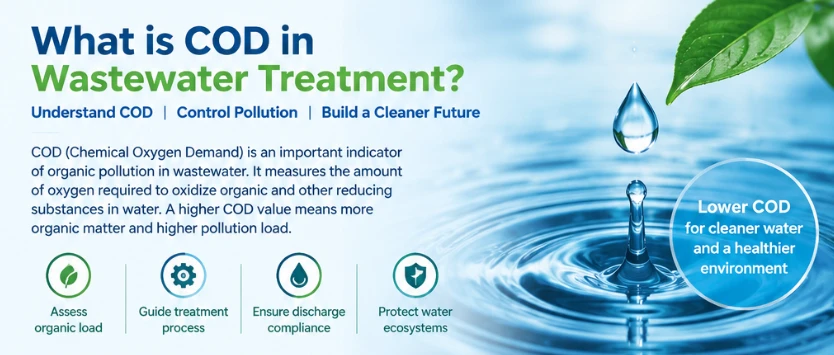
In industrial production and municipal wastewater treatment, COD (Chemical Oxygen Demand) is one of the important water quality indicators used to evaluate the degree of organic pollution in a water body.
The English name for COD is Chemical Oxygen Demand. Simply put, COD is used to represent the amount of oxidant consumed when reducing substances in a water sample are oxidized by a strong oxidant under certain conditions.
Reducing substances in water are not limited to organic matter; they may also include nitrites, sulfides, ferrous salts, and others. However, in most industrial wastewaters, the content of organic matter is usually significantly higher than that of other reducing substances. Therefore, COD can generally be used as an important reference indicator for determining the organic pollution load of wastewater.
From the perspective of wastewater treatment engineering, COD is not merely a laboratory testing number; it is also closely related to the biodegradability of wastewater, the selection of treatment processes, aeration requirements, chemical dosing, and whether the final discharge meets regulatory standards.
Therefore, before conducting industrial wastewater treatment or constructing a wastewater treatment system, accurately understanding the influent COD concentration is an important foundation for determining the treatment plan.
What Does a High COD Value Mean?
Generally speaking, the higher the COD concentration, the more reducing substances in the water that need to be oxidized.
When a large amount of organic matter enters a water body, microorganisms consume a large amount of dissolved oxygen in the process of decomposing this organic matter. If the pollution load continues to increase, it may lead to hypoxia in the water body, thereby affecting the aquatic ecosystem.
Therefore, the control of COD in wastewater treatment generally holds significant importance in the following aspects:
Assessing Organic Pollution Load
COD helps engineering personnel quickly assess the overall organic pollutant load in wastewater, providing a reference for subsequent process design.
Assessing Biochemical Treatment Pressure
For systems using processes such as the activated sludge process, biofilm process, or anaerobic treatment, the influent COD directly affects the treatment load of the microorganisms.
Assisting in Determining Treatment Processes
COD from different sources has different compositions.
For example, COD in food wastewater may mainly come from grease, starch, sugars, and proteins; COD in papermaking wastewater may be related to substances such as cellulose, lignin, and resins.
Therefore, the treatment process cannot be selected based solely on the COD numerical value; it must be comprehensively analyzed in combination with BOD, suspended solids (SS), pH, chroma, TDS, and specific pollutant compositions.
How is COD Determined?
COD testing is one of the fundamental tasks in the operation and management of wastewater treatment.
As introduced in the attached materials, common COD determination methods currently include:
Acidic potassium permanganate oxidation method
Potassium dichromate oxidation method
The basic principle of both methods is to utilize an oxidant to oxidize reducing substances in the water sample, and then calculate the COD based on the amount of oxidant consumed.
1. Acidic Potassium Permanganate Oxidation Method
Potassium permanganate solution is added to the water sample under acidic conditions, heated to boiling and maintained for a certain period, followed by titration with sodium sulfite solution to obtain the COD value through relevant calculations.
This method is more suitable for natural water or general wastewater containing easily oxidizable organic matter.
2. Potassium Dichromate Oxidation Method
The potassium dichromate method involves adding potassium dichromate and concentrated sulfuric acid to the water sample. After heating for reaction, an ammonium ferrous sulfate solution is used for titration, and COD is calculated based on the consumption of potassium dichromate.
Compared with the acidic potassium permanganate oxidation method, the potassium dichromate method can oxidize a wider variety of organic matter, and thus has stronger applicability for COD testing of industrial wastewaters with more complex compositions.
In actual engineering, the appropriate testing method should be selected according to the water sample type, testing methods, and applicable standards.
COD Standards and Control Requirements for Different Wastewaters
COD discharge requirements vary depending on the water body type, industry, and specific discharge standards.
Reference data provided in the attached materials include:
Surface water COD requirement: 15–40 mg/L
Wastewater COD requirement: 50–500 mg/L
Papermaking industry COD discharge standard: 200 mg/L
Food industry COD discharge standard: 300 mg/L
Chemical industry COD discharge standard: 400 mg/L
It should be particularly noted that actual engineering projects cannot determine whether discharge is permissible based solely on a general COD numerical value; confirmation must be made in accordance with the current national standards, local standards, industry standards, and specific environmental impact assessment (EIA) requirements of the project location.
For enterprises, the key to treating excessive COD is not simply adding a certain chemical, but first clarifying the source of COD, pollutant composition, and target discharge requirements, and then determining a suitable combined process.
What Impacts Does Excessive COD Bring?
When wastewater COD remains at a high level for a long time, it will produce multiple impacts on the water environment and the wastewater treatment system.
1. Depleting Dissolved Oxygen in Water Bodies
A large amount of organic matter entering a water body will be decomposed by microorganisms. This process requires the consumption of a large amount of dissolved oxygen.
If the organic pollution load is too high, it may cause hypoxia in the water body, thereby affecting the normal survival of fish and other aquatic organisms.
2. Affecting the Sensory Quality of Water Bodies
A higher organic pollution load may be accompanied by problems such as chroma, turbidity, and odor, reducing the transparency of the water body and affecting the overall quality of the water environment.
3. Increasing the Operational Pressure of Wastewater Treatment Systems
For industrial wastewater treatment plants, a higher influent COD means a higher organic load.
If the design capacity of the biochemical system is insufficient, the following issues may occur:
Excessively high load in the biochemical tank
Increased dissolved oxygen demand
Abnormal sludge conditions
Unstable effluent COD
Increased pressure on subsequent advanced treatment
Therefore, COD control should run through multiple stages of the wastewater treatment system, including pretreatment, biochemical treatment, and advanced treatment.
How to Reduce COD? Three Main Treatment Methods
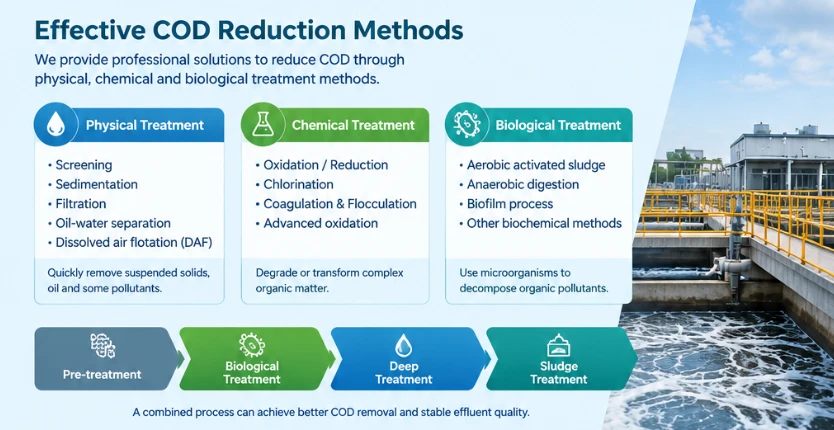
The core concept of reducing COD is to separate, oxidize, transform, or biodegrade organic pollutants in water through physical, chemical, and biological means.
In actual engineering, there is rarely a single process applicable to all types of high-COD wastewater. Therefore, combined design must be performed according to wastewater characteristics.
1. Physical Method: Separation First, Then Reducing Subsequent Treatment Load
Physical treatment mainly utilizes methods such as sedimentation, filtration, adsorption, and evaporation to separate pollutants from water.
Common physical pretreatment equipment includes:
Bar screens
Sedimentation tanks
Filtration equipment
Oil-water separators
Equalization tanks
Air flotation equipment
The advantage of physical treatment is that the process is relatively simple and can quickly remove some suspended solids, floating oils, sediments, and other pollutants.
However, for organic pollutants truly dissolved in water, relying solely on physical methods is usually difficult to achieve thorough removal; therefore, they often need to be combined with biochemical treatment or advanced treatment processes.
2. Chemical Method: Rapid Treatment of Refractory Pollutants
Chemical treatment mainly utilizes reactions such as oxidation, reduction, chlorination, and flocculation to transform pollutants or form substances that are easy to separate.
For example, in certain high-COD industrial wastewaters, if there is a large amount of refractory biodegradable organic matter, consideration can be given to improving the treatability of pollutants through advanced oxidation and other means.
Chemical treatment generally features fast reaction speed and high treatment efficiency, but chemical consumption, operating costs, and byproduct control also need to be key considerations in engineering design.
For wastewater containing a large amount of suspended solids and colloidal pollutants, coagulation and flocculation can also serve as an important link in pretreatment or advanced treatment.
3. Biological Method: Utilizing Microorganisms to Degrade Organic Matter
Biological treatment is one of the important methods for removing COD from industrial wastewater.
Its basic principle is to utilize the metabolic action of microorganisms to convert biodegradable organic matter into carbon dioxide, water, and other inorganic substances.
Common biological treatment methods include:
Aerobic activated sludge process
Anaerobic digestion
Biofilm process
Other biochemical treatment processes
For wastewater with good biodegradability, biological treatment usually has the advantage of relatively lower operating costs.
However, biological systems are quite sensitive to temperature, pH, dissolved oxygen, nutrient ratios, and changes in influent load. Therefore, COD removal from industrial wastewater requires process design combined with actual water quality, rather than simply copying standard procedures.
Why Do High-COD Wastewaters Require Combined Processes?
In actual engineering, COD sources are often relatively complex.
For example, an industrial wastewater may simultaneously contain suspended solids, colloids, organic matter, grease, chroma, and refractory pollutants. If only a single treatment method is adopted, it is difficult to accommodate different pollutants.
Therefore, a complete set of wastewater treatment equipment can generally be set up according to pollutant characteristics:
Pretreatment-Biochemical Treatment-Advanced Treatment -Sludge Treatment
Such a combination method can first reduce the pollution load, then remove biodegradable organic matter through biochemical processes, and finally use advanced treatment to further improve effluent water quality.
This is also why wastewater treatment projects cannot look only at "what the COD is," but also need to understand:
BOD
COD
SS
pH
TDS
Chroma
Grease
Water temperature
Wastewater source
Discharge or reuse requirements
Only by obtaining relatively complete water quality data can the COD removal process be selected more reasonably.
Papermaking Wastewater COD Treatment Case Study
In the attached case, wastewater from a papermaking mill mainly originates from production processes such as paper machines, pulpers, and bleaching machines.
The wastewater contains a large amount of organic matter such as cellulose, lignin, resins, and grease, and the influent COD reaches:
1000 mg/L
The national standard reference value adopted in the attached case is:
200 mg/L
Therefore, this wastewater cannot be discharged directly and requires systematic treatment.
Treatment Plan
For this papermaking wastewater, the project adopted:
Pretreatment System + Biochemical Treatment System + Advanced Treatment System + Sludge Treatment System
In the pretreatment stage, physical methods such as bar screens, sedimentation, and filtration were used to remove suspended solids, sediments, and floating oil, reducing COD by approximately:
30%
Subsequently, it entered the biochemical treatment stage, where aerobic activated sludge processes were used to degrade organic pollutants via microorganisms, further reducing COD by approximately:
70%
Afterward, ozone oxidation was adopted as an advanced treatment means to further oxidize refractory organic matter and chroma substances, reducing COD by approximately:
10%
Sludge was dewatered through a filter press to reduce sludge volume and weight, facilitating subsequent transportation and disposal.
Final Treatment Effect
After treatment by the complete set of wastewater treatment equipment:
COD was reduced from 1000 mg/L to 150 mg/L.
In the attached case, the final COD met the requirements, while indicators such as chroma, turbidity, and odor were also significantly improved.
This case illustrates that for high-COD papermaking wastewater, the rational configuration of pretreatment, biochemical treatment, and advanced treatment can form a multi-stage COD removal path.
Food Processing Wastewater COD Treatment Case Study
Another case comes from the food processing industry.
Wastewater from this food plant is mainly generated from processes such as food processing, cleaning, and disinfection, containing organic matter such as grease, starch, sugars, and proteins.
The influent COD in the case reached:
800 mg/L
The food industry COD standard reference value in the attachment is:
300 mg/L
Therefore, this wastewater needs to undergo further treatment to meet discharge requirements.
Treatment Plan
This project adopted:
Pretreatment System + Biochemical Treatment System + Advanced Treatment System + Sludge Treatment System
First, equipment such as oil-water separators, equalization tanks, and air flotation machines were used to treat grease, suspended solids, and scum, reducing COD by approximately:
40%
Afterward, an anaerobic digestion process was adopted to convert some organic pollutants into biogas and inorganic salts through the action of anaerobic microorganisms, reducing COD by approximately:
50%
In the advanced treatment stage, a biofilm process was utilized to further remove remaining organic matter, reducing COD by approximately:
10%
Finally, sludge was treated via a dewatering machine to reduce sludge volume and weight.
Final Treatment Effect
After treatment by the complete treatment system:
COD was reduced from 800 mg/L to 200 mg/L.
According to the attached case, this treatment result met the standard requirements adopted by the case, while indicators such as chroma, turbidity, and odor were also improved.
How to Select a Suitable COD Treatment Plan?
The COD composition of wastewater produced by different industries varies significantly.
Therefore, when selecting a COD wastewater treatment plan, judgments cannot be made solely based on the high or low COD concentration.
For example:
Food Wastewater: Generally requires a focus on organic pollutants such as grease, proteins, sugars, and starch; consideration can be given to combining pretreatment with anaerobic and aerobic biochemical processes.
Papermaking Wastewater: Requires attention to pollutants such as cellulose, lignin, resins, and chroma; usually requires a combination of pretreatment, biochemical treatment, and advanced treatment.
Chemical Wastewater: Pollutant composition may be more complex; it is necessary to further analyze refractory organic matter, toxic substances, salinity, and other characteristic pollutants before determining suitable treatment technologies.
Therefore, truly professional industrial wastewater treatment plans should be established based on water quality analysis and treatment objectives.
How Does ECOLINK TECHNOLOGY Provide Wastewater Treatment Solutions?
ECOLINK TECHNOLOGY specializes in the supply of water treatment chemicals(PAM & PAC) and water treatment equipment, providing industrial clients with product matching, technical support, and one-stop water treatment services.
For different types of industrial wastewater, we can assist in analyzing suitable treatment directions based on the water quality data, treatment volume, and final discharge or reuse requirements provided by clients.
Service contents can cover:
Wastewater treatment equipment
Industrial wastewater treatment systems
Water treatment chemicals
Coagulation and flocculation treatment
Biochemical treatment systems
Advanced treatment systems
Sludge treatment
RO/UF/EDI and other water treatment equipment
Project product matching
Technical data support
Sample testing and product evaluation
For industrial clients needing to reduce COD, it is recommended to provide as complete water quality data as possible in the early stage of the project, including influent COD, BOD, SS, pH, TDS, chroma, treatment volume, and target effluent indicators.
ECOLINK TECHNOLOGY can assist in judging whether physical, chemical, or biological treatment, or a combination of multiple processes, is more suitable based on these basic information points.
Reducing COD is Not Simply "Adding Chemicals"
When encountering excessive COD, many enterprises' first reaction may be to increase the chemical dosing amount.
However, from an engineering perspective, analyzing the cause of excessive COD is often much more important than simply adding chemicals.
If COD mainly comes from biodegradable organic matter, then optimizing the biochemical system may be more economical than simple chemical oxidation.
If COD mainly comes from suspended solids and colloids, then optimizing the coagulation, sedimentation, or air flotation links may be more effective.
If COD mainly comes from refractory organic matter, then it is necessary to consider ozone oxidation, advanced oxidation, bio-augmentation, or other advanced treatment methods.
Therefore, truly effective COD control should follow:
Water Quality Analysis -Pollutant Identification- Process Selection-Parameter Optimization -Continuous Operation Monitoring
Rather than simply adopting a single treatment method.
Conclusion: From COD Data to Complete Wastewater Treatment Plans
COD is a very important water quality parameter in wastewater treatment, but a single COD number cannot completely describe a stream of wastewater.
To achieve stable COD removal, it is necessary to further understand the organic composition, biodegradability, suspended solids, grease, salinity, and other pollutants in the wastewater, and design a reasonable treatment flow according to final discharge or reuse requirements.
From pretreatment to biochemical treatment, and then to advanced treatment and sludge disposal, every link may affect the final COD result.
The papermaking wastewater case in the attachment shows that COD can be reduced from 1000 mg/L to 150 mg/L; the food wastewater case reduced it from 800 mg/L to 200 mg/L. These cases embody the application value of combined treatment processes in high-COD industrial wastewater.
For enterprises looking for industrial wastewater COD treatment plans, COD removal processes, wastewater treatment equipment, or water treatment chemicals, ECOLINK TECHNOLOGY can provide support from the perspective of product matching and overall solutions.