I. Difference Between Pure Water and Mineral Water: Why Are Different Water Treatment Systems Needed?
With the continuous improvement of water quality requirements in the drinking water market, the food and beverage industry, and industrial production, selecting an appropriate water treatment system has become a crucial aspect of corporate investment and production management.
Although both pure water and mineral water are treated or managed drinking water, clear differences exist between the two regarding raw water conditions, treatment processes, final water quality, and production equipment.
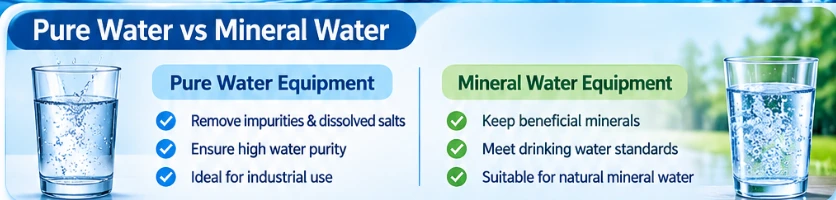
Pure Water Treatment Equipment primarily utilizes technologies such as reverse osmosis, distillation, and ion exchange to reduce dissolved salts, suspended solids, organic matter, and other impurities in raw water, meeting the water quality demands of various production processes.
Mineral Water Treatment Equipment is based on natural mineral water sources that meet relevant standards. Through appropriate filtration, purification, and disinfection processes, it controls microbial and other pollution risks while preserving the inherent mineral composition and characteristics of the water source as much as possible.
Therefore, when selecting equipment, one should not focus solely on equipment prices. A comprehensive evaluation of raw water quality, target product standards, design production capacity, operating costs, and long-term maintenance conditions is also required.
ECOLINK TECHNOLOGY focuses on product matching and technical services for water treatment chemicals and water treatment equipment, offering corresponding water treatment solutions tailored to different water sources and application needs.
II. Working Principles and Core Process Flow of Pure Water Equipment
2.1 Basic Principle of Reverse Osmosis Technology
Currently, Reverse Osmosis (RO) is one of the most widely applied core treatment technologies in pure water production.
Reverse osmosis technology uses the pressure provided by high-pressure pumps to force raw water through a reverse osmosis membrane with selective separation capabilities. Water molecules can pass through the membrane, while most dissolved salts, colloids, suspended particles, and other impurities are rejected, thereby forming two streams of water:
Permeate (Pure Water): Product water that passes through the reverse osmosis membrane.
Concentrate: The water stream rejected by the reverse osmosis membrane, containing higher concentrations of impurities and minerals.
The desalination effect of the reverse osmosis system is influenced by factors such as raw water salinity, operating pressure, temperature, membrane performance, and recovery rate. In actual design, membrane element configuration and operating parameters must be determined based on raw water analysis reports and target product water quality.
2.2 Main Components of Pure Water Equipment
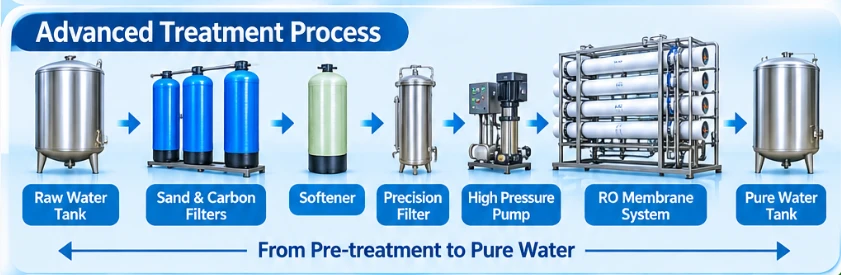
A complete set of pure water equipment usually consists of the following components:
Raw Water Tank: Stores raw water to ensure continuous supply to the system.
Raw Water Pump: Provides the required flow rate and pressure for subsequent pretreatment units.
Sand Filter: Removes sand, rust, and other large suspended particles.
Activated Carbon Filter: Reduces residual chlorine, organic matter, color, and odor.
Softener: Reduces calcium and magnesium ion concentrations in water via ion exchange, lowering the risk of reverse osmosis membrane scaling.
Precision Filter (Micron/Cartridge Filter): Further retains fine particles to reduce the risk of particulate fouling on membrane elements.
High-Pressure Pump: Provides the operating pressure required by the reverse osmosis system.
RO Membrane Elements: Complete the main desalination and impurity separation process.
Pure Water Tank: Stores reverse osmosis product water.
Pure Water Pump: Conveys treated water to downstream points of use.
UV Sterilizer: Utilizes ultraviolet light to lower microbial risks in the water.
Ozone Generator: Used for disinfection control in subsequent water treatment or storage systems; specific configurations depend on product process requirements.
2.3 Complete Treatment Process of Pure Water Equipment
A typical RO pure water production system operates according to three main stages: raw water pretreatment, membrane separation, and post-treatment.
First Stage: Raw Water Pretreatment Raw water is first delivered by the raw water pump to the sand filter to remove large particle impurities such as sand, rust, and suspended solids.
It then enters the activated carbon filter to reduce residual chlorine, organic matter, color, and odor. For systems utilizing polyamide reverse osmosis membranes, controlling inlet residual chlorine is particularly critical, as free chlorine can cause oxidative damage to membrane materials.
After activated carbon treatment, the water enters the softener, which reduces the risk of insoluble salt deposition (such as calcium carbonate) on the membrane surface by lowering calcium and magnesium ion levels.
Finally, the water passes through a precision filter to further remove fine particles, providing more stable inlet conditions for the reverse osmosis membrane.
Second Stage: RO Membrane Separation Pretreated water enters the high-pressure pump and is introduced into the RO membrane elements under appropriate pressure.
The membrane elements split the feed water into two parts: pure water and concentrate. Pure water enters the pure water tank for storage, while concentrate is recycled or discharged according to system design, raw water conditions, and local discharge regulations.
Third Stage: Product Water Disinfection and Conveyance Pure water is conveyed by the pure water pump to downstream treatment units. UV sterilizers and ozone generators can be configured based on application requirements to control microbial risks during storage and conveyance.
It should be noted that ultraviolet light and ozone represent different disinfection methods. It cannot be simply assumed that increasing the quantity of equipment will automatically improve water quality. Design should be reasonably conducted based on storage tank structures, piping hygienic conditions, product standards, and disinfection validation results.
III. Advantages, Limitations, and Price Factors of Pure Water Equipment
3.1 Main Advantages of Pure Water Equipment
Pure water equipment can effectively reduce dissolved salts and various impurities in raw water, making it suitable for production scenarios with high requirements for water purity and stability.
Main advantages include:
Stable Water Quality: Consistent product water quality can be obtained through reasonable pretreatment and reverse osmosis processes.
Good Desalination Effect: RO membranes can remove most dissolved salts from water.
Wide Industry Application: Can be used in food and beverage, pharmaceutical, chemical, electronics, and other fields.
High Degree of Automation: Can be configured with pressure, flow, conductivity, and liquid level monitoring devices to monitor operating status.
Easy System Expansion: The number of membrane elements, storage capacity, and post-treatment units can be adjusted according to production demands.
3.2 Limitations of Pure Water Equipment
In practical use, RO pure water systems also present specific operational and maintenance requirements:
RO systems require certain operating pressures, thereby consuming electrical energy.
RO membranes are key consumables that require cleaning or replacement based on fouling status and operating performance.
The equipment generates concentrate, requiring proper planning for recycling or discharge treatment.
Fluctuations in raw water quality may affect membrane operating conditions and system water production capacity.
Inadequate maintenance of the pretreatment system can easily cause membrane fouling, scaling, and reduced water production capacity.
Therefore, when purchasing industrial pure water equipment, enterprises should evaluate power consumption, membrane replacement costs, cleaning chemical costs, and daily maintenance expenses in addition to initial investment.
3.3 Prices of Pure Water Equipment
The price of pure water equipment is usually determined by factors such as treatment capacity, system configuration, degree of automation, membrane brands, materials, and technical services.
Generally, the price range for the pure water equipment listed in the original text spans from tens of thousands to hundreds of thousands of RMB.
Equipment configurations may vary significantly for projects with different production capacities and water quality requirements. Before finalizing a procurement budget, it is recommended to provide a raw water quality report, target product water standards, and actual water consumption to facilitate appropriate equipment selection.
IV. Treatment Characteristics and Process Design of Mineral Water Equipment
4.1 Basic Treatment Concept of Mineral Water Equipment
Unlike RO pure water equipment, which aims primarily at reducing dissolved salt content, mineral water equipment needs to focus on the water source's own mineral composition and product water quality characteristics.
Mineral water production is typically based on natural mineral water sources that comply with relevant standards. Equipment configuration should adhere to the principle of preserving the original characteristics of the water source; ordinary water processed with added minerals cannot be directly equated to natural mineral water.
Based on water source analysis results and applicable product standards, a mineral water treatment system can be configured with:
Raw water storage and conveyance systems; Multi-media filtration or appropriate precision filtration devices; Iron and manganese removal units configured according to water quality needs; Disinfection systems suitable for target product requirements; Sanitary-grade storage tanks, piping, and filling equipment.
4.2 Key Water Quality Indicators for Mineral Water Equipment
Mineral water equipment design cannot focus solely on filtration accuracy; a comprehensive analysis of the water source is also required.
Key parameters to focus on include:
pH value; Total Dissolved Solids (TDS); Primary minerals such as calcium, magnesium, sodium, and potassium; Bicarbonate, sulfate, and chloride ions; Related elements such as iron and manganese; Microbiological indicators; Contaminant indicators required by other applicable standards.
Mineral compositions vary significantly across different water sources, and treatment processes cannot be duplicated directly from other projects. For mineral water production lines, proper equipment selection should be based on water source test reports and final product standards.
V. How to Choose Between Pure Water Equipment and Mineral Water Equipment?
When planning drinking water production projects or industrial water treatment projects, enterprises should start from actual application requirements rather than simply comparing which of the two types of equipment is better.
5.1 Selection Based on Water Purpose
If the water is primarily used in electronics, pharmaceuticals, chemicals, or certain food production processes where the process requires low dissolved salt content, RO pure water equipment is generally more suitable. Advanced treatment units such as ion exchange or EDI can be added if necessary.
If the project involves natural mineral water production, it should first be confirmed whether the water source meets mineral water requirements. Mineral water treatment equipment should then be designed according to water source characteristics to preserve mineral compositions that conform to product standards as much as possible.
5.2 Selection Based on Water Consumption and Production Capacity
Equipment treatment capacity should match actual production water consumption.
For continuous production projects, the following should be considered:
Actual hourly water consumption; Daily operating hours; Peak water demand; Storage tank capacity; Backup equipment capacity; Design recovery rate of the RO system.
Specifically, the actual water production capacity of RO equipment is related to feed water temperature, water quality, operating pressure, and membrane fouling extent, and should not be judged solely by the nominal capacity on the equipment nameplate.
5.3 Selection Based on Investment Budget and Operating Costs
When procuring water treatment equipment, it is recommended to use Total Cost of Ownership (TCO) as the evaluation basis rather than merely comparing equipment price quotes.
Expenses to consider include:
Initial equipment procurement and installation costs; Operating electricity costs; Filter media and cartridge replacement costs; RO membrane cleaning and replacement costs; Disinfection and cleaning chemical costs; Manual maintenance and water testing costs; Concentrate treatment and discharge costs.
A reasonable equipment configuration can lower long-term operational costs while meeting water quality requirements.
VI. Key Daily Operation and Maintenance Points for Pure Water Equipment
Scientific equipment maintenance can extend equipment service life and maintain stable water production capacity.
6.1 Periodically Monitor Raw Water and Product Water Quality
It is recommended to regularly test indicators such as conductivity, pH, and turbidity of raw and product water, adding relevant testing parameters based on specific applications.
For RO systems, feed pressure, concentrate pressure, product flow rate, and concentrate flow rate should also be continuously recorded to identify abnormal changes in a timely manner.
6.2 Control Reverse Osmosis Membrane Fouling Properly
Common problems with RO membranes include:
Inorganic salt scaling; Colloidal fouling; Organic fouling; Microbial fouling; Membrane oxidation caused by inlet residual chlorine.
Targeting different fouling types, corresponding pretreatment, operational adjustments, and chemical cleaning measures must be taken. The selection of cleaning chemicals should be determined based on foulant types, membrane materials, and membrane manufacturer requirements, avoiding indiscriminate use of cleaning agents.
6.3 Maintain Pretreatment Equipment Regularly
Sand filters require backwashing based on differential pressure and operating status; activated carbon filters require attention to adsorption capacity and backwash conditions; softeners require inspection of resin exchange capacity and regeneration status; precision filter cartridges should be replaced in a timely manner based on differential pressure changes.
Normal operation of pretreatment equipment is the foundation for ensuring stable operation of RO membranes.
6.4 Maintain Hygiene in Water Storage and Conveyance Systems
Pure water tanks, water pipelines, valves, and related connection components can all become sources of secondary contamination.
Tank and piping cleaning/disinfection plans should be established according to production requirements to control dead legs and long-term stagnant water, preventing treated water from becoming contaminated during storage and conveyance.
VII. ECOLINK TECHNOLOGY: Water Treatment Equipment and System Solution Services
Selecting appropriate water treatment equipment requires considering not only technical parameters of single units but also raw water conditions, process flows, equipment matching, and post-maintenance comprehensively.
ECOLINK TECHNOLOGY focuses on water treatment chemicals and water treatment equipment, committed to providing water treatment solutions for customers across different countries and regions through product matching, technical support, and auxiliary services.
Our products and service directions include:
Pure Water Equipment: RO pure water systems and related pretreatment and post-treatment configurations.
Mineral Water Treatment Equipment: Process configurations tailored to water source test results and product requirements.
Industrial Water Treatment Systems: Water treatment equipment tailored to various industrial production processes.
Water Treatment Chemicals: Including polyacrylamide (PAM), polyaluminium chloride (PAC), and other water treatment agents.
Technical Support Services: Assisting with product and equipment selection based on customer raw water conditions, target water quality, and application demands.
We place great emphasis on practical application needs and suggest that customers provide raw water quality reports, target product water standards, design production capacities, and application industries before selecting equipment, enabling a more accurate determination of treatment processes and equipment configurations.
VIII. Conclusion: Select Water Treatment Equipment Tailored to Water Quality Requirements and Production Demands
Pure water equipment and mineral water equipment each have distinct characteristics regarding treatment targets, process designs, and application fields.
RO pure water equipment is suitable for application scenarios requiring strict control over dissolved salts and impurities; mineral water equipment must be based on qualified natural water sources, appropriately controlling treatment intensity and preserving the water source's mineral characteristics while ensuring hygienic safety.
When selecting equipment, it is recommended to prioritize evaluating water source conditions, target water quality, actual production capacity, equipment investment, and long-term O&M costs.
ECOLINK TECHNOLOGY can provide water treatment equipment and related product matching services based on different project requirements.
For information on pure water equipment prices, RO system configurations, or mineral water production equipment selection, feel free to contact us with your specific water quality and project requirements to receive a more tailored equipment proposal.