1. Why Are More and More Enterprises Choosing Integrated Water Purification Equipment?
Water quality stability directly affects industrial production, commercial operations, and terminal water safety. Whether in industrial manufacturing, commercial water supply, or high-water-quality-demanding industries such as electronics, pharmaceuticals, and chemicals, selecting the appropriate water treatment process is a crucial step in ensuring production efficiency and water quality.
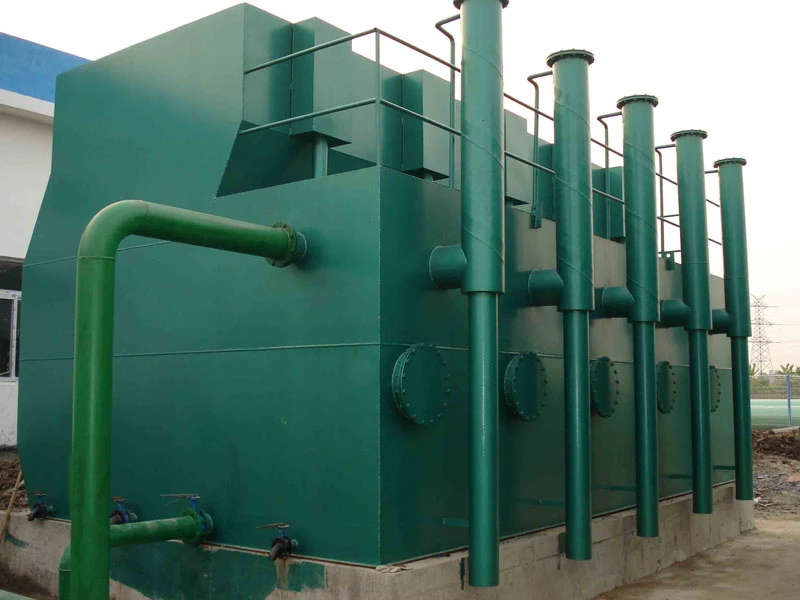
Integrated water purification equipment integrates multiple water treatment units into a single system, purifying raw water in stages through processes such as pretreatment, membrane separation, and subsequent disinfection. Compared with configuring multiple separate pieces of equipment, a reasonably designed integrated system helps simplify process connections, optimize equipment layout, and enhance the convenience of operational management.
For enterprises requiring a continuous and stable water supply, equipment selection must not only consider effluent water quality but also comprehensively evaluate raw water conditions, designed water production capacity, energy consumption, maintenance costs, and future expansion needs.
ECOLINK TECHNOLOGY focuses on the matching and supply of water treatment chemicals and water treatment equipment. Based on the customer's application scenarios, raw water quality, and target effluent indicators, we assist in matching appropriate water treatment solutions to provide more targeted product selection and technical support for industrial and commercial customers.
2. What Is Integrated Water Purification Equipment? What Are Its Main Components?
Integrated water purification equipment is a system that integrates and operates multiple water treatment process units. It can combine different filtration, softening, membrane separation, and disinfection processes according to raw water characteristics and final water use requirements.
The main components of a typical system include:
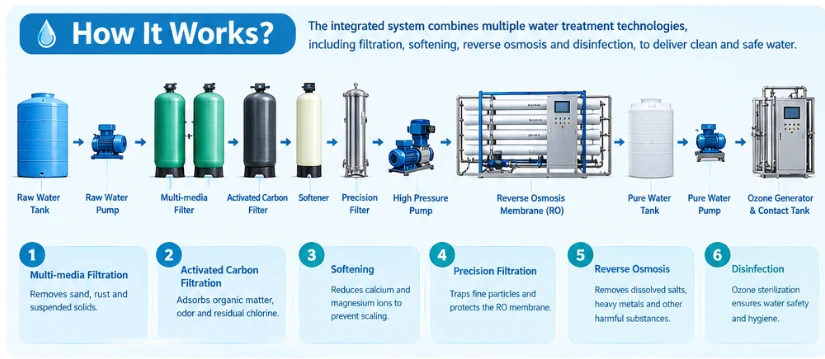
Raw Water Tank: Used to store raw water and provide relatively stable water supply conditions for subsequent treatment.
Raw Water Pump: Transports raw water to various levels of pretreatment units.
Multi-Media Filter: Removes sand, rust, and some suspended solids, reducing the particle load on subsequent treatment units.
Activated Carbon Filter: Adsorbs certain organic matter, odors, and residual chlorine; specific effects depend on activated carbon properties and operating conditions.
Softener: Reduces calcium and magnesium ion content in water through ion exchange to lower the risk of scaling.
Precision Filter: Further intercepts particulate matter to reduce the suspended solids load entering reverse osmosis membrane elements.
High-Pressure Pump and Reverse Osmosis Membrane Elements: Drive the membrane separation process through pressure to reduce dissolved salts and other retainable substances in water.
Pure Water Tank and Pure Water Pump: Used to store and transport treated water.
Ozone Generator and Ozone Contactor: In applicable process designs, subsequent disinfection treatment is achieved through ozone contact.
Not all projects require all the above-mentioned units to be configured. The actual system should be designed based on raw water test results, target water quality, water consumption, and hygiene requirements.
3. Working Principle of Integrated Water Purification Equipment: From Raw Water to Purified Water
A reasonable process combination is key to ensuring stable system operation. A typical treatment process is as follows:
1. Multi-Media Filtration: Reducing Particulate Load in Raw Water
Raw water is first delivered by the raw water pump to the multi-media filter. Filter media can intercept part of the sand, rust, and suspended solids, thereby reducing the pollution load on subsequent equipment.
When raw water turbidity is high, filter media, filtration speed, and backwashing conditions should be evaluated based on actual conditions. If necessary, coagulation, sedimentation, or other pretreatment processes can be added to improve the overall treatment effect.
2. Activated Carbon Filtration: Improving Water Quality and Protecting Subsequent Units
Water after preliminary filtration enters the activated carbon filter. Activated carbon can adsorb certain organic substances, odors, and pigments, and reduce residual chlorine content under appropriate conditions.
For systems using polyamide reverse osmosis membranes, controlling feedwater residual chlorine is particularly important, as free chlorine may cause oxidative damage to membrane materials. Therefore, activated carbon filtration or other dechlorination measures should be configured according to raw water quality and membrane element requirements, and the dechlorination effect should be tested regularly.
3. Softening Treatment: Controlling Scaling Risks
When raw water hardness is high, calcium and magnesium ions may form deposits on membrane surfaces or inside equipment, affecting system operation efficiency.
The softener reduces water hardness through ion exchange, helping to reduce scaling risks. For raw water with high hardness, high alkalinity, or containing other scaling ions, it is also necessary to evaluate antiscalant dosing, softening treatment, or other applicable solutions in combination with water quality analysis.
4. Precision Filtration: Further Reducing Particulate Pollution
Pretreated water enters the precision filter to further remove residual particles and reduce the pollution load entering reverse osmosis membrane elements.
It should be noted that precision filters are mainly used to intercept particulate matter and cannot independently guarantee the removal of dissolved salts, all colloids, bacteria, or viruses. Their filtration precision should be reasonably selected based on the feedwater requirements of the membrane elements.
5. Reverse Osmosis Membrane Separation: Reducing Dissolved Substance Content
Pretreated water is pressurized by a high-pressure pump and enters the reverse osmosis membrane elements. Reverse osmosis utilizes the selective separation characteristics of semi-permeable membranes to allow some water molecules to pass through the membrane while retaining most dissolved salts and other retainable substances.
The actual desalination rate and water production capacity of a reverse osmosis water purification system are affected by factors such as feedwater salinity, temperature, operating pressure, recovery rate, and membrane fouling degree.
Therefore, equipment design cannot focus solely on the membrane elements themselves; it also requires reasonable configuration of pretreatment, concentrated water discharge, pressure control, and operational monitoring systems to ensure long-term operational stability.
6. Pure Water Storage and Ozone Disinfection
Product water treated by reverse osmosis can be transported to a pure water tank for storage and then supplied to water use points via a pure water pump.
In applicable process designs, the system can also be configured with an ozone generator and an ozone contactor for subsequent disinfection treatment of the water. Ozone dosage, contact time, equipment materials, and subsequent water storage conditions should all be determined based on actual water quality and hygiene requirements.
For applications with high microbial control requirements, tank hygiene design, pipeline cleaning, circulation methods, and terminal disinfection measures should also be comprehensively evaluated.
4. Three Core Advantages of Integrated Water Treatment Equipment
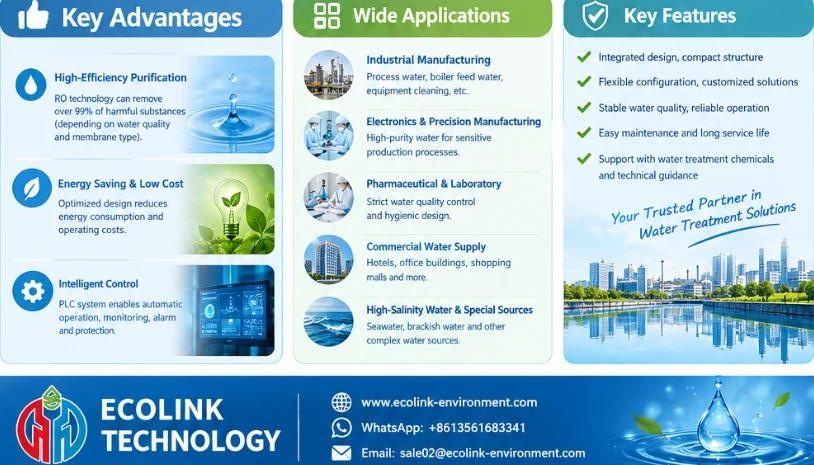
Advantage 1: Multi-Stage Purification, Enhancing Water Quality Control Capability
Through filtration, softening, reverse osmosis, and applicable disinfection processes, each treatment unit can divide labor and collaborate to target and treat different types of pollutants.
The reverse osmosis process mentioned in the original text has a removal capacity of over 99% for harmful substances in water. This figure should be understood in combination with specific pollutant types, membrane element performance, and actual operating conditions, and cannot be directly regarded as a guarantee that all pollutants can achieve the same removal rate.
Similarly, whether the final effluent of the equipment meets the requirements of drinking water, pharmaceutical, electronic, or chemical industries needs to be based on corresponding water quality indicators, applicable standards, and testing results.
Advantage 2: Optimizing Energy Use, Reducing Comprehensive Operating Costs
A scientifically configured water treatment system can optimize energy consumption and maintenance costs through the reasonable selection of pumps, filters, membrane elements, and automatic control equipment.
The operating cost of a reverse osmosis system depends not only on electricity consumption but is also related to raw water quality, pretreatment chemicals, membrane cleaning frequency, consumable replacement cycles, and water recovery rate.
Regularly checking filter pressure differentials, pressure before and after membranes, product water flow rate, and conductivity helps to discover pollution or scaling problems in a timely manner. Only when water quality and equipment conditions permit should the feasibility of concentrated water recycling and reuse be evaluated, to avoid salt accumulation or system failures caused by unreasonable reuse.
Advantage 3: Automated Control, Simplifying Daily Operational Management
Reasonably designed integrated water purification equipment can be configured with PLC control systems and relevant instruments to achieve equipment start-stop, operating status monitoring, abnormal alarms, and partial automatic protection functions.
According to project requirements, the system can also be configured with automatic backwashing, membrane cleaning auxiliary control, water tank liquid level control, and remote monitoring functions.
It should be noted that the degree of automation depends on the actual configuration. Automatic control can help operators improve management efficiency, but regular inspections, consumable replacements, and preventive maintenance still need to be carried out according to equipment requirements.
5. One-Touch Operation and Intelligent Control: Making Water Treatment Management More Convenient
For industrial and commercial projects requiring long-term continuous water supply, operational convenience and operational safety are equally important.
In systems equipped with corresponding control functions, one-touch operation can simplify equipment start-up and shutdown processes, reduce repetitive operations, and lower the complexity of daily management.
Intelligent Identification and Operational Adjustment
The system can adjust its operating status according to preset logic based on liquid level, pressure, flow rate, or other sensor signals. For example, when the storage tank reaches a set liquid level, the control system can stop the relevant water supply or water production equipment.
Abnormal Alarm and Safety Protection
By configuring appropriate pressure switches, liquid level sensors, and other protection devices, the system can issue alarms or execute shutdown protection under specific abnormal conditions, helping to reduce the risk of equipment damage.
Energy-Saving Operation and Reducing Ineffective Work
When the water tank is full, raw water supply is insufficient, or the system triggers preset protection conditions, automatic control logic can reduce unnecessary operation.
Specific protection items and control logic should be determined during the design phase and debugged according to on-site water supply conditions, equipment configuration, and operational requirements.
6. Which Industries Are Integrated Water Purification Equipment Suitable For?
Different application scenarios have obvious differences in requirements for effluent water quality, water supply capacity, and operation modes. Therefore, when selecting industrial integrated water purification equipment, priority should be given to clarifying the water source type and ultimate purpose.
1. Industrial Manufacturing
Water demand in manufacturing may involve production makeup water, equipment cleaning, boiler feedwater pretreatment, and other process water. Treatment units such as multi-media filtration, activated carbon filtration, softening, and reverse osmosis can be configured according to specific process requirements.
2. Electronics and Precision Manufacturing
Some production links in the electronics industry have high requirements for the content of ions, particulate matter, and organic matter in water. Reverse osmosis can serve as an important link in pure water preparation, and when necessary, can be combined with deep treatment processes such as electrodeionization (EDI).
Final water quality should be determined based on production processes and customer requirements, and whether it meets ultrapure water standards cannot be judged solely by equipment type.
3. Pharmaceuticals and Laboratories
Pharmaceutical and laboratory applications typically require stricter water quality control, hygienic design, and operational records. System configuration should be determined based on actual usage and applicable regulations, adding corresponding deep treatment, disinfection, and water quality monitoring links when necessary.
4. Commercial Water Supply and Supporting Facilities
Hotels, office buildings, commercial facilities, and other places requiring centralized water supply can select appropriate filtration, softening, or reverse osmosis systems based on raw water conditions and actual water consumption.
5. High-Salinity Raw Water and Special Water Source Treatment
For special water sources such as high-salinity groundwater or seawater, it is necessary to evaluate applicable membrane systems, operating pressure, material selection, and pretreatment processes based on salinity, pollutant composition, and target product water requirements. Such projects usually require separate process design and cannot directly adopt ordinary municipal tap water treatment plans.
7. How to Choose a Suitable Reverse Osmosis Water Purification System?
Whether the selection is reasonable directly affects equipment investment, product water quality, and long-term operating costs. It is recommended to focus on evaluating the following factors before purchasing:
First, clarify raw water quality. It is recommended to provide the raw water source and water quality test report, including turbidity, hardness, total dissolved solids (TDS), conductivity, pH, residual chlorine, and other indicators relevant to the project.
Second, determine target effluent water quality. Different uses correspond to different water quality requirements. Key indicators to be controlled should be clarified, such as conductivity, TDS, hardness, or specific ion content, and whether further deep treatment is required should be confirmed.
Third, calculate actual water consumption. In addition to average daily water consumption, hourly water demand, peak water consumption, operating duration, and water storage requirements should also be clarified. System water production capacity should match actual demand, and the impact of raw water temperature and operating conditions on water production capacity should be considered.
Fourth, evaluate installation space and site conditions. Equipment layout should consider water supply conditions, drainage facilities, electrical configuration, maintenance channels, and subsequent consumable replacement space. For projects with limited space, integrated design helps optimize layout, but necessary maintenance space must still be reserved.
Fifth, focus on long-term operation and after-sales support. In addition to equipment purchase prices, comprehensive consideration should be given to costs such as membrane elements, filter media, chemicals, electricity, cleaning, and regular maintenance. Complete technical data and clear maintenance plans help reduce uncertainties in long-term equipment operation.
ECOLINK TECHNOLOGY can assist in evaluating equipment configuration directions based on customer-provided raw water quality, target effluent indicators, and water consumption needs, and provide supporting water treatment products and technical communication support.
8. ECOLINK TECHNOLOGY: Matching Water Treatment Solutions for Different Water Needs
The success of a water treatment project depends not only on the performance of a single piece of equipment but also on process selection, equipment configuration, chemical matching, and subsequent operational management.
ECOLINK TECHNOLOGY focuses on water treatment chemicals and water treatment equipment, committing to providing appropriate solutions for different application scenarios through product matching, technical support, and one-stop service.
For different projects, the following configuration directions can be evaluated based on actual needs:
Pretreatment System: Multi-media filtration, activated carbon filtration, softening, precision filtration, etc.
Reverse Osmosis System: Match membrane elements and related auxiliary equipment according to raw water quality and water production targets.
Deep Pure Water Treatment: Evaluate subsequent treatment processes such as EDI when necessary.
Disinfection and Water Storage System: Configure corresponding treatment units according to water quality and hygiene requirements.
Water Treatment Chemicals Matching: Evaluate applicable water treatment agents based on specific processes and operating conditions.
Specific equipment configuration, effluent indicators, and automation functions must be confirmed according to project requirements. Through early demand communication and reasonable model selection, customers can be helped to reduce unnecessary equipment configuration and establish a clear technical foundation for subsequent operation and maintenance.
9. Conclusion: Starting from Water Quality Requirements, Choose a More Suitable Water Purification Solution
From raw water pretreatment to reverse osmosis membrane separation, and then to water storage and applicable disinfection links, a reasonable integrated system can connect multiple water treatment units in an orderly manner, helping enterprises establish a water supply process that is easier to manage.
However, the equipment truly suitable for a project is not necessarily the one with the most configurations or the lowest price, but a solution that achieves a reasonable balance among target water quality, actual water production capacity, operating costs, and maintenance requirements.
If you are looking for industrial integrated water purification equipment solutions, or need to match a suitable reverse osmosis system for an existing project, welcome to contact ECOLINK TECHNOLOGY.
Please provide your raw water source, target effluent water quality, daily water consumption, and main application scenarios, and we will assist in evaluating suitable equipment configurations and water treatment products accordingly.
ECOLINK TECHNOLOGY
Official Website: www.ecolink-environment.com
WhatsApp: +8613561683341
Email: sale02@ecolink-environment.com