1. What Is Swimming Pool Water Purification Equipment? Why Is a Professional Water Treatment System Needed?
Swimming pool water quality directly affects swimmers' health, comfort, and the lifespan of pool facilities. As commercial pools, hotel pools, fitness centers, water parks, and private pools become increasingly widespread, continuously removing impurities from water, controlling microbial contamination, and maintaining stable water quality have become crucial aspects of pool operation and management.
Swimming pool water purification equipment is a system of devices used for circulating and treating pool water. It continuously treats pool water typically through physical filtration, chemical disinfection, and hydraulic circulation processes to improve water clarity, control microbial risks, and maintain suitable water quality conditions.
Compared to simply replacing pool water, a properly designed circulation treatment system can reduce unnecessary drainage and replenishment, lowering water resource consumption and daily operating costs. However, circulation treatment does not mean that pool water can remain unreplaced indefinitely. Actual operation still requires water replenishment, discharge, and maintenance based on water quality testing results, pollution loads, and applicable standards.
Equipment configuration, circulation flow rate, filtration precision, and disinfection methods vary depending on the scale and purpose of different pools. ECOLINK TECHNOLOGY focuses on product matching, technical support, and one-stop services for water treatment chemicals and equipment, assisting customers in evaluating suitable water treatment solutions based on project requirements.
2. How Swimming Pool Water Purification Equipment Works: Four Core Components
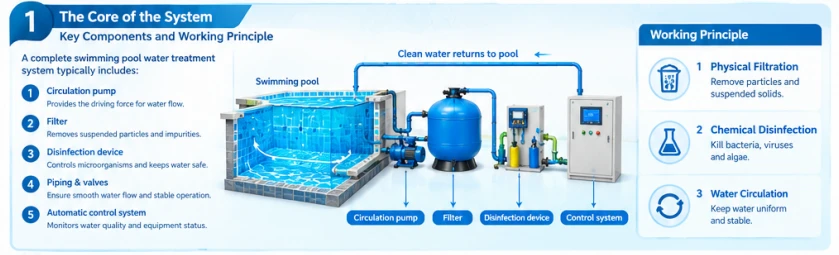
To understand how swimming pool water purification equipment works, it is necessary first to recognize the main equipment in the system and their respective functions. A complete pool water treatment system typically consists of circulation pumps, filters, disinfection devices, piping valves, and automatic control systems.
2.1 Circulation Pump: Providing Power for the Water Treatment System
The circulation pump is responsible for driving pool water to flow through pipes and treatment equipment, allowing pool water to continuously enter the filtration and disinfection stages before returning to the pool.
Pump selection generally requires comprehensive consideration of the following factors:
Effective volume of the pool and designed circulation period.
System resistance generated by filters, pipes, valves, and disinfection equipment.
Required circulation flow rate and actual operating conditions.
Pump energy efficiency, operational noise, and maintenance convenience.
Insufficient circulation flow may lead to uneven mixing of pool water and localized accumulation of pollutants; excessively high flow rates may increase energy consumption and even impair filtration efficacy. Therefore, properly matching the pump with filtration equipment forms an important foundation for ensuring stable system operation.
2.2 Filter: Removing Suspended Particles and Water Impurities
The filter is one of the core units of the pool water treatment system, primarily used to intercept sand, dust, rust, and other suspended particles in the water, thereby reducing turbidity and improving water clarity.
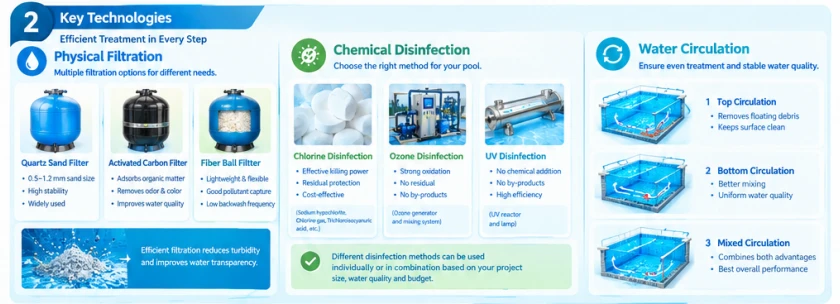
Common pool filtration methods include quartz sand filtration, activated carbon adsorption filtration, and fiber ball filtration. Different filter media do not have identical functions and should be chosen based on raw water quality, pollutant types, and system design.
2.3 Disinfection Device: Controlling the Risk of Microbial Contamination
Filtration cannot replace disinfection. Even if the pool water appears clear, it does not mean disease-causing microorganisms are absent.
Disinfection devices lower microbial contamination risks through appropriate disinfection processes. Common methods include chlorination, ozone disinfection, and ultraviolet (UV) disinfection. In actual projects, single or combined processes can be selected based on pool usage, treatment scale, operational management capabilities, and relevant regulations.
2.4 Automatic Control System: Monitoring Operating Status and Water Quality Parameters
Automatic control systems can be used to manage pump start/stop actions, equipment operating status, flow rates, pressure, and other parameters. Depending on the configuration, they can also integrate pH, residual chlorine, or other water quality monitoring instruments to achieve automatic chemical dosing, alarms, and operation logging functions.
It should be noted that whether an automatic control system can achieve accurate water quality adjustment depends on sensor precision, calibration maintenance, control logic, and the matching level of chemical dosing equipment.
3. Physical Filtration Principles and Common Filtration Methods for Swimming Pools
Physical filtration is a vital link in pool water treatment. Its basic principle is to utilize the pore structure, surface properties, and interception capacity of filter media to remove suspended particles from water.
3.1 Quartz Sand Filtration: Widely Used Traditional Filtration Method
Quartz sand filtration is a common pool filtration method. As described in the original text, the particle size of the quartz sand filter medium is generally 0.5–1.2 mm.
When pool water passes through the quartz sand filter bed, particulate matter in the water is intercepted within the filter bed, thereby reducing effluent turbidity. Quartz sand possesses good chemical stability and mechanical strength, making it suitable for various conventional pool filtration scenarios.
A quartz sand filter typically consists of a tank, filter media layer, support layer, water distribution or collection device, and related valves. As operating time increases and pollutants accumulate, filtration resistance may rise, and effluent flow rate or filtration efficacy may change.
Therefore, backwashing needs to be scheduled based on equipment manuals, pressure differential changes, and effluent conditions. During backwashing, the flow direction is typically opposite to normal filtration to loosen the filter bed and wash away accumulated pollutants. After backwashing is complete, necessary rinsing and operational recovery should be performed according to equipment requirements.
3.2 Activated Carbon Filtration: Assisting in the Removal of Organic Matter and Odors
Activated carbon possesses a well-developed pore structure and a large specific surface area, allowing it to remove certain organic substances, pigments, and odoriferous materials through adsorption. The specific adsorption effect depends on the type of activated carbon, the nature of pollutants in the water, contact time, and operating conditions.
In pool water treatment systems, activated carbon is usually used as an auxiliary treatment unit and is not mandatory for all pools.
Special attention should be paid to the fact that backwashing is primarily used to remove accumulated particulate matter from the filter bed and cannot guarantee the restoration of consumed activated carbon adsorption capacity. When activated carbon adsorption capacity drops, the filter medium generally needs to be replaced according to operating performance and equipment requirements.
Furthermore, activated carbon may affect disinfectant residuals in the water. Therefore, its installation position and operating mode should be designed reasonably to avoid weakening subsequent disinfection effects.
3.3 Fiber Ball Filtration: Suitable for Specific Suspended Solid Treatment Needs
Fiber ball filtration uses fibrous materials as filter media, leveraging the fibrous structure to intercept suspended particles in water. The fiber balls mentioned in the original text are usually made of polypropylene fiber, offering characteristics such as lightweight structure, good elasticity, and corrosion resistance.
The original text mentions that fiber ball filters are generally backwashed once a month, but this should only serve as a reference and cannot be directly applied as a fixed maintenance cycle for all projects. Actual backwashing frequency should be determined based on influent pollution load, operating pressure differential, effluent water quality, and manufacturer requirements.
For projects needing to improve pool water clarity, the choice of filter media should combine particle characteristics, design flow velocity, and filter structure, rather than judging treatment effects solely by the name of the filter medium.
4. Swimming Pool Disinfection Principles: How to Choose Among Chlorine, Ozone, and UV?
Physical filtration primarily removes particulate matter, whereas disinfection focuses on controlling microbial risks. The disinfection stage in how pool water purification equipment works needs to coordinate with filtration, circulation, and water quality monitoring.
4.1 Chlorination: Balancing Disinfection Efficacy with Continuous Protection
Chlorination is a widely used disinfection method in pools. Common disinfectants include sodium hypochlorite, liquid chlorine, and trichloroisocyanuric acid.
After chlorine disinfectants enter the water, they form active chlorine components with disinfectant properties. Among them, the ratio of hypochlorous acid to hypochlorite ions is affected by pH value, and the existing form and concentration of active chlorine impact actual disinfection efficacy.
The main characteristics of chlorination include:
Excellent microbial control capability.
Maintaining appropriate disinfectant residuals provides continuous disinfection protection for pool water.
Mature equipment and chemical supply systems facilitate daily management.
However, chlorination also requires standardized operations. When disinfectants react with nitrogenous substances and other pollutants in pool water, by-products such as chloramines may form, some of which cause irritating odors or discomfort. Therefore, ventilation, water quality testing, and pollution load management should be strengthened, and chemical dosing should be controlled according to specific operating conditions.
Residual chlorine and pH values need to be managed together. Residual chlorine reflects the status of residual disinfection capacity in the water but cannot represent all water quality safety indicators on its own. Specific control ranges should be determined based on pool usage and applicable national or local standards.
4.2 Ozone Disinfection: Leveraging Strong Oxidizing Power for Auxiliary Treatment
Ozone is a strong oxidant that can inactivate certain microorganisms through oxidation and help decompose certain oxidizable pollutants.
Ozone generators typically prepare ozone using air or oxygen, then fully mix it with water through mixing devices. A properly designed ozone system can serve as an auxiliary disinfection process for pool water treatment.
The advantage of ozone lies in its strong oxidizing power without forming the same type of persistent residual chlorine in water as chlorine does. However, ozone itself has poor stability and cannot be relied upon alone to maintain continuous disinfection protection within the pool.
Therefore, when adopting ozone technology, it is still necessary to configure appropriate subsequent disinfection measures based on project design, while paying attention to ozone leakage protection, off-gas treatment, and equipment safety.
4.3 Ultraviolet (UV) Disinfection: Inactivating Microorganisms via UV Radiation
UV disinfection utilizes ultraviolet radiation of appropriate wavelengths to destroy the genetic material of microorganisms, causing them to lose reproductive or infective capabilities.
UV equipment is usually installed in circulation treatment pipelines, where water flow receives irradiation when passing through the UV reactor. Treatment effects are influenced by factors such as UV dosage, water light transmittance, flow rate, lamp status, and equipment structure.
UV disinfection features no direct addition of disinfection chemicals to the water and no generation of persistent residual chlorine. However, the action of UV primarily occurs within the effective irradiation zone inside the equipment and cannot replace the continuous disinfection measures required in pool water.
Therefore, UV is often used as an auxiliary disinfection method in combination with other disinfection techniques.
4.4 Comparison of the Three Disinfection Methods
| Comparison Item | Chlorination | Ozone Disinfection | UV Disinfection |
|
Primary Function |
Oxidation and microbial inactivation |
Strong oxidation and microbial inactivation |
Microbial inactivation via UV radiation |
|
Continuous Residual Protection |
Can maintain appropriate residual chlorine |
Ozone itself usually does not provide long-lasting residuals |
Does not provide continuous residual protection |
|
Equipment Requirements |
Requires safe storage, dosing, and monitoring |
Requires generator, mixing, and safety facilities |
Requires UV reactor and lamp maintenance |
|
Operational Focus |
Management of residual chlorine, pH, and by-products |
Ozone contact efficiency, off-gas, and safety control |
UV dose, light transmittance, and equipment status |
|
Typical Applications |
Conventional pool disinfection |
Auxiliary oxidation and disinfection |
Auxiliary disinfection |
The final choice should be comprehensively determined based on project scale, operational budget, water quality requirements, and local regulations, rather than judging solely on a single advantage of a specific process.
5. Pool Water Circulation Systems: How to Ensure Uniform Treatment of Pool Water?
The pool water circulation system is responsible for continuously delivering pool water to treatment equipment and returning the treated water to the pool. Circulation design relates not only to filtration efficiency but also affects water quality uniformity across different locations in the pool.
5.1 Skimmer / Overflow Circulation (Upper Layer)
Upper layer circulation mainly utilizes return water or water collection facilities near the pool surface to treat surface water bodies, which is favorable for collecting floating debris, scum, and foam from the water surface.
However, if circulation distribution design is unreasonable, insufficient water flow exchange may occur at the pool bottom or corners, requiring coordination with proper return water layout.
5.2 Bottom Circulation (Lower Layer)
Lower layer circulation primarily extracts or distributes water through related ports at the pool bottom, with specific forms depending on system design. Proper bottom water distribution helps improve water mixing, but it cannot be assumed that all bottom areas receive sufficient treatment merely because inlets are located at the bottom.
5.3 Combined Circulation
Combined circulation integrates wall, bottom, or surface facilities to improve flow distribution within the pool through well-organized water supply and return.
In engineering design, pool shape, depth variations, inlet/return positions, and actual flow fields should be combined to reduce dead zones and short-circuiting phenomena. For large commercial pools, circulation system design requires special attention to flow uniformity and maintenance convenience.
5.4 How to Determine Circulation Flow Rate and Turnover Rate?
Circulation flow rate is closely related to effective pool volume, designed turnover rate, and system operating conditions.
Assuming an idealized complete mixing state, the design circulation flow rate can be estimated using the following formula:
Design Circulation Flow Rate =Effective Pool Volume/Designed Turnover Period
For example, if a pool has an effective volume of 300 m³ and a designed turnover period of 6 h, the theoretical circulation flow rate is 50m³/h.
This example is solely used to illustrate the calculation method and does not represent design parameters applicable to all pools. Actual engineering must also satisfy corresponding regulatory requirements and verify allowable filter flow rates, pump operating points, pipeline resistance, and design conditions of disinfection equipment.
A rational pool water circulation filtration system should simultaneously consider circulation flow rate, filtration capacity, and disinfection effects, rather than simply increasing pump power.
6. Pool Water Quality Testing: Which Indicators Require Key Attention?
Normal equipment operation does not guarantee compliant water quality. Pool managers need to conduct continuous water quality monitoring combining on-site testing with necessary laboratory analyses.
6.1 Physical Indicators
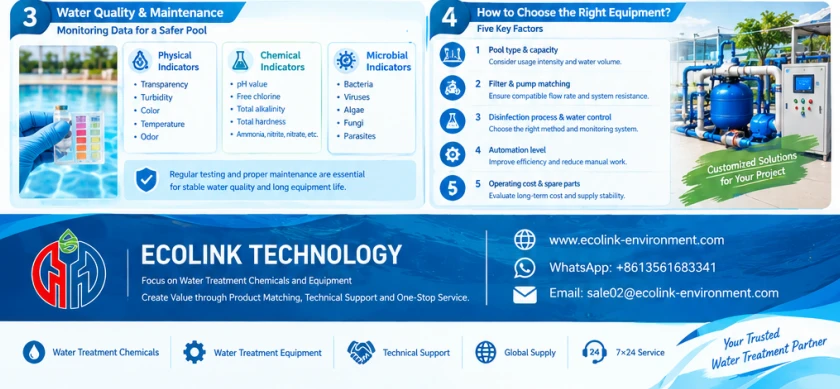
Physical indicators mainly include clarity, turbidity, color, temperature, and odor, which can be used to judge water appearance, particulate content, and certain operational anomalies.
If filter effluent turbidity continues to rise, filter media status, filtration flow rate, backwash efficacy, and equipment abnormalities should be inspected.
6.2 Chemical Indicators
Common chemical indicators include:
pH Value: Affects disinfection efficacy, swimmer comfort, and corrosion or scaling risks for certain equipment.
Residual Chlorine: Used to evaluate residual chlorine disinfection capacity status in pool water.
Total Alkalinity: Related to pH buffering capacity.
Total Hardness: Pertains to scale formation and operation/maintenance of certain equipment.
Ammonia Nitrogen & Other Related Indicators: Can be tested based on water source, pollution risk, and applicable regulations.
The items actually requiring testing and their limit values should be based on current standards corresponding to the pool's purpose, rather than directly applying control requirements of one project to all pools.
6.3 Microbiological Indicators
Microbiological testing is used to evaluate microbial contamination in pool water. Specific testing items should be determined based on applicable standards and risk assessments, and can be completed by qualified testing institutions when necessary.
It should be noted that clear water without obvious odor does not equate to compliant microbiological indicators. Therefore, daily sensory observation cannot replace standardized water quality testing.
7. How to Select Swimming Pool Water Purification Equipment? Five Key Factors
When selecting equipment, decisions should stem from water quality goals, system capabilities, and life-cycle costs, avoiding mere comparison of procurement prices.
7.1 Pool Purpose and Effective Volume
Private pools, hotel pools, public pools, and water parks differ in usage intensity, pollution loads, and management requirements, which may lead to varying circulation flow rates and treatment configurations.
7.2 Matching Filters with Circulation Pumps
Design flow rate of filters, allowable filtration load, pump operating point, and system resistance should be verified to prevent mismatching between pump capacity and filter specifications.
7.3 Disinfection Process and Water Quality Control
Select appropriate disinfection methods based on local regulations, operational staff's technical competence, and maintenance budgets, while confirming whether water quality monitoring and dosing control plans are complete.
7.4 Automation Level and Maintenance Requirements
Functions such as automatic monitoring, alarms, scheduled backwashing, and automatic chemical dosing can improve management efficiency, but they also increase equipment investment and maintenance demands. Automation configuration should be decided based on actual usage needs during selection.
7.5 Operating Costs and Spare Parts Supply
Besides initial procurement costs, long-term costs including pump power consumption, filter media replacement, disinfectant consumption, backwash water usage, instrument calibration, and spare parts supply should be evaluated.
For overseas engineering projects, ECOLINK TECHNOLOGY can assist in organizing equipment configuration needs based on pool scale, treatment targets, and site conditions provided by customers, while supporting selection communication and supply for related water treatment equipment and matching products.
8. Daily Maintenance and Common Issues of Swimming Pool Water Purification Equipment
Standardized maintenance helps maintain treatment efficiency, reduce unplanned downtime, and extend equipment lifespan.
8.1 Rising Filter Pressure Differential
Possible causes include pollutant accumulation in the filter bed, insufficient backwash, increased influent pollution load, or pipeline anomalies.
It is recommended to check inlet/outlet pressures, operating flow rates, and effluent quality, and determine whether backwashing or further overhaul is required based on equipment manuals.
8.2 Turbid Pool Water or Reduced Clarity
This may relate to filter media status, uneven circulation distribution, unreasonable filtration flow rates, or increased external pollution loads.
Inspect filter operation and the circulation system first, then adjust treatment plans according to water quality test results, rather than directly increasing disinfectant dosage.
8.3 Noticeable Irritating Odor
Noticeable irritating odors may relate to disinfection by-products such as chloramines, but odor alone cannot accurately determine specific causes.
It is recommended to test residual chlorine, pH, and related water quality indicators, check ventilation conditions and pollution loads, and have professionals take action based on test results.
8.4 Fluctuations in Water Quality Indicators
Water quality fluctuations may originate from changes in bather load, make-up water quality changes, unstable chemical dosing, instrument errors, or equipment operation anomalies.
It is recommended to establish operation logs, periodically calibrate testing instruments, and adjust circulation and disinfection strategies based on actual data.
8.5 High Long-term Equipment Operating Costs
Evaluations can be made regarding pump energy efficiency, filter resistance, backwash frequency, filter media lifespan, and disinfectant dosing control.
A rational maintenance plan should be based on actual operating data rather than simply extending backwash cycles or reducing necessary water quality testing.
9. Why Choose ECOLINK TECHNOLOGY for Water Treatment Equipment Communication?
Equipment selection for water treatment projects requires consideration of site conditions, process requirements, matching products, and long-term operational management. For different markets and application scenarios, standardized equipment configurations may not directly meet the needs of all projects.
ECOLINK TECHNOLOGY focuses on water treatment chemicals and equipment, committed to providing customers with procurement solutions better suited to actual application needs through product matching, technical support, and one-stop services.
Our service focuses include:
Requirement Communication: Organizing needs based on customer project purpose, treatment scale, and target water quality.
Equipment Selection Support: Assisting in verifying basic configuration requirements for circulation, filtration, disinfection, and ancillary equipment.
Matching Product Supply: Communicating supply plans for related water treatment equipment and chemicals based on project needs.
Technical Documentation Support: Providing available technical materials and relevant documentation according to specific products and project conditions.
International Trade Services: Cooperating with overseas customers on product information confirmation, quotation communication, and delivery arrangements.
For clients such as hotels, commercial pools, engineering contractors, and equipment distributors, clarifying treatment targets, site conditions, and technical requirements early helps reduce information discrepancies during procurement and improves project scheme adaptability.
If you need to consult on pool water treatment equipment or other water treatment projects, feel free to contact ECOLINK TECHNOLOGY.
Website: www.ecolink-environment.com
WhatsApp: +8613561683341
Email: sale02@ecolink-environment.com
10. Conclusion: Building an Efficient and Stable Pool Water Treatment System
Swimming pool water quality management cannot be accomplished relying on a single filter or disinfection device alone; it requires circulation transport, physical filtration, disinfection treatment, and water quality monitoring to work in synergy.
Understanding how pool water purification equipment works helps project managers rationally select filter media, configure circulation pumps, determine disinfection methods, and establish scientific daily maintenance routines.
From quartz sand filtration to activated carbon auxiliary adsorption, from chlorination to ozone and UV auxiliary treatment, and to comprehensive management of circulation flow rates and water quality indicators, every link impacts overall system performance.
For pools of different scales and purposes, corresponding solutions should be formulated based on actual water quality, applicable standards, equipment performance, and operational budgets. Through rational equipment selection, standardized operation management, and continuous water quality testing, pool water cleanliness and hygienic safety can be better maintained.
ECOLINK TECHNOLOGY will continue to focus on water treatment chemicals and equipment, providing product matching, technical support, and one-stop supply services to assist customers in advancing water treatment solutions that meet their project requirements.