The global polyaluminum chloride market is projected to grow from USD 1.7 billion in 2025 to approximately USD 3.7 billion by 2035, at a CAGR of 8.1% during the forecast period from 2026 to 2035.
Polyaluminum chloride (PAC) is an inorganic coagulant primarily used in water and wastewater treatment. It accelerates particle aggregation and sedimentation, removing turbidity, color, and suspended solids from raw water. Municipal water utilities and industrial facilities prefer PAC over traditional coagulants due to its wider effective pH range and lower sludge production.
PAC removes 88–99% of turbidity and 50–90% of color, making it the coagulant of choice for high-turbidity water sources, especially during rainy seasons. The Kerala Water Authority also reports that 1 kg of PAC replaces 3–4 kg of conventional alum, reducing chemical handling, storage, and logistics costs despite a higher unit price.
In major manufacturing economies, industrial wastewater discharge regulations have tightened significantly. Paper, textile, and chemical industries now face mandatory effluent quality standards that traditional alum-based treatments cannot reliably meet. PAC's superior coagulation efficiency at lower dosages provides a compliance advantage, accelerating its substitution in these sectors.
The PAC-chitosan composite formulation achieved optimal performance at 1% CTS concentration, 80 rpm stirring speed, pH 7–8, and 9 mg/L dosage, highlighting the growing commercial potential of hybrid coagulant systems in high-performance applications. Updated industry standards have also established technical benchmarks for PAC grades, including Al₂O₃ content, basicity, pH value, and water insolubles.
Key Takeaways
The global polyaluminum chloride market was valued at USD 1.7 billion in 2025 and is expected to reach USD 3.7 billion by 2035, growing at a CAGR of 8.1% from 2026 to 2035.
Liquid PAC leads with a 49.3% market share, favored for ease of handling and metering in large-scale treatment facilities.
Polyaluminum chloride (PAC) dominates product types with a 56.7% share.
Drinking water grade PAC accounts for 43.2% of total grade consumption.
Medium basicity PAC holds the largest share at 41.6%.
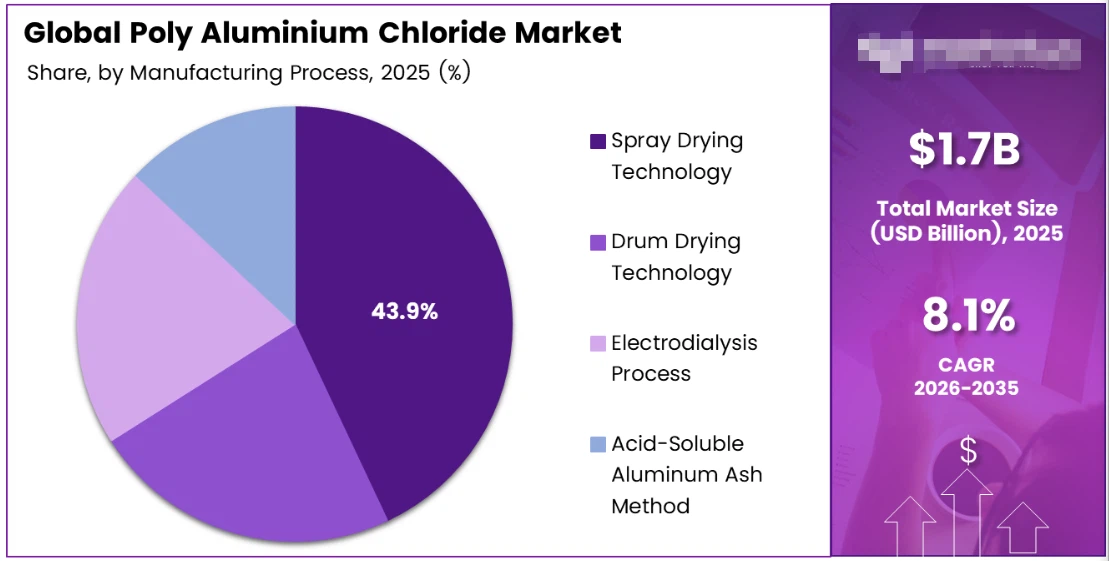
Spray drying technology leads with a 43.9% market share.
Water treatment PAC represents 79.1% of total market demand.
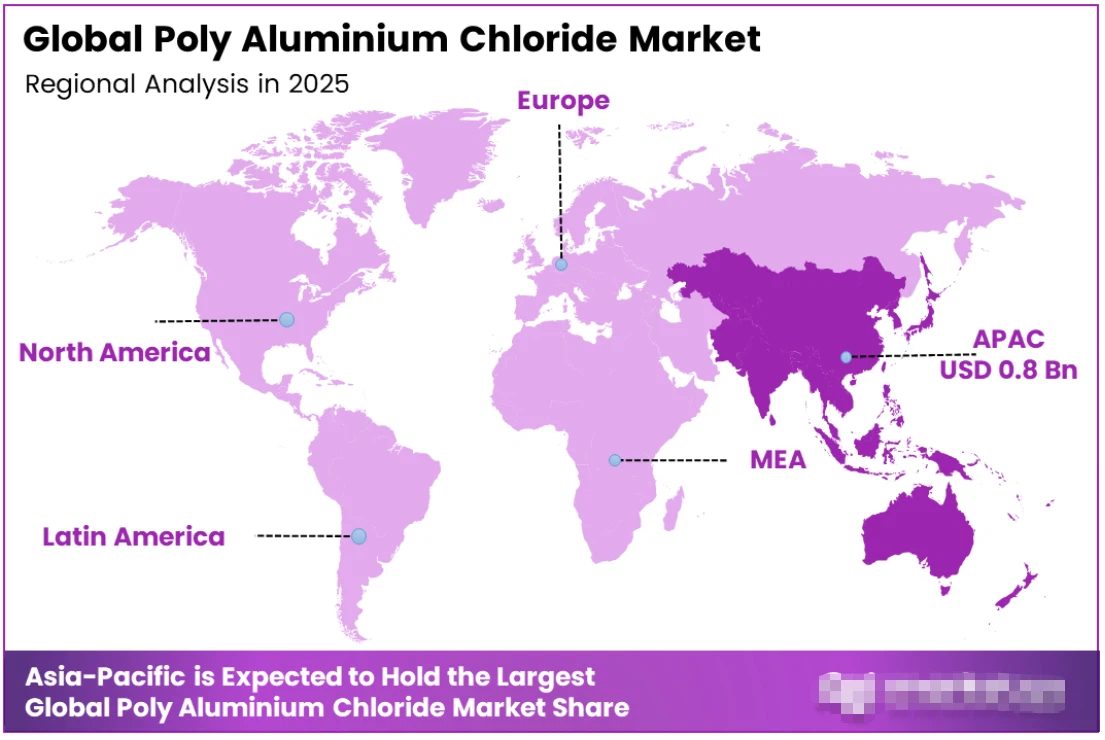
Asia Pacific holds the largest regional share at 48.4%, valued at approximately USD 0.8 billion.
Form Analysis
Liquid PAC dominates with a 49.3% share due to easy metering and handling.
In 2025, liquid polyaluminum chloride led the form segment with a 49.3% share. Large municipal water treatment plants prefer liquid PAC because it integrates directly into automated chemical dosing systems, eliminating dissolution steps and reducing operator workload.
Granular PAC offers operational advantages for facilities requiring controlled slow-release coagulation. In industrial wastewater treatment for chemical processing, operators prefer granular PAC when dosing precision is critical and liquid storage facilities are unavailable. Its slower dissolution rate suits batch treatment processes where continuous chemical release provides operational benefits.
Product Type Analysis
PAC dominates with a 56.7% share due to broad treatment compatibility and cost-effectiveness.
In 2025, polyaluminum chloride (PAC) led the product type segment with a 56.7% share. PAC's leadership reflects its regulatory approvals across drinking water, industrial, and food-grade applications.
For demanding wastewater treatment requiring simultaneous sulfate removal, polyaluminum chloride sulfate (PACS) offers superior performance. Industrial facilities in textile and leather industries choose PACS when color removal targets exceed what standard PAC formulations can achieve.
Grade Analysis
Drinking water grade PAC dominates with a 43.2% share due to mandatory municipal procurement.
In 2025, drinking water grade PAC led the grade segment with a 43.2% share. Municipal utilities represent the largest and most stable buyer group, with procurement driven primarily by regulatory obligations rather than discretionary spending.
Food-grade PAC serves a narrower but higher-margin range of applications, including food processing wastewater and direct food contact uses. Buyers in this segment require food safety certifications, creating a barrier that benefits suppliers with robust quality management systems. The profit premium for food-grade PAC compensates for its lower absolute volume compared to drinking water grade.
Basicity Analysis
Medium basicity PAC dominates with a 41.6% share, offering optimal performance across various water qualities.
In 2025, medium basicity PAC led the basicity segment with a 41.6% share. Medium basicity formulations balance coagulation efficiency and pH stability, making them suitable for a wide range of raw water qualities.
Low basicity PAC performs best under acidic water conditions where traditional coagulants struggle. Industrial applications such as mining and mineral processing, which typically have low influent pH levels, represent the primary demand market for low basicity PAC. Its narrower application range limits its market share, but under target conditions it delivers coagulation performance that medium basicity PAC cannot match.
Manufacturing Process Analysis
Spray drying technology leads with a 43.9% share due to production flexibility and export-grade compatibility.
In 2025, spray drying technology led the manufacturing process segment with a 43.9% share. Spray drying produces powdered PAC with consistent particle size distribution and moisture content-key quality parameters for precise dosing applications.
Roller drying technology produces flake PAC with higher bulk density and alumina (Al₂O₃) concentration per unit weight. Facilities choosing roller drying prioritize energy efficiency over particle uniformity, as roller lines consume less thermal energy per ton than spray systems. This cost advantage makes roller drying the preferred process for high-volume commodity-grade PAC production in cost-competitive manufacturing regions.
End-User Industry Analysis
Water treatment dominates with a 79.1% share due to mandatory compliance and nondiscretionary procurement cycles.
In 2025, the water treatment industry led the end-user segment with a 79.1% share. Municipal water utilities procure PAC under long-term supply contracts linked to treatment capacity obligations, creating predictable and stable demand.
The pulp and paper industry represents the second-largest demand pillar, with PAC used as a retention aid in fiber processing and as a wastewater coagulant. Paper mills generate high volumes of process wastewater containing complex organic matter that requires reliable coagulation chemistry. PAC's ability to perform effectively in the alkaline pH ranges common in papermaking gives it a technical advantage over acidic coagulants in this end-use application.
Key Market Segments
By Form
Liquid PAC
Powder PAC (Spray Dried)
Granular PAC
Flake PAC (Roller Dried)
By Product Type
Polyaluminum Chloride (PAC)
Polyaluminum Chloride Sulfate (PACS)
Aluminum Chlorohydrate (ACH)
Composite PAC
Nano PAC
By Grade
Drinking Water Grade PAC
Food Grade PAC
Industrial Grade PAC
Filtration Grade PAC
By Basicity
Low Basicity
Medium Basicity
High Basicity
Ultra-High Basicity
By Manufacturing Process
Spray Drying Technology
Roller Drying Technology
Electrodialysis Process
Acid-Soluble Aluminum Ash Method
By End-User Industry
Water Treatment
Pulp and Paper Industry
Emerging Trends
Smart Dosing Technology and High-Purity Formulations Reshape PAC Application Standards
Water treatment plants have integrated smart monitoring systems with advanced chemical dosing platforms to optimize PAC dosage in real time. AI-optimized PAC dosing protocols determine concentrations of approximately 4 ppm for typical raw water and 12 ppm for degraded influent water. This precision reduces both over-dosing costs and residual aluminum levels, meeting operational and environmental performance targets.
Demand for food-grade and high-purity PAC formulations is growing as drinking water standards become stricter and high-specification industrial applications expand. A PAC-chitosan composite study confirmed optimal performance at 9 mg/L dosage, pH 7–8, and 80 rpm stirring speed, demonstrating the precision engineering required by modern water treatment specifications.
Cross-industry collaboration promoting sustainable wastewater recycling is driving PAC formulators to develop eco-efficient coagulants with lower sludge production. Paper mills, textile processors, and chemical plants increasingly require water reuse solutions that minimize treatment byproducts. PAC suppliers that develop low-sludge composite formulations can capture early-mover advantages in the regulatory-driven shift toward closed-loop industrial water management models.
Drivers
Municipal Infrastructure Investment and Industrial Compliance Standards Accelerate PAC Procurement
Governments across Asia, Africa, and Latin America are investing heavily in municipal water treatment facility upgrades. Urban population growth outpaces existing treatment infrastructure capacity, making coagulant procurement a continuous and growing expenditure. Municipalities that historically relied on traditional alum are switching to PAC because its higher efficiency reduces chemical storage and handling costs at scale.
Industrial wastewater discharge regulations in major manufacturing economies have set emission limits that standard coagulants cannot reliably achieve. PAC increases coagulation and sedimentation rates by 2–3 times and reduces sludge volume by 1.5 times, quantifying its operational advantages and driving substitution for aluminum sulfate across industries.
Reported testing by the Kerala Water Authority for PAC procurement-triggered by 10 days of alum supply shortages during monsoon-driven turbidity spikes-shows that seasonal extreme water quality forces utilities to evaluate PAC's dosage efficiency advantages. This procurement behavior is common across tropical and monsoon-affected water systems, representing a structural, cyclical demand driver that traditional alum cannot reliably address.
Restraints
Raw Material Price Volatility and Residual Aluminum Concerns Constrain Market Expansion
Prices of aluminum-based chemicals fluctuate with bauxite supply conditions, smelting energy costs, and global aluminum commodity cycles. PAC producers relying on primary aluminum raw materials face margin compression during price spikes, and these cost increases ultimately transfer to municipal procurement budgets with limited flexibility.
Environmental concerns over residual aluminum in treated water pose regulatory risks for PAC adoption in drinking water applications. PAC requires only 21 mg/L dosage to remove 98.6% of suspended solids-yet even optimized dosages produce residual aluminum requiring monitoring, adding compliance costs to operational budgets.
Disposal of treatment byproducts adds regulatory constraints. PAC processes generate aluminum-rich sludge that requires classified disposal or resource recovery, with disposal costs rising as landfill regulations tighten. Small municipal utilities in developing countries often lack the technical and financial capacity to manage byproducts properly.
Growth Factors
Desalination Scale-Up and Customized PAC Formulations Open High-Value Applications
Increasing desalination capacity in the Middle East, North Africa, and coastal Asia has created rapidly growing demand for high-performance coagulants in pretreatment. Water purification facilities require coagulants with high charge density and stable performance across varying salinity levels in influent water.
Customized PAC formulations tailored to industry-specific applications enable suppliers to command price premiums above the general coagulant market. PAC combined with FeCl₃ or polymers achieves up to 95% color removal and 99% turbidity reduction, demonstrating that composite formulations outperform PAC alone in demanding applications.
Infrastructure projects in rural and semi-urban markets drive demand for portable and decentralized water treatment systems. PAC's high efficiency in low dosages and its liquid form make it the preferred coagulant for these applications, and the scale of global rural water supply projects translates this into a structural growth opportunity in underserved areas.
Regional Analysis
Asia Pacific Dominates the Polyaluminum Chloride Market with a 48.4% Share, Valued at USD 0.8 Billion
Asia Pacific accounts for 48.4% of global PAC consumption, valued at approximately USD 0.8 billion. China and India drive this position through large-scale municipal water supply infrastructure projects and substantial industrial manufacturing output requiring compliant wastewater treatment.
North America supports PAC demand through a mature regulatory framework enforcing strict drinking water and discharge standards. US EPA maximum contaminant level mandates require utilities to specify certified coagulants, ensuring institutional procurement consistency.
The European PAC market follows the EU Water Framework Directive, which requires member states to progressively improve water body quality. Industrial emission regulations specified in IPPC and BAT reference documents generate compliance-driven demand across paper, textile, and chemical manufacturing industries.
The Latin American PAC market expands as municipal water supply projects advance in Brazil, Mexico, and Colombia. Secondary city population growth creates demand for new treatment capacity, while industrial water reuse laws in Brazil's manufacturing corridor push plants to adopt advanced coagulation chemistry.
Key Regions and Countries
North America
United States
Canada
Europe
Germany
France
United Kingdom
Spain
Italy
Rest of Europe
Asia Pacific
China
Japan
South Korea
India
Australia
Rest of Asia Pacific
Latin America
Brazil
Mexico
Rest of Latin America
Middle East & Africa
GCC Countries
South Africa
Rest of Middle East & Africa
CTA
Get Polyaluminum Chloride (PAC) Market Insights & Custom Quotes
Global water treatment and industrial wastewater compliance demands are continuously rising, unlocking the market potential of polyaluminum chloride (PAC) as a high-efficiency coagulant. Whether you are a municipal water utility, industrial wastewater treatment plant, pulp & paper enterprise, or PAC supplier and distributor, accurately understanding product specifications, regional supply options, and pricing trends will give you a competitive edge.
As a professional PAC supplier, ECOLINK TECHNOLOGY offers:
Supply and problem-solving solutions for various PAC grades (drinking water grade, industrial grade)
Free sample testing
Product technology selection recommendations
Dosage optimization suggestions
Customized coagulation solutions for complex water qualities such as high turbidity, high color, and heavy metals
Latest market price trends, regional procurement advice, and logistics solution design
👉 Contact us today for the latest product catalog, technical data sheets, or a free quotation.
📧 Email: sale02@ecolink-environment.com
🌐 Website: www.ecolink-environment.com
📞 Call/WhatsApp: +86 13561683341
Our technical team helps you reduce costs and improve compliance in water treatment and industrial applications.