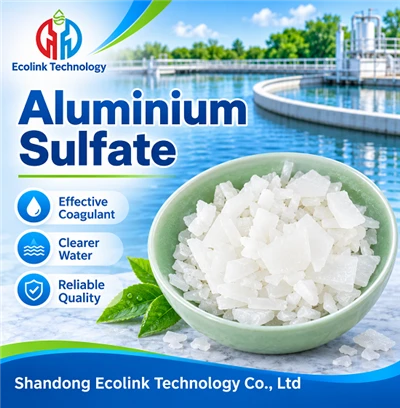
I. Product Overview: From Raw Material Purity to Production Applications, Meeting Procurement Needs Across Multiple Fields
In industrial fields such as drinking water treatment, industrial wastewater treatment, paper manufacturing, and titanium dioxide post-treatment, aluminium sulfate is an important inorganic aluminium salt raw material. Different production processes have different requirements for the product's alumina content, ferric oxide content, water-insoluble matter, dissolution performance, and product form.
During actual procurement and application, ordinary aluminium sulfate may present the following challenges:
Iron Impurities Affecting Product Quality: Production processes with strict requirements for product whiteness, purity, and iron impurity content need to pay special attention to the ferric oxide indicator in raw materials.
Water-Insoluble Matter Affecting Solution Clarity: If there is a high amount of insoluble residue after the product dissolves, it may increase the impurity burden on subsequent production steps.
Incomplete Product Dissolution: Mismatches between product particle size, feeding speed, water temperature, and agitation conditions can lead to incomplete dissolution or localized caking.
Difficulty in Controlling Dosage: Different water quality and production conditions require different chemical dosages; a dosing scheme must be determined in conjunction with the actual process.
Product Moisture Absorption and Caking: Aluminium sulfate is hygroscopic. A humid storage environment or inadequate package sealing may affect the product's appearance and operational convenience.
To address customer needs in product procurement, solution preparation, chemical feeding, and storage, ECOLINK TECHNOLOGY provides Iron-Free Aluminium Sulfate products with different alumina content specifications and multiple physical forms, enabling customers to choose according to their specific production processes.
Key Product Features:
Alumina Content Specifications: Available in 16% and 17% specifications to meet the raw material requirements of different production processes.
Ferric Oxide Indicator Control: Strict control over Fe2O3 content, suitable for industrial production requiring high whiteness and low raw material impurities.
Water-Insoluble Matter Indicator: Quality indicator control for water-insoluble matter, reducing the impact of insoluble impurities on subsequent processes.
Four Product Forms: Available in powder, lump, flake, and granular forms to adapt to various feeding and dissolution methods.
Multi-Field Applications: Can be used in drinking water treatment, industrial wastewater treatment, paper manufacturing, titanium dioxide post-treatment, and other industrial production.
ECOLINK TECHNOLOGY focuses on water treatment chemicals and water treatment equipment, helping customers select suitable product specifications based on specific application needs through product matching, technical support, and one-stop supply services.
II. What is Iron-Free Aluminium Sulfate?
Iron-Free Aluminium Sulfate is an inorganic aluminium salt product with aluminium sulfate as its main component and strictly controlled iron impurity indicators.
Its chemical molecular formula is Al2SO4_3, and its CAS number is 10043-01-3. The product usually exists in a solid form containing crystal water, with a white or off-white appearance, and can be manufactured into powder, flake, lump, and granular forms.
Iron-free aluminium sulfate is easily soluble in water, and its aqueous solution is acidic. In the field of water treatment, it can be used as an aluminium salt coagulant; in paper manufacturing, titanium dioxide post-treatment, and other industrial production, it can also serve as a corresponding chemical raw material.
The term "Iron-Free" in the product name is a product category designation. The actual ferric oxide content should be based on specific technical indicators and batch test results, and does not imply that the iron content is absolutely zero.
2.1 Basic Product Information
| Item | Technical Information |
|
|
|
|
English Name |
Iron-Free Aluminium Sulfate |
|
Chemical Formula |
Al2SO4_3 |
|
CAS No. |
10043-01-3 |
|
HS Code |
2833220000 |
|
Executive Standard |
HG/T 2225-2010 |
|
Product Specifications |
16% / 17% |
|
Product Forms |
Powder, Lump, Flake, Granular |
|
Product Appearance |
White or off-white solid |
|
Water Solubility |
Easily soluble in water |
|
Aqueous Solution Property |
Acidic |
III. Iron-Free Aluminium Sulfate Technical Parameters: Alumina, Ferric Oxide, and Water-Insoluble Matter Indicators
When procuring iron-free aluminium sulfate, one should not only focus on the product name and price per ton, but also comprehensively compare parameters such as alumina content, ferric oxide content, pH value, and water-insoluble matter.
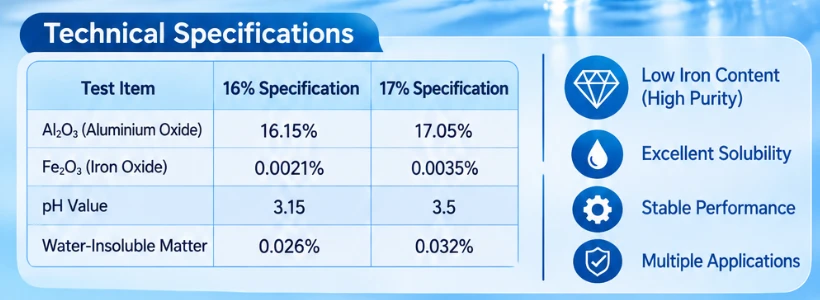
ECOLINK TECHNOLOGY provides two specifications, 16% and 17%. The specific technical parameters are as follows:
3.1 Product Quality Indicators
| Test Item | 16% Specification | 17% Specification |
|
Alumina (Al2O3) |
16.15% |
17.05% |
|
Ferric Oxide (Fe2O3) |
0.0021% |
0.0035% |
|
pH Value |
3.15 |
3.5 |
|
Water-Insoluble Matter |
0.026% |
0.032% |
Note: The above data is compiled according to the product technical parameter sheet on the official website. Actual supply indicators and batch testing results are subject to the product specifications and COA confirmed by both parties.
3.2 Alumina Content (Al2O3)
Alumina content is one of the important indicators for measuring the active component of aluminium sulfate products.
Currently, the product is offered in two specifications:
16% Specification: (Al2O3) content is 16.15%.
17% Specification: (Al2O3) content is 17.05%.
Alumina content affects the amount of aluminium components provided per unit of product. When selecting different specifications, customers should perform a comprehensive comparison considering the procurement price, active component content, and actual process requirements.
3.3 Ferric Oxide Content(Fe2O3)
Ferric oxide content is a quality parameter requiring key attention during the procurement of iron-free aluminium sulfate.
The (Fe2O3) contents for the two specifications are 0.0021% and 0.0035%, respectively. For production processes such as paper manufacturing and titanium dioxide post-treatment that demand high whiteness and minimal raw material impurities, the ferric oxide content is a critical reference item for raw material acceptance.
Customers are advised to clarify their (Fe2O3) indicator requirements during procurement and verify them against the actual batch COA.
3.4 Water-Insoluble Matter
Water-insoluble matter is an important parameter for evaluating insoluble residues in aluminium sulfate solutions.
If there are excessive insoluble impurities after dissolution, it may increase sediment residue in the solution, affecting certain production processes that demand high solution clarity.
According to official parameters:
16% Specification: Water-insoluble matter is 0.026%.
17% Specification: Water-insoluble matter is 0.032%.
Customers can determine corresponding requirements based on their own production processes, solution preparation methods, and quality acceptance standards.
3.5 pH Value
When aluminium sulfate dissolves in water, the aqueous solution is acidic. In the product parameters, the pH value of the 16% specification is 3.15, and that of the 17% specification is 3.5.
In water treatment processes, the hydrolysis of aluminium sulfate consumes part of the alkalinity in water, which may lead to a decrease in water pH. Therefore, the actual coagulation effect is not only related to the product's own parameters, but is also influenced by factors such as raw water pH, alkalinity, turbidity, and water temperature.
IV. Working Principle of Iron-Free Aluminium Sulfate: Coagulation and Flocculation Processes in Water Treatment
Aluminium sulfate is a common inorganic aluminium salt coagulant. In the water treatment process, after the product dissolves, aluminium ions undergo a hydrolysis reaction to form various species of hydrolysis products.
Under suitable pH and water quality conditions, these hydrolysis products promote the aggregation of colloidal particles and suspended solids in water through charge neutralization, adsorption, and micro-floc formation. The aggregated particles are then separated through sedimentation or filtration.
4.1 Charge Neutralization
Some colloidal particles in raw water carry identical or similar surface charges, creating electrostatic repulsion between particles that prevents natural aggregation.
The charged hydrolysis species formed after aluminium sulfate dissolves can reduce the electrostatic repulsion between particles, facilitating contact and aggregation among fine particles.
4.2 Adsorption and Floc Formation
Aluminium salt hydrolysis products can adsorb some of the colloidal particles and fine suspended solids in water, promoting the formation of larger flocs among the particles.
4.3 Floc Settlement and Solid-Liquid Separation
Under suitable coagulation and flocculation conditions, the formed flocs can be removed from water through sedimentation or other solid-liquid separation processes, thereby improving effluent clarity.
4.4 Impact of pH and Alkalinity on Coagulation Effect
The hydrolysis process of aluminium sulfate consumes alkalinity in water. If the raw water alkalinity is insufficient, dosing aluminium sulfate may cause the water pH to drop, which in turn affects the formation of aluminium hydrolysis products and the overall coagulation efficiency.
Therefore, in actual water treatment projects, comprehensive consideration must be given to:
Raw water turbidity;
Raw water pH;
Raw water alkalinity;
Water temperature;
Coagulant dosage;
Rapid mixing and flocculation conditions;
Subsequent sedimentation and filtration processes.
It is recommended to determine reasonable chemical dosages and operational conditions through Jar Tests, rather than relying on a fixed dosage.
V. Main Application Fields of Iron-Free Aluminium Sulfate
Iron-Free Aluminium Sulfate features a low ferric oxide indicator and can be applied in water treatment, paper manufacturing, titanium dioxide post-treatment, and other industrial production fields according to specific process requirements.
5.1 Drinking Water Treatment
During drinking water treatment, raw water may contain silt, suspended particles, and colloidal substances. These fine particles do not easily settle naturally and require treatment through coagulation, flocculation, sedimentation, and filtration processes.
The hydrolysis products formed after aluminium sulfate dissolves promote the aggregation of suspended particles and colloids into larger flocs, which are subsequently removed through sedimentation and filtration.
Common Customer Issues:
Large fluctuations in raw water turbidity leading to unstable coagulation performance;
Excessively high chemical dosages increasing operational costs;
Insufficient raw water pH or alkalinity affecting coagulation efficiency;
Small flocs or slow settling velocity;
Iron impurity indicators of ordinary aluminium sulfate failing to meet specific project requirements.
Product Selection Recommendations: In drinking water treatment projects, it is recommended to focus on parameters such as Al2O3, Fe2O3, and water-insoluble matter, and perform product selection based on raw water quality.
ECOLINK TECHNOLOGY can assist in discussing product specifications and application testing plans based on customer-provided raw water turbidity, pH, alkalinity, and treatment process parameters.
Special Note: Whether a specific product can be used for drinking water treatment depends on compliance with relevant regulations, applicable standards, and hygienic requirements of the target market, as well as necessary water quality validations. Suitability for drinking water cannot be judged solely by product name or a single indicator.
5.2 Industrial Wastewater Treatment
Industrial wastewater typically contains suspended solids, colloidal particles, and other pollutants. Since wastewater composition varies significantly across different production processes, the choice of coagulant and dosage must be determined based on actual water quality.
Iron-free aluminium sulfate can be used for coagulation and sedimentation pretreatment of certain industrial wastewaters, promoting suspended particle aggregation and improving downstream solid-liquid separation conditions.
Common Application Scenarios:
Pretreatment of textile dyeing wastewater;
Coagulation and sedimentation of paper mill wastewater;
General industrial manufacturing wastewater treatment;
Coagulation treatment of industrial wastewater containing suspended solids;
Treatment of certain industrial circulating water and process water.
Common Issues in Industrial Wastewater Treatment:
Issue 1: High Chemical Dosage May be related to fluctuations in raw water quality, dosage solution concentration, pH conditions, or mismatched mixing intensity. Recommendation: Perform Jar Tests under varying dosages and pH conditions to compare floc formation, settling behavior, and effluent parameters to identify an optimal dosing scheme.
Issue 2: Small Flocs and Suboptimal Settling Effect May be due to improper coagulant dosage, unreasonable rapid mixing conditions, or the presence of fine, hard-to-settle particles in the wastewater. Recommendation: Optimize by adjusting chemical dosage, mixing parameters, and flocculation time. When necessary, evaluate the feasibility of dual dosing with Polyacrylamide (PAM).
Issue 3: Variations in Treatment Performance Across Batches Recommendation: Pay close attention to indicators like Al2O3, Fe2O3, and water-insoluble matter during procurement and application, and analyze performance alongside on-site operational data.
Proper use of aluminium sulfate helps improve coagulation and sedimentation performance in industrial wastewater, creating favorable conditions for subsequent filtration, biological treatment, or advanced treatment.
5.3 Paper Manufacturing
Aluminium sulfate is a common inorganic chemical raw material in the paper industry, widely used in paper sizing systems and related manufacturing processes.
In papermaking, aluminium sulfate participates in the chemical equilibrium of the sizing system, helps regulate the ionic environment in the system, and works in synergy with other papermaking auxiliaries.
Key Quality Indicators for Paper Mills:
Whether the ferric oxide content meets paper whiteness and raw material purity standards;
Whether water-insoluble matter increases the impurity load on the production system;
Whether the alumina content satisfies production formula requirements;
Whether product indicators remain stable across different batches;
Whether product dissolution and feeding methods are compatible with existing equipment.
For papermaking processes with strict whiteness and raw material purity demands, iron-free aluminium sulfate serves as an ideal raw material option. The actual application performance also depends on pulp properties, sizing agent types, system pH, addition sequence, and operating conditions.
5.4 Titanium Dioxide Post-Treatment
Iron-free aluminium sulfate can be used as an industrial chemical raw material in processes related to titanium dioxide post-treatment.
Titanium dioxide and other products sensitive to whiteness, color, and impurity levels have strict requirements regarding raw material quality. Therefore, during raw material procurement, ferric oxide content, alumina content, and water-insoluble matter are all vital parameters to monitor.
Common Customer Concerns:
Whether iron impurities affect the color and purity specifications of the final product;
Whether different alumina contents fit existing production formulations;
Whether water-insoluble matter impacts material uniformity in certain processes;
Whether raw material batch variations affect continuous production management.
It is recommended that customers conduct laboratory or pilot tests according to their specific titanium dioxide post-treatment process before confirming bulk procurement specifications.
5.5 Other Industrial Applications
In addition to water treatment, papermaking, and titanium dioxide post-treatment, iron-free aluminium sulfate can also be used in various chemical and industrial production fields, such as:
Catalyst carrier-related production;
Firefighting foam concentrate production;
Production of thermal insulation and flame-retardant materials;
Refractory material additives;
Production of molecular sieves and other chemical raw materials.
Different industrial applications have distinct requirements for product indicators and usage methods. For special applications, customers are advised to provide process requirements, raw material indicators, and final product quality expectations in advance to confirm product suitability.

VI. Iron-Free Aluminium Sulfate Product Forms: Powder, Lump, Flake, and Granular
Different customers have varying production equipment, feeding systems, dissolution methods, and storage conditions. Therefore, in addition to chemical indicators, the physical form of the product is an essential factor to consider during procurement.
ECOLINK TECHNOLOGY offers four product forms, allowing customers to select based on their production processes and operating habits.
6.1 Powdered Iron-Free Aluminium Sulfate (Powder)
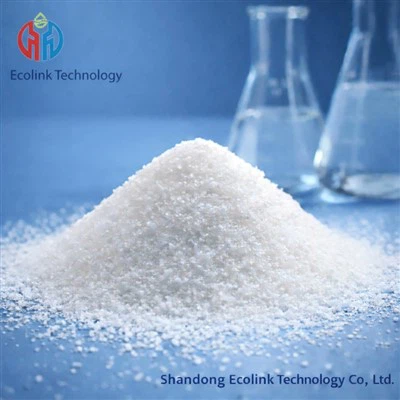
The powdered product appears as a white or off-white powder, suitable for industrial production processes requiring accurate weighing, solution preparation, and quantitative dosing.
Product Features:
White or off-white powder appearance;
Easy to weigh, meter, and prepare according to proportion;
Suitable for preparing solutions in dissolving tanks prior to dosing;
Applicable in water treatment and various industrial processes.
Usage Recommendations: When preparing powder solutions, control the feeding speed and mixing intensity to avoid localized caking caused by dumping large quantities at once. Dissolution time and dosing methods should be determined based on water temperature, target concentration, and equipment conditions, while paying attention to dust management and workspace ventilation.
6.2 Lump Iron-Free Aluminium Sulfate (Lump)
The lump product appears as irregular solid lumps with a specification of 2–10 cm, suitable for industrial customers equipped with solid raw material storage, crushing, or specialized dissolution equipment.
Product Features:
White or off-white solid lump appearance;
Product size: 2–10 cm;
Convenient for packaging and transportation in solid form;
Can be crushed or dissolved based on production needs;
Dust generation during routine handling is generally easier to control than with powder products.
Usage Recommendations: The dissolution rate of lump products is closely linked to lump size, contact surface area, water temperature, and agitation conditions. For customers requiring continuous solution preparation, it is recommended to evaluate tank volume, stirring capacity, and dissolution time beforehand. If dissolution efficiency needs improvement, moderate crushing can be considered depending on equipment conditions.
6.3 Flake Iron-Free Aluminium Sulfate (Flake)
The flake product features a white or off-white thin flake structure, suitable for industrial applications requiring solid material storage, handling, and subsequent dissolution/preparation.
Product Features:
White or off-white flake appearance;
Meets corresponding product quality specifications;
Flake structure facilitates packaging and handling of solid product;
Helps reduce dust generation during routine handling;
Can be dissolved and prepared according to production needs.
Usage Recommendations: The dissolution efficiency of flake products depends on flake size, feeding rate, water temperature, and mixing conditions. Batch feeding is recommended to prevent large amounts of product from accumulating at the bottom of the dissolving tank. For continuous production, small-scale dissolution tests should be conducted first to establish suitable feeding rates and mixing parameters.
6.4 Granular Iron-Free Aluminium Sulfate (Granular)
The granular product features a relatively uniform particle structure, available in 2–5 mm and 2–8 mm particle size specifications. It is ideal for industrial customers with specific requirements for particle size, feeding operations, and solid raw material management.
Product Features:
White or off-white granular appearance;
Available in 2–5 mm and 2–8 mm specifications;
Relatively uniform granules, facilitating metering and solid feeding;
Dust generation during handling is generally easier to control compared to powder;
Can be dissolved or prepared according to process needs.
Usage Recommendations: Granular products can be applied via direct dry feeding or solution preparation depending on equipment capability. The 2–5 mm and 2–8 mm products may differ in specific surface area and dissolution performance; selection should be made according to dissolving tank design, stirring capability, and production requirements.
6.5 Comparison of the Four Product Forms
| Comparison Item | Powder | Lump | Flake | Granular |
|
English Name |
Powder |
Lump |
Flake |
Granular |
|
Appearance |
White powder |
Irregular lumps |
Thin flakes |
Granules |
|
Product Size |
Powder |
2–10 cm |
Flake |
2–5 / 2–8 mm |
|
Feeding Method |
Weighing, preparation |
Crushing or dissolution |
Solid feeding |
Dosing / Metering |
|
Dust Management |
Requires attention |
Relatively easy to control |
Relatively easy to control |
Relatively easy to control |
|
Dissolution Key Points |
Feeding speed, caking |
Lump size |
Flake size |
Particle size |
|
Suitable Needs |
Metering & solution prep |
Solid raw material usage |
Conventional solid feeding |
Granular metering & feeding |
Note: The actual dissolution efficiency of different forms depends on product size, water temperature, agitation conditions, and solution concentration. Performance in specific applications should be verified through actual process testing.
VII. Quality Control: What to Focus on During Procurement and Use?
For long-term buyers of iron-free aluminium sulfate, in addition to product price, it is essential to comprehensively evaluate active ingredients, impurity indicators, product forms, and batch stability.
7.1 Key Quality Indicators
Al2O3: Alumina Content Alumina content is a core indicator for evaluating the active component of aluminium sulfate. When procuring, compare the actual content across different specifications and calculate the unit cost per active ingredient in relation to the purchase price.
Fe2O3: Ferric Oxide Content Ferric oxide content is a key item in quality control. For paper manufacturing, titanium dioxide post-treatment, and other processes sensitive to whiteness and raw material impurities, ferric oxide limits and acceptance standards must be clearly defined.
Water-Insoluble Matter Water-insoluble matter can affect residue levels after solution preparation. It is recommended to establish reasonable indicator limits based on your actual production process and check batch test results.
pH Value Aqueous aluminium sulfate solutions are acidic. In water treatment applications, coagulation performance is closely tied to raw water pH and alkalinity; testing should be carried out using actual process water.
7.2 How to Optimize Dosage via Jar Testing?
The Jar Test is a widely used method in water treatment engineering for coagulant selection and dosage optimization.
The following procedure is recommended:
Collect representative raw water samples of equal volume.
Set up a range of different aluminium sulfate dosage gradients.
Add the chemical under rapid mixing conditions to ensure complete blending with the water.
Adjust mixing conditions (slow stirring) to promote the growth of fine particles into larger flocs.
Allow to settle quietly; observe floc size, formation speed, and settling behavior.
Measure residual turbidity and other target water quality parameters for each sample.
Comprehensively compare treatment performance, chemical consumption, and sludge volume to determine optimal operational conditions.
For full-scale projects, test results should be reviewed periodically to account for seasonal variations in raw water quality.
7.3 Product Quality Documentation
Depending on actual supply batches and customer requests, the following documentation can be provided upon communication:
COA: Certificate of Analysis
TDS: Technical Data Sheet
SDS: Safety Data Sheet
MSDS: Material Safety Data Sheet
Product specifications and packaging information.
The availability, applicable versions, and test data of specific documents are subject to actual supplied products and supplier confirmation.
VIII. Packaging, Storage, and Transportation
Iron-free aluminium sulfate is hygroscopic; prolonged exposure to humid air may cause it to absorb moisture and form lumps. Therefore, proper packaging and storage methods are vital for maintaining product quality.
8.1 Packaging Specifications
| Packaging Type | Packaging Specification |
|
Woven Bag with Inner Plastic Liner |
25 kg |
|
Woven Bag with Inner Plastic Liner |
50 kg |
|
Jumbo Bag (Ton Bag) |
1000 kg |
Export packaging can be confirmed based on customer-provided packaging requirements, order quantities, shipping methods, and shipping mark details.
8.2 Storage Precautions
Store in a dry, well-ventilated warehouse.
Keep original packaging intact and tightly sealed.
Avoid direct contact with water.
Avoid prolonged exposure to humid air.
Use promptly after opening; re-seal any remaining product immediately.
Store different batches separately with clear batch identification marks.
Proper warehouse management helps minimize the risk of moisture absorption and caking, ensuring the product remains in optimal condition.
8.3 Export Transportation Precautions
During export transport, primary focus should be placed on packaging integrity and moisture protection.
It is recommended to choose appropriate packaging and container desiccant/moisture-proofing solutions based on transport distance, transit methods, and destination climate. For ocean freight exports, special attention should be paid to humidity inside containers and moisture protection during loading.
IX. Why Choose ECOLINK TECHNOLOGY?
ECOLINK TECHNOLOGY focuses on water treatment chemicals and water treatment equipment, committed to providing global procurement support through product matching, technical assistance, and one-stop supply services.
For Iron-Free Aluminium Sulfate products, we work closely with customers on the following aspects:
Product Specification Matching: Assist in confirming suitable product specifications according to customer requirements for alumina content, ferric oxide content, water-insoluble matter, and physical forms.
Application Requirement Communication: Understand specific process requirements across drinking water treatment, industrial wastewater treatment, paper manufacturing, and titanium dioxide post-treatment.
Technical Documentation Support: Provide relevant documentation such as COA, TDS, and SDS based on actual product batches.
Packaging Solution Alignment: Assist in confirming suitable packaging options according to order volume, export standards, and storage conditions.
Export Supply Coordination: Coordinate product supply, packaging, logistics, and export procedures per order requirements.
Order Follow-Up & After-Sales Communication: Promptly follow up on technical, packaging, transport, and quality feedback to enhance procurement efficiency.
We focus not only on the product itself, but also on matching products to our customers' actual production processes, striving to build long-term, stable cooperative relationships through reliable supply services.
X. Frequently Asked Questions (FAQ)
Q1: What is iron-free aluminium sulfate? How does it differ from ordinary aluminium sulfate?
A: Iron-free aluminium sulfate is an aluminium sulfate product with strict control over iron impurity limits. The main difference lies in quality indicators such as ferric oxide content. For applications demanding high whiteness or low raw material impurities-such as drinking water treatment, paper manufacturing, and titanium dioxide post-treatment-customers typically focus heavily on the Fe2O3 indicator.
Q2: What physical forms are available for iron-free aluminium sulfate?
A: The product is available in four forms: powder, lump, flake, and granular. Lump products are sized at 2–10 cm, while granular products are offered in 2–5 mm and 2–8 mm specifications. Customers can select based on feeding equipment, dissolution methods, and production needs.
Q3: What is the difference between the 16% and 17% specifications?
A: The primary differences lie in alumina content and certain impurity limits.
| Test Item | 16% Specification | 17% Specification |
| Al2O3 |
16.15% |
17.05% |
| Fe2O3 |
0.0021% |
0.0035% |
|
pH |
3.15 |
3.5 |
|
Water-Insoluble Matter |
0.026% |
0.032% |
The 17% specification offers higher alumina content, but its ferric oxide and water-insoluble matter values are slightly higher than those of the 16% specification. A comprehensive choice should be made based on actual procurement needs, unit cost, and production process requirements.
Q4: Can iron-free aluminium sulfate be used for drinking water treatment?
A: Aluminium sulfate can serve as a coagulant in drinking water treatment to help remove suspended solids and colloidal matter. However, whether a specific product meets drinking water standards depends on local market regulations, standards, and health authority certifications.
Q5: Why might the water pH drop after adding aluminium sulfate?
A: When aluminium sulfate dissolves in water, it undergoes a hydrolysis reaction that consumes a portion of the water's alkalinity, which can cause the pH to drop. It is advisable to conduct Jar Tests considering raw water quality to establish optimal dosage and operational pH levels.
Q6: What is the recommended dosage for iron-free aluminium sulfate?
A: There is no fixed dosage applicable to all water qualities. Actual dosage depends on raw water turbidity, colloidal properties, pH, alkalinity, water temperature, and treatment process design. Dosage should be determined experimentally via Jar Testing.
Q7: Can iron-free aluminium sulfate be used together with PAM?
A: Yes, in many water treatment applications, aluminium sulfate can be used in combination with Polyacrylamide (PAM). Aluminium sulfate acts primarily as a coagulant, while PAM promotes further aggregation of fine flocs depending on its ionic charge and molecular weight. Dosing sequence, time intervals, and proportions should be determined by testing; direct mixing of the two products before dosing is not recommended.
Q8: Why does iron-free aluminium sulfate easily absorb moisture and cake?
A: Aluminium sulfate is inherently hygroscopic. Prolonged exposure to humid air causes moisture absorption and subsequent caking. Store it in a dry environment, keep packages sealed, and protect it from rain and dampness.
Q9: Which form is best: powder, flake, lump, or granular?
A: Each of the four forms has its own advantages, and none is universally "best." Powder is easy to weigh and dissolve; flake is convenient for solid handling and storage; lump suits facilities with crushing/dissolving systems; and granular fits operations requiring specific particle size and automated solid metering. Select based on your facility's feeding setup and operational requirements.
Q10: What packaging sizes are available for iron-free aluminium sulfate?
A: Standard packaging includes 25 kg and 50 kg woven bags with inner plastic liners, as well as 1000 kg jumbo bags (ton bags). Customized export packaging can be arranged upon request.
Q11: Which parameters should be prioritized when procuring iron-free aluminium sulfate?
A: Focus should be placed on:
Al2O3: Alumina content;
Fe2O3: Ferric oxide content;
pH Value: Acidity indicator of the product solution;
Water-Insoluble Matter;
Product appearance and physical form;
Packaging type and specification.
For special industrial uses, additional test items should be added according to specific process needs.
Q12: How can I request a quotation and technical documentation?
A: Please provide ECOLINK TECHNOLOGY with the following details:
Required product form (powder, lump, flake, or granular);
Required alumina content (16% or 17%);
Estimated purchase quantity;
Application field;
Packaging and transport requirements;
Destination port or delivery location.
We will provide tailored product specifications, supply plans, and pricing based on your detailed requirements.
XI. Contact Us: Obtain Aluminium Sulfate Product Data and Quotations
If you are looking for Iron-Free Aluminium Sulfate for drinking water treatment, industrial wastewater treatment, paper manufacturing, titanium dioxide post-treatment, or other industrial processes, please contact ECOLINK TECHNOLOGY.
Send us your required product specifications, quality indicators, physical forms, order quantities, and application fields for further product matching and cooperation options.
ECOLINK TECHNOLOGY
Website: www.ecolink-environment.com
WhatsApp: +8613561683341
Email: sale02@ecolink-environment.com
ECOLINK TECHNOLOGY - Focus on Water Treatment Chemicals and Equipment, Creating Value Through Product Matching, Technical Support and One-Stop Supply Services.