Detailed Explanation of PAC Coagulation and Flocculation Principles: Comprehensively Improving Water Treatment Efficiency
In various industrial wastewater treatment, drinking water purification, municipal sewage treatment, and mining wastewater treatment processes, polyaluminum chloride (PAC) is one of the most widely used inorganic polymer coagulants. However, many engineering personnel in actual operations still tend to view Coagulation and Flocculation as the same process, leading to unreasonable equipment design, chemical dosing, and mixing parameter settings, which in turn affects the overall treatment effect.
In fact, although these two stages are interrelated, they have completely different action mechanisms, operational goals, and mixing requirements. Only by correctly understanding the difference between PAC Coagulation and PAC Flocculation can the treatment performance of polyaluminum chloride be fully utilized to achieve higher turbidity removal rates, lower total suspended solids (TSS) content, and more stable effluent water quality.
This article will detail the working principles, optimal operating conditions, and engineering design essentials of PAC in both stages, and help you optimize the entire PAC Water Treatment Process.
What is Coagulation?
Coagulation is the chemical starting point of the entire water treatment reaction
Coagulation is the first reaction stage after PAC enters the water body, and it is also the fastest chemical reaction in the entire water treatment process. When polyaluminum chloride (PAC) is dosed into raw water, its active aluminum components disperse rapidly and immediately interact with negatively charged colloidal particles.
Since sediment, colloids, organic matter, and suspended particles in natural water bodies usually carry negative charges, they can remain stably suspended in water for a long time and do not easily settle naturally. The polynuclear hydroxyaluminum ions released by PAC can rapidly neutralize the charges on the surface of these particles, causing them to lose electrostatic stability and creating conditions for subsequent particle aggregation.
This process is Coagulation, the essence of which is Charge Neutralization and particle destabilization, rather than the formation of large flocs.
Therefore, in the application process of PAC water treatment chemicals, Coagulation determines whether subsequent Flocculation can proceed smoothly, and it is also an important foundation affecting the efficiency of the entire treatment system.
Why does Coagulation require rapid mixing?
Because Coagulation is an instantaneous chemical reaction, PAC must be uniformly dispersed throughout the water body in a very short time.
Typically, it takes only a few milliseconds to a few seconds from the moment PAC contacts the water body to the completion of charge neutralization.
If the mixing speed is insufficient, PAC cannot diffuse sufficiently; some particles may have already reacted while other particles remain in a stable state, ultimately resulting in:
Reduced chemical utilization efficiency
Decreased turbidity removal rate
Increased chemical consumption
Reduced efficiency of subsequent Flocculation
Poorer stability of effluent water quality
Therefore, in industrial water treatment systems, Coagulation is usually configured with independent rapid mixing equipment, such as a Flash Mixer or a high-speed mechanical stirrer, to ensure that PAC can quickly come into full contact with all particles.
For engineering projects looking to improve PAC Coagulation Efficiency, rapid and uniform mixing is far more important than simply increasing the PAC dosage.
Why does PAC perform more efficiently in the Coagulation stage?
Compared with traditional aluminum sulfate (Alum), polyaluminum chloride (PAC) has obvious technical advantages because PAC is a pre-polymerized inorganic polymer coagulant.
A large number of highly active polymeric aluminum structures are already formed inside PAC, especially the stably existing $\text{Al}_{13}$ polycations, which can directly participate in the Coagulation reaction without going through a complex on-site hydrolysis process.
Therefore, when PAC enters raw water, it can quickly complete:
Charge neutralization
Colloidal destabilization
Micro-floc formation
Creating reaction conditions for Flocculation
In contrast, traditional alum needs to step-by-step complete its hydrolysis reaction in water before it can form active aluminum ions, so the entire reaction speed is significantly slower.
In addition, the hydrolysis process of alum is easily affected by temperature and pH changes. In low-temperature seasons or when the raw water pH deviates from the optimal range, the hydrolysis reaction often cannot proceed fully, leading to a decline in treatment efficiency.
Since the active components of PAC are formed in advance, it has better adaptability to temperature and pH changes, and can still maintain high Coagulation efficiency under low temperature, high turbidity, and complex water quality conditions. This is also an important reason why more and more industrial enterprises, municipal water plants, and mining projects adopt High Efficiency PAC Coagulants.
Recommended Coagulation operating conditions for PAC
In order to fully exert the performance of PAC in the Coagulation stage, it is recommended that the rapid mixing system meets the following operating parameters:
| Parameter | Recommended Value |
| Mixing intensity (G value) | 200-400S-1 |
| Rapid mixing time | 30-60 seconds |
| PAC dosing location | Flash mixer inlet or near the inlet location |
| Main objective | Rapidly complete charge neutralization and particle destabilization |
The above parameters can help PAC achieve uniform diffusion in the shortest time, improve chemical utilization, and form stable micro-flocs for the subsequent Flocculation stage.
It is worth noting that if the G value is too low, the contact between PAC and particles will be insufficient; if the rapid mixing time is too long, it will cause a waste of energy and have limited effect on improving the Coagulation results. Therefore, in the PAC process for Industrial Wastewater Treatment, operating parameters should be further optimized through a Jar Test based on raw water characteristics.
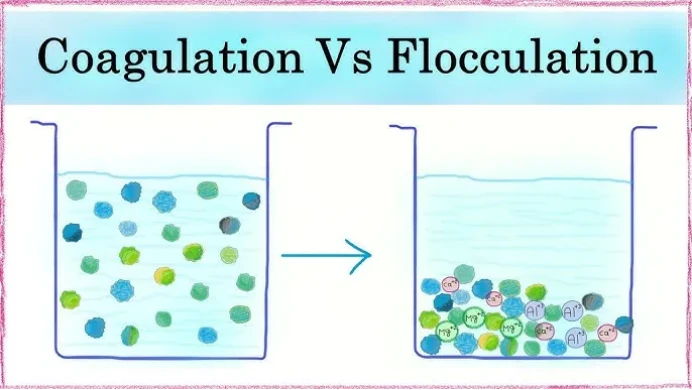
Coagulation and Flocculation are not the same process
Many water treatment practitioners are accustomed to collectively referring to Coagulation and Flocculation as "coagulation", but from a process perspective, the two actually undertake different tasks.
Coagulation is a rapidly completed chemical reaction whose main goal is to eliminate the electrostatic repulsion between particles and destabilize colloids; while Flocculation is a subsequent physical aggregation process that promotes these already destabilized micro-flocs to continuously collide and grow under slow stirring, eventually forming large particle flocs that can settle rapidly.
Therefore, the two not only differ in their mechanism of action but also have completely opposite requirements for equipment design and mixing conditions.
| Comparison Item | Coagulation | Flocculation |
| Essence | Chemical reaction | Physical aggregation |
| Main Action | Charge neutralization, particle destabilization | Micro-flocs grow to form flocs |
| Reaction Time | A few milliseconds to a few seconds | $15\text{--}30\text{ minutes}$ |
| Stirring Speed | High speed | Low speed |
| Energy Requirement | High | Low |
| Main Role of PAC | Rapidly neutralize charges | Polymer bridging to promote floc growth |
Precisely because the two require completely different operating environments, modern water treatment systems usually employ independent rapid mixing zones and slow flocculation zones to ensure that PAC can exert its best performance in both stages respectively.
Understanding the essential difference between Coagulation and Flocculation not only helps optimize the PAC dosing effect but also effectively reduces chemical consumption, improves settling efficiency, and enhances the operational stability of the overall water treatment system.
Why does Flocculation determine the final settling effect?
After completing Coagulation, although the colloidal particles in the raw water have lost their electrostatic stability, the flocs formed at this time are merely micro-flocs of extremely small size and light weight. Although these micro-flocs can contact each other, they are still insufficient to settle rapidly by their own weight.
Therefore, the key step that truly determines the clarification effect, settling velocity, and total suspended solids (TSS) removal rate is Flocculation.
Unlike Coagulation, Flocculation is a physical aggregation process. In this stage, the already destabilized micro-flocs continuously collide, adsorb, and combine under slow stirring, gradually growing into macro-flocs visible to the naked eye, which can eventually settle rapidly or be effectively intercepted by the filtration system.
For polyaluminum chloride (PAC), Flocculation is not only a natural continuation after Coagulation but also an important link for the entire PAC Water Treatment Process to achieve high-efficiency turbidity removal.
How does PAC promote floc growth during the Flocculation stage?
Many people think that PAC only plays a role in the Coagulation stage, but this is actually not the case.
After entering the Flocculation stage, the pre-polymerized structure inside polyaluminum chloride (PAC) continues to play a role. In addition to having completed charge neutralization, the polymer chains in PAC can further connect different micro-flocs, forming stable "bridges" between particles and promoting multiple micro-flocs to continuously combine and grow.
This effect is commonly referred to as Polymer Bridging.
Precisely because of the presence of bridging action, the large particle flocs formed by PAC usually possess the following advantages:
Larger floc size
More compact structure
Faster settling velocity
Stronger shear resistance
Better subsequent sludge dewatering performance
Compared with traditional alum (Alum), PAC can not only complete Coagulation faster but also continuously promote floc growth during the Flocculation stage, so the overall treatment efficiency is usually higher.
Especially in the following applications, the advantages of PAC are more pronounced:
Industrial wastewater treatment
Mining wastewater treatment
Coal mine coal washing wastewater
Paper mill wastewater treatment
Textile dyeing wastewater treatment
Municipal sewage treatment
For these water qualities with high suspended solids and high turbidity, PAC can significantly shorten the floc formation time and improve settling efficiency, thereby reducing the operating load on subsequent sedimentation tanks and filtration systems.
Why must Flocculation employ low-speed mixing?
The goal of Flocculation is not a rapid reaction, but to provide sufficient collision opportunities for micro-flocs.
If high-speed stirring like that in Coagulation is still used in this stage, a large number of already formed large particle flocs will be continuously subjected to shear forces and broken back down into fine particles.
This not only reduces the settling velocity but also increases effluent turbidity.
Therefore, during the PAC Flocculation process, the mixing energy must be significantly reduced, maintaining just enough fluid circulation.
Slow and continuous mechanical stirring is recommended so that particles can:
Collide naturally
Adsorb each other
Grow continuously
Avoid breakage
Practice has proved that stable low-speed Flocculation is usually better at improving treatment effects than simply increasing the PAC dosage.
Recommended Flocculation operating parameters for PAC
In order to obtain stable large particle flocs, it is recommended that the Flocculation system adopts the following operating conditions:
| Parameter | Recommended Value |
| Mixing intensity (G value) | 20-60-1 |
| Flocculation time | 15-30minutes |
| Mixing method | Slow continuous stirring |
| Energy design | Tapered mixing energy design (high at inlet, low at outlet) |
Among them, a Tapered Mixing Energy Design is most recommended.
Namely:
The first cell maintains a slightly higher mixing energy;
The second cell gradually decreases;
The third cell continues to decrease;
Maintain the lowest shear force before finally entering the sedimentation tank.
This design allows flocs to grow continuously without being broken due to excessive stirring in the later stages, and is therefore widely used in large-scale PAC Water Treatment projects.
Why does the combination of PAC and PAM yield better results?
Although PAC can simultaneously complete Coagulation and part of Flocculation, for some complex water qualities, relying solely on PAC still fails to achieve the best settling effect.
At this time, polyacrylamide (PAM) is usually added as an auxiliary flocculant.
The two chemicals undertake completely different functions:
| Chemical | Main Role |
| PAC | Coagulation (charge neutralization, micro-floc formation) |
| PAM | Flocculation (bridging micro-flocs to form large flocs) |
PAM possesses extremely long polymer chains that can further connect multiple micro-flocs formed by PAC, making them rapidly grow into more compact large particle flocs.
Therefore, in the following working conditions, PAC + PAM can usually achieve better treatment effects than using PAC alone:
Rapid settling in high-throughput sedimentation tanks
Ultrafine particle removal
Clay and coal slime removal
Mineral suspended solids removal
Coal washing wastewater treatment
Sludge dewatering
Low-temperature raw water treatment
For enterprises that need to improve settling efficiency and reduce sludge moisture content, utilizing PAC and PAM for Industrial Wastewater Treatment has become a relatively mature and economical process scheme.
Correct dosing sequence for PAC and PAM
The chemical dosing sequence directly affects the entire Flocculation result.
The recommended dosing workflow is as follows:
Step 1: Rapid dosing of PAC
PAC should first be dosed into the rapid mixing zone. The rapid mixing time is maintained for 30-60seconds to allow PAC to fully complete the Coagulation reaction.
Step 2: PAM enters the slow mixing zone
After the particles have completed destabilization, PAM is then added at the Flocculation inlet. Subsequently, slow mixing is maintained for 15-25 minutes to allow PAM to fully exert its bridging role and promote the formation of large particle flocs.
Step 3: Entering the sedimentation system
After mature large particle flocs enter the sedimentation tank, rapid settling can be achieved, improving effluent clarity and reducing the operational pressure on subsequent filtration systems.
Why can't PAM be added first?
This is a common mistake made by many field operators.
If the particles are still in an electrostatically stable state, although PAM can enter the water body, it cannot effectively connect the particles, and most of the long molecular chains will lose their effect, which not only increases operating costs but may also lead to chemical waste.
Therefore, in any PAC Flocculation Process, one should always adhere to: PAC completes Coagulation first, and PAM then strengthens Flocculation.
Only by following this principle can the respective advantages of both chemicals be fully utilized to achieve higher treatment efficiency, faster settling velocity, and more stable effluent water quality.

Common Problems and Optimization Schemes for PAC Mixing Systems
Even if high-quality polyaluminum chloride (PAC) is selected, if the operating parameters of the two stages of Coagulation and Flocculation are unreasonably set, it can still lead to a decline in turbidity removal rate, an increase in chemical consumption, and fluctuations in effluent water quality. Therefore, in the PAC Water Treatment Process, process optimization is often more important than simply increasing the chemical dosage.
Listed below are several of the most common types of problems in actual engineering and their corresponding optimization recommendations.
1. Coagulation effect is good, but settling velocity is slow
Possible Causes
If the raw water can rapidly form micro-flocs after rapid mixing, but the settling velocity inside the sedimentation tank is slow, it usually indicates that Coagulation has been completed, while the Flocculation stage has not reached its optimal state. The main causes of this phenomenon include:
Insufficient Flocculation retention time;
Excessive slow mixing energy;
Large particle flocs enter the sedimentation tank before being fully formed.
Optimization Recommendations
The following measures are recommended:
Appropriately reduce the mixing intensity (lower the G value) in the Flocculation stage;
Extend the slow mixing retention time;
For water quality with many fine particles, PAM can be added to assist bridging and increase the floc growth rate.
By optimizing the Flocculation process, settling efficiency can usually be significantly enhanced, while simultaneously lowering effluent turbidity and suspended solids content.
2. Floc formation is slow after PAC dosing
Possible Causes
If obvious flocs still cannot form a long time after PAC is added, it is usually not a problem with the PAC product itself, but rather caused by the following factors:
Insufficient PAC dosage;
Non-uniform dispersion during rapid mixing;
Raw water pH value deviates from the optimal working range of PAC;
Seasonal changes occur in raw water quality.
Optimization Recommendations
It is recommended to first perform a Jar Test to reconfirm the optimal PAC dosage. At the same time, check:
Whether the rapid mixing equipment can reach the recommended G value of $200\text{--}400\text{ s}^{-1}$;
Whether PAC can be uniformly dispersed within $30\text{--}60\text{ seconds}$;
Whether the raw water pH is suitable for PAC to exert its best Coagulation effect.
For different seasons and different water sources, the PAC dosing scheme should be dynamically adjusted according to water quality changes, rather than adopting a fixed dosage for a long time.
3. Large particle flocs break apart after entering the sedimentation tank
Possible Causes
If large flocs have already formed during the Flocculation stage, but become smaller again or even float after entering the sedimentation tank, it indicates that the flocs are subjected to large shear forces. Common causes include:
Excessive flow velocity at the sedimentation tank inlet;
Unreasonable design of the water distribution structure;
Severe water flow turbulence;
Excessive disturbance of the sludge blanket.
Optimization Recommendations
It is recommended to focus on checking:
Reducing the flow velocity at the sedimentation tank inlet;
Optimizing the flow guide structure;
Adding baffles or deflection plates when necessary;
Reducing inlet turbulence.
In many cases, it is not that the PAC performance is insufficient, but rather that the hydraulic design of the sedimentation tank restricts the achievements of Flocculation.
4. Treatment effect declines in winter
Why does low temperature affect water treatment?
After the water temperature drops in winter, fluid viscosity increases, and particle movement velocity decreases, so the probability of collisions between particles is significantly reduced. This means:
Flocculation speed slows down;
Floc growth time becomes longer;
Settling efficiency declines.
Compared with traditional alum (Alum), polyaluminum chloride (PAC) has better adaptability to low-temperature environments due to its pre-polymerized structure, so it can usually still maintain a high Coagulation efficiency.
Optimization Recommendations
Under low-temperature conditions, the following measures can be taken:
Appropriately extend the Flocculation time;
Reduce mixing intensity to minimize floc breakage;
Add PAM as an auxiliary flocculant;
Re-optimize the PAC dosage based on a Jar Test.
For northern regions, municipal water supply, and mining winter operation projects, these measures can usually significantly improve treatment results.
Coagulation and Flocculation Quick Comparison Table
| Parameter | Coagulation | Flocculation |
| Process Nature | Chemical reaction | Physical aggregation |
| Main Goal | Charge neutralization | Floc growth |
| Reaction Time | A few milliseconds to a few seconds | 15-30minutes |
| Recommended G Value | 200-400S-1 | 20-60S-1 |
| Main Role of PAC | Rapidly destabilize particles | Polymer bridging to promote growth |
| Role of PAM | Does not participate | Enhances bridging effect |
| Common Problems | Insufficient mixing leads to incomplete destabilization | Excessive mixing leads to floc breakage |
This comparison table can help engineering personnel quickly judge the operating status of the system and take corresponding optimization measures for different stages.
Frequently Asked Questions (FAQ)
1.Does PAC always need to be used in combination with PAM?
Not necessarily. For water quality with moderate turbidity and sufficient Flocculation time, using PAC alone can form flocs with good settling performance. However, for the following working conditions, a combined PAC and PAM process is recommended:
A large amount of ultrafine particles;
High-turbidity mining wastewater;
Coal washing wastewater;
Low-temperature operation in winter;
High requirements for sludge dewatering;
Large-flow treatment systems requiring rapid settling.
2.Can Coagulation and Flocculation be completed within the same tank?
Theoretically yes, but it is usually not recommended. The reason is that the mixing energy required by the two is completely different:
Coagulation requires high-speed mixing;
Flocculation requires slow stirring. If the same mixing speed is adopted, it is difficult to balance both reactions. Therefore, most modern water treatment systems will set up independent rapid mixing zones and slow flocculation zones to obtain more stable treatment effects.
3.How to judge whether Flocculation has reached its best state?
A preliminary judgment can be made by observing floc characteristics: High-quality flocs usually possess the following characteristics:
Clearly visible to the naked eye;
Size is approximately from pinhead to pea size;
Compact structure, not easily broken;
Able to settle rapidly after stirring stops. If the water body still appears uniformly turbid, it indicates that Flocculation conditions still need further optimization.
4.Why is the Jar Test (Jar Test) important?
Water quality varies greatly across different regions, different seasons, and different industrial wastewaters, and no single fixed dosage is applicable to all projects. A Jar Test can help users quickly determine:
Optimal PAC dosage;
Whether PAM needs to be added;
Optimal pH range;
Optimal Coagulation and Flocculation time;
Recommended mixing intensity. Therefore, when officially putting into production or when water quality changes, it is recommended to prioritize performing a beaker test to obtain the best operating parameters.
Conclusion
Coagulation and Flocculation, although belonging to the same water treatment process, undertake completely different tasks.
Coagulation is responsible for rapidly completing charge neutralization to make colloidal particles lose stability; Flocculation, through slow mixing, allows micro-flocs to continuously collide, bridge, and grow into large particle flocs that are easy to settle.
As an efficient inorganic polymer coagulant, polyaluminum chloride (PAC) can not only quickly complete Coagulation but also continuously promote floc growth during the Flocculation stage. Through reasonable design of rapid mixing, slow flocculation, and combined PAC and PAM dosing schemes, turbidity removal rates, suspended solids removal rates, and overall operational stability can be significantly improved.
For industries such as drinking water purification, municipal sewage treatment, industrial wastewater treatment, mining wastewater treatment, as well as papermaking and textile dyeing, a deep understanding of the working mechanisms of Coagulation and Flocculation is an important foundation for optimizing PAC application effects, reducing operating costs, and enhancing treatment efficiency.
Get Professional PAC Water Treatment Solutions
ECOLINK TECHNOLOGY focuses on polyaluminum chloride (PAC), polyacrylamide (PAM), and overall industrial water treatment solutions. We can provide professional technical support based on your raw water quality, treatment goals, and process requirements, including:
Free Jar Test scheme recommendations;
PAC/PAM product selection guidance;
Chemical dosing optimization schemes;
Coagulation and Flocculation process optimization;
Industrial wastewater, drinking water, and municipal sewage treatment solutions;
One-on-one technical consultation and after-sales support.
Welcome to contact us to get the PAC application scheme suitable for your project, and we will provide you with a professional reply within 24 hours.