I. What Challenges Does Acidified Oil Wastewater Treatment Face? How to Achieve Stable Standard Compliance?
Acidified oil wastewater is mainly produced during industrial fatty acid production and related processing operations. Due to differences in raw materials, process conditions, and separation methods, the wastewater may contain components such as glycerol, organic acids, inorganic acids, inorganic salts, and mucilage, characterized by high acidity, high salinity, high chemical oxygen demand (COD), and high color intensity.
The pH value of the raw wastewater generally ranges between 1 and 3, with a glycerol content of approximately 5% to 8%. This type of wastewater not only contains a high concentration of organic pollutants, but its acidic environment and high salinity also affect microbial activity, posing significant challenges to conventional biological treatment.
If directly discharged without effective treatment, it may lead to water pollution, soil salinization, and ecological environmental risks. Therefore, establishing a reasonable acidified oil wastewater treatment process requires comprehensive consideration of pH adjustment, pollutant removal, salinity control, water resource recovery, and the stability of subsequent treatment processes.
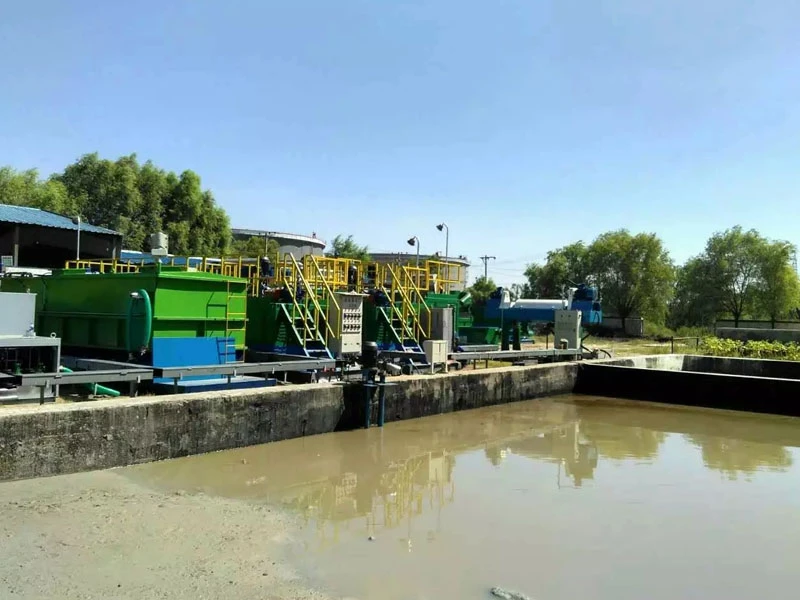
In response to the above characteristics, ECOLINK TECHNOLOGY introduces a combined treatment approach consisting of calcium oxide suspension neutralization and flocculation, forced circulation evaporation, and aerobic biological treatment. This approach gradually reduces the pollution load in the wastewater through multi-stage treatment, creating favorable conditions for subsequent treatment and discharge control.
II. Acidified Oil Wastewater Treatment Process Flow
For wastewater with high acidity, high salinity, and high COD, a single treatment technology often struggles to simultaneously address problems related to acidity, suspended solids, dissolved organics, and salinity. The core of a combined process is to reasonably arrange physicochemical treatment and biological treatment according to the treatment objectives of each stage.
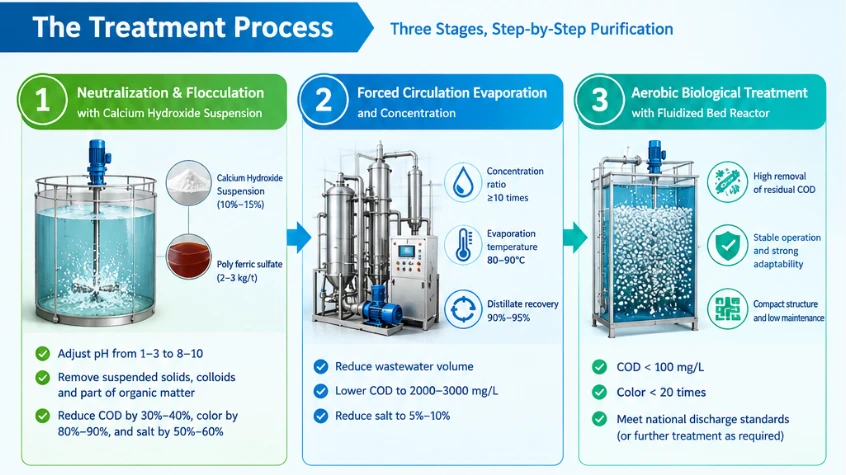
2.1 First Stage: Calcium Oxide Suspension Neutralization and Flocculation
After the acidified oil wastewater enters the treatment system, it first requires pH adjustment and the removal of a portion of suspended solids, colloidal substances, and separable pollutants through flocculation and separation.
This process utilizes calcium oxide powder mixed with water to prepare a neutralizing suspension, with a reference concentration of 10% to 15%.
When calcium oxide comes into contact with water, it generates calcium hydroxide, forming an alkaline suspension system. Upon adding the acidic wastewater, the alkaline components undergo a neutralization reaction with the acidic substances, thereby raising the wastewater's pH value.
The main process parameters are as follows:
Raw water pH value: 1–3
Calcium oxide suspension concentration: 10%–15%
Target pH value after neutralization: 8–10
Reference price of calcium oxide powder: Approx. 0.5 RMB/kg
Reference dosage of calcium oxide powder: 0.5–1 kg per ton of wastewater
The above dosage and cost are reference data provided in the original text, and actual operations should determine these through acidity titration and beaker tests. For wastewater with higher acidity, stronger buffering capacity, or significant composition fluctuations, actual chemical demand may vary.
How Does Polyferric Sulfate Improve Flocculation Effect?
Upon completing neutralization, suspended particles, colloids, and some organic pollutants may still remain in the wastewater. At this point, polyferric sulfate (PFS) can be added as an inorganic flocculant to promote the aggregation of fine particles into larger flocs, facilitating subsequent settling and solid-liquid separation.
The reference dosage of polyferric sulfate given in the original text is 2–3 kg per ton of wastewater.
The flocculation effect depends not only on the chemical dosage, but also on the pH value, mixing intensity, reaction time, floc settling performance, and raw water composition. In engineering applications, chemical dosage should be optimized through beaker tests to avoid increased chemical consumption or elevated sludge volume caused by over-dosing.
After calcium oxide suspension neutralization and polyferric sulfate flocculation treatment, the reference treatment performance provided in the original text is as follows:
COD reduced by 30%–40%
Color intensity reduced by 80%–90%
Salts reduced by 50%–60%
It should be noted that the salt removal effect is closely related to the specific composition and solubility of the salts. Precipitates generated during the neutralization process can be removed through solid-liquid separation, but this does not imply that all dissolved salts can be effectively removed.
2.2 Second Stage: Forced Circulation Evaporation and Concentration
After completing neutralization and flocculation, a portion of the suspended solids, organic pollutants, and precipitable components in the wastewater are removed. However, residual organics and salinity may still remain high, making it not necessarily suitable for direct entry into the biological treatment system.
Therefore, acidified oil wastewater treatment can further consider adopting forced circulation evaporation technology to achieve the separation of water and concentrated liquid through heating, evaporation, and condensation.
A forced circulation evaporator uses a circulation pump to keep the wastewater continuously flowing through heat exchange equipment and circulation pipelines, utilizing thermal energy to evaporate moisture. Steam condenses to form condensate water, while non-volatile dissolved substances primarily remain in the concentrated liquid.
Main Technical Characteristics of Forced Circulation Evaporation
Reduce the volume of wastewater needing subsequent treatment
The original text notes that this equipment can concentrate wastewater by more than 10 times. Concentration can reduce the volume of subsequent concentrated liquid, but it does not mean that the total amount of pollutants is reduced proportionally, nor does it mean all pollutants can be completely removed.
Control evaporation temperature and scaling risk
The evaporation temperature given in the original text is generally 80–90°C. Forced circulation helps improve flow status and lower the risk of local overheating, but in actual operations, attention must still be paid to heat transfer surface scaling, corrosion, viscosity increase, and circulation flow changes.
For wastewater containing higher salinity and organics, equipment materials, cleaning cycles, and operational energy consumption should be evaluated based on boiling point elevation, salt solubility, and concentration factor.
Recover condensate water to enhance water resource utilization
The distilled water recovery rate given in the original text is generally 90%–95%. Whether the condensate water can be directly reused in production or cooling systems should be determined based on its water quality testing results and actual water use requirements.
The evaporation process belongs to a gas-liquid separation process and cannot be simply understood as the total disappearance of pollutants. For potentially volatile organics, the risk of condensate water contamination must also be evaluated, and necessary collection and treatment facilities should be configured based on exhaust gas composition.
After forced circulation evaporation, the reference indicators provided in the original text are:
COD reduced to 2000–3000 mg/L
Salts reduced to 5%–10%
The above data represent the reference results of the process described in the original text. Different influent water qualities, evaporation conditions, and concentration methods may lead to significant differences; hence, project design should verify these through water quality analysis and material balance beforehand.
2.3 Third Stage: Aerobic Biological Treatment to Further Reduce Organic Pollutants
After front-end physicochemical treatment and evaporation concentration, part of the pollution load in the wastewater is reduced. However, it is still necessary to evaluate whether residual organics, salinity, pH value, and potential inhibitory substances are suitable for biological treatment.
This process employs a biofilm fluid bed reactor as the aerobic biological treatment unit. This technology uses microorganisms attached to the carrier surface to degrade biodegradable organic matter in the wastewater, maintaining microbial metabolic activity through oxygen supply.
Compared with treatment methods that rely solely on suspended activated sludge, biofilm systems can retain a certain amount of attached biomass through carriers. However, specific operational performance still depends on carrier characteristics, dissolved oxygen, temperature, nutrient conditions, and influent water quality.
Application Advantages of Biofilm Fluid Bed
Helps lower residual COD. Microorganisms can utilize part of the biodegradable organic matter as metabolic substrates, further lowering the organic pollution load in the wastewater.
Adapts to water quality fluctuations within a certain range. Reasonable biomass retention and operational control help maintain system stability, though high salinity, extreme pH values, or toxic substances may still inhibit microbial activity.
Compact structure, facilitating system integration. Biofilm fluid beds can be designed according to project scale and treatment objectives, but actual footprint, oxygen demand, and maintenance costs need to be determined in combination with engineering conditions.
The reference results for aerobic biological treatment provided in the original text are:
COD reduced to below 100 mg/L
Color intensity reduced to below 20 times
The original text links this result to National Class 1A discharge standards requirements. However, actual projects must verify compliance against applicable discharge standards, discharge destinations, and other control metrics, rather than determining overall compliance solely based on COD and color intensity.
Furthermore, the post-evaporation COD of 2000–3000 mg/L mentioned in the original text does not mean all such wastewater can directly enter the aerobic system. Prior to design, salinity, pH value, biodegradability, and biological toxicity should be confirmed, and regulation, dilution, or other pretreatment measures should be configured when necessary.
III. Three Core Advantages of Acidified Oil Wastewater Treatment
Reasonably configuring neutralization and flocculation, evaporation concentration, and biological treatment allows different technologies to assume their suitable treatment tasks, preventing a single process from bearing an excessively high pollution load.
Advantage 1: Removing pollutants in stages to improve overall treatment conditions
Front-end neutralization and flocculation focus on resolving pH adjustment and a portion of suspended solids, colloids, and separable pollutants; evaporation concentration is used to separate water and reduce liquid-phase volume; aerobic biological treatment further degrades biodegradable organic matter.
This division of labor helps reduce the load on individual treatment units and improves the targeted nature of process configuration.
Advantage 2: Balancing condensate water recovery with concentrate reduction
For industrial wastewater with high water recovery value, evaporation condensation can provide a potential source of reused water while reducing the volume of concentrated liquid requiring further treatment.
However, concentrated liquid still requires an appropriate disposal or subsequent treatment method selected according to pollutant and salt composition. When performing project economic analysis, costs for steam, electricity, circulation pumps, cleaning, condensate water treatment, and concentrate disposal should all be calculated simultaneously.
Advantage 3: Adjusting processes based on actual water quality to enhance operational controllability
Different enterprises may have different raw material sources, production conditions, and wastewater discharge methods; even within the same industry, water quality may not be identical.
Therefore, acidified oil wastewater treatment should not directly adopt fixed chemical dosages or equipment parameters. Through raw water testing, beaker tests, evaporation tests, and biological feasibility assessments, chemical dosing, evaporation concentration conditions, and biological treatment loads can be determined more reasonably.
For new projects or existing system renovations, staged verification also helps reduce the risk of process selection errors and subsequent operational instability.
IV. What Key Factors Need Attention When Designing an Acidified Oil Wastewater Treatment System?
To improve system operational stability, engineering design must focus not only on the processing capacity of individual equipment, but also on water quality changes and material balances throughout the entire process flow.
4.1 Raw Water Quality Analysis
It is recommended to focus on testing pH value, COD, salinity and main ion composition, color intensity, suspended solids, oil/grease content, and biodegradability. For wastewater with large compositional fluctuations, water quality changes across different production batches and operating periods should also be evaluated.
4.2 Chemical Selection and Dosing Control
Dosages of calcium oxide suspension and polyferric sulfate should be determined based on actual water quality. In addition to chemical costs, sludge production, settling performance, effluent residual iron content, and operational requirements of subsequent equipment should be considered.
4.3 Evaporation Equipment and Thermal Energy Consumption
The selection of forced circulation evaporators should be calculated by combining treated water volume, target concentration factor, influent boiling point elevation, scaling tendency, corrosion risk, and heat source conditions.
Evaporation concentration typically requires high thermal energy. Therefore, complete material balance and energy consumption analyses must be performed to compare the full life-cycle costs of evaporation systems against alternative technology routes.
4.4 Influent Conditions for Biological Treatment
Aerobic biological systems require suitable pH values, dissolved oxygen, and nutrient conditions. High-salinity environments and residual inhibitory substances may affect microbial growth; thus, salinity adaptability and biodegradability should be evaluated prior to entry.
4.5 Discharge and Reuse Standards
Design targets should be based on applicable local discharge standards, discharge destinations, and reuse requirements for the project location. If further salinity reduction or higher reuse ratios are required, evaluations should be made on whether to add membrane treatment, advanced oxidation, or other tertiary treatment units.
V. ECOLINK TECHNOLOGY: Providing Product and Solution Support for Industrial Wastewater Treatment
ECOLINK TECHNOLOGY focuses on water treatment chemicals and water treatment equipment, committed to supporting customers' water treatment projects through product matching, technical support, and one-stop services.
For acidified oil wastewater and other industrial wastewater projects, specific plans should be evaluated based on influent water quality, treatment scale, effluent targets, and site conditions. Different projects may require a combination of neutralizers, flocculants, evaporation equipment, and biological treatment systems, and final plans cannot be determined solely by wastewater names.
During the solution evaluation stage, it is recommended to clarify the following information first:
Wastewater source: Acidified oil production, fatty acid processing, or other industrial processes.
Treatment scale: Daily wastewater volume and production fluctuations.
Raw water indicators: pH value, COD, salinity, color intensity, suspended solids, and main pollutants.
Treatment targets: Standard compliance discharge, production reuse, or further volume reduction.
Site conditions: Available heat sources, power supply conditions, space, and concentrate disposal methods.
Based on this information, chemical selection, process combination, equipment configuration, and operating costs can be evaluated in a more targeted manner, avoiding unreliable design commitments made without critical data.
If you need to learn about industrial wastewater treatment chemicals, flocculants, or supporting water treatment equipment, feel free to contact ECOLINK TECHNOLOGY.
Official Website: www.ecolink-environment.com
VI. Conclusion
Acidified oil wastewater is characterized by high acidity, high salinity, high COD, and high color intensity. Its treatment process needs to balance pollutant removal, salinity management, water resource recovery, and subsequent disposal.
The combined route of calcium oxide suspension neutralization and flocculation, forced circulation evaporation, and aerobic biological treatment introduced in this article provides a technology approach worth evaluating for this type of industrial wastewater. Its actual applicability and final effluent performance need to be confirmed through water quality testing, test verification, engineering design, and continuous operational data.
ECOLINK TECHNOLOGY can assist in evaluating applicable water treatment chemicals and equipment configurations based on project water quality characteristics and treatment targets, formulating more reasonable and implementable industrial wastewater treatment solutions for customers.
Welcome to contact ECOLINK TECHNOLOGY to explore industrial wastewater treatment solutions suitable for your project.