I. Rethinking Sludge Dewatering: Higher Chemical Dosage Does Not Guarantee Better Performance
In municipal wastewater treatment, sludge dewatering is a critical process for reducing sludge volume, lowering transportation costs, and optimizing downstream disposal. Many wastewater treatment plants attempt to improve dewatering performance by increasing polymer dosage; however, in practice, sludge dewatering does not always follow the principle that "higher dosage yields drier filter cake."
Once the polymer dosage reaches an optimal range, further dosage increases may fail to lower filter cake moisture content and may even deteriorate dewatering efficiency. Meanwhile, continuously increasing chemical consumption imposes unnecessary operational costs on the plant.
For systems using cationic polyacrylamide for sludge conditioning, chemical performance depends not only on dosage, but also closely on molecular weight, charge density, sludge properties, and mechanical dewatering conditions. Therefore, the key to optimizing sludge dewatering is identifying the chemical combination and dosage range suited to the specific sludge, rather than blindly pursuing higher dosage.
ECOLINK TECHNOLOGY focuses on matching water treatment chemicals with actual process conditions, assisting users in comprehensively evaluating sludge dewatering requirements across chemical selection, dosage control, and operational performance.
II. Why Overdosing Deteriorates Sludge Dewatering Performance
Cationic polyacrylamide is a widely used sludge conditioner that promotes the aggregation of fine sludge particles into flocs through mechanisms such as charge neutralization and polymer bridging. However, when polymer properties do not match the sludge, or when dosage exceeds the optimal range, interactions that originally favored solid-liquid separation can change.
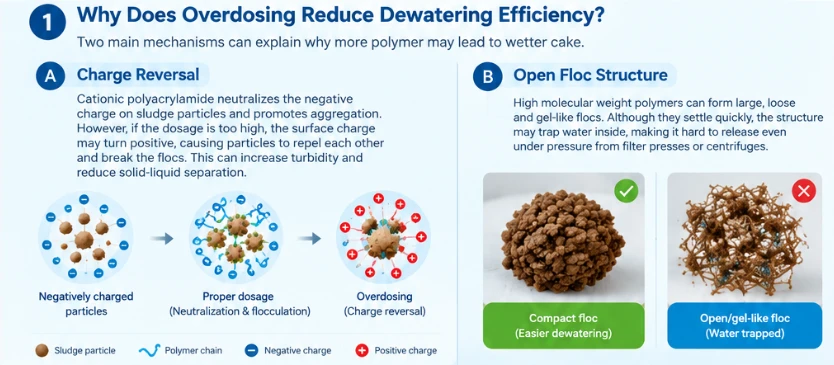
2.1 Charge Reversal: Overdosing May Restabilize Particles
Many sludge particle surfaces carry a negative charge. Adding cationic polyacrylamide neutralizes part of the negative surface charge, reducing electrostatic repulsion between particles and encouraging flocculation.
However, if cationic polymer is added in excess, the particle surface charge may shift from net negative to net positive. At this stage, electrostatic repulsion can re-emerge between particles, causing formed flocs to break apart and some fine particles to re-disperse into the water.
This phenomenon can cause filtrate or centrate turbidity to rise, harming solid-liquid separation. Consequently, selecting sludge dewatering chemicals should not rely solely on cationic characteristics; it must incorporate particle surface charge and actual conditioning effects.
2.2 Loose Floc Structure: Water Trapped Inside
Beyond charge reversal, floc structure is an important factor affecting dewatering performance.
High-molecular-weight polymers can promote rapid aggregation of sludge particles, but under certain conditions, the resulting flocs may feature an open, loose, or gel-like structure. Although such flocs are larger in volume and settle faster, they are not necessarily easily dewatered by filter presses or centrifuges.
The reason is that internal water within flocs may be constrained by the polymer network structure, making it difficult to migrate and release. Even under mechanical pressure, achieving the desired cake solids content remains challenging.
Thus, evaluating cationic polyacrylamide performance requires looking beyond floc size and settling speed to assess floc strength, filtrate quality, drainage capacity, and final cake moisture content.
III. Key Insights Revealed by Experimental Data: Balancing Molecular Weight, Charge Density, and Dosage
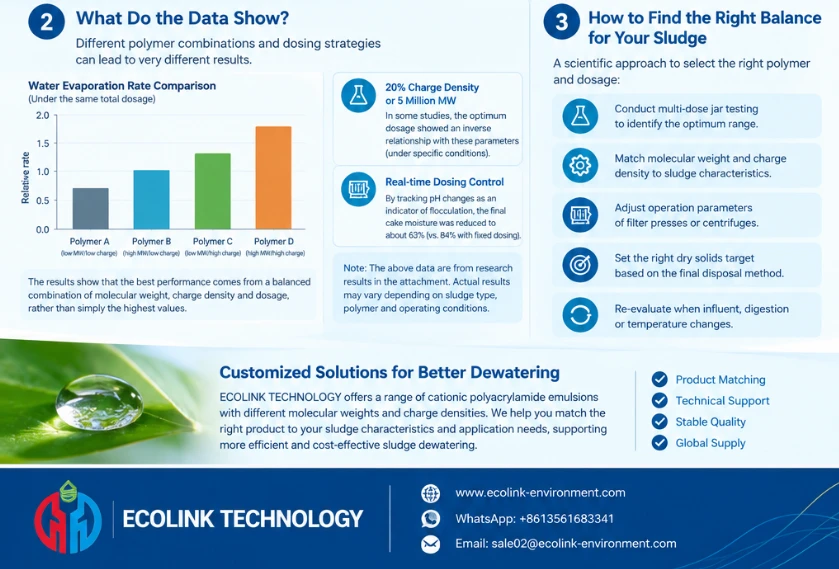
In a study comparing the performance of different cationic polyacrylamide formulations in sewage sludge treatment, researchers evaluated four combinations of molecular weight and charge density at a fixed dosage.
The results showed that even when the total amount of polymer added was equivalent across groups, water evaporation rates differed by more than two-fold between combinations. This demonstrates that identical chemical dosage does not mean identical dewatering performance. The combination of molecular weight and charge density can significantly impact floc structure and subsequent moisture release.
Another widely cited study indicated that under specific conditions, when cationic polyacrylamide charge density reached approximately 20% or molecular weight approached 5 million, the optimal dosage and corresponding parameters showed an inverse trend. This value represents a reference outcome under specific research conditions, not a universal selection standard for all sludges and products.
Another study using real-time sensor-controlled dosing tracked pH drop after polymer addition as an indicator of flocculation effectiveness. That system ultimately achieved a filter cake moisture content of approximately 63%, compared to approximately 84% for the same sludge under a fixed, non-adaptive dosing regime.
These findings demonstrate that improving dewatering performance does not necessarily rely on increasing chemical dosage. Identifying optimal dosing timing, controlling chemical dosage, and adjusting press conditions can yield superior operational outcomes.
Note that the above data are derived from the research studies cited in the attachment; specific application outcomes depend on sludge characteristics, testing conditions, polymer types, and equipment operating parameters.
IV. How to Determine If Sludge Dewatering Chemicals Are Overdosed
In daily operation, operators can evaluate whether the current dosage remains effective by monitoring filtrate appearance, floc status, cake solids content, and chemical consumption.
4.1 Filtrate or Centrate Turbidity Increases Instead of Decreasing
As dosage increases, if filtrate or centrate fails to become clearer and instead shows rising turbidity, fine particles may be re-dispersing or the flocculation system may have drifted from optimal charge balance.
At this point, chemical dosage, sludge properties, and mixing conditions should be inspected rather than directly increasing dosage further.
4.2 Large Floc Volume, but Soft or Gel-Like Texture
Flocs with large volume and fast settling speeds do not necessarily indicate good mechanical dewatering performance. If flocs lack structural strength or retain substantial internal water, effective drainage during subsequent pressing or centrifugation becomes difficult.
When evaluating polyacrylamide flocculants, attention should simultaneously focus on floc formation, shear resistance, and actual drainage performance.
4.3 Cake Solids Content Plateaus After Two to Three Dosage Increases
When cake solids content shows no further improvement-or even slight decline-after two to three incremental dosage increases, the return on continuing dosage increases is likely minimal.
Jar testing and equipment logs should be used to confirm the optimal dosage range and prevent wasteful chemical consumption.
4.4 Increasing Chemical Consumption Without Corresponding Drops in Cake Moisture
If polymer consumption increases significantly across batches while filter cake moisture measured at the press or centrifuge shows no corresponding drop, chemical grade, dosing concentration, mixing conditions, and mechanical parameters require re-evaluation.
These indicators help treatment plants build more effective sludge dewatering management protocols, shifting chemical dosing from empirical guesswork to data-assisted decision making.
V. How to Select the Right Cationic Polyacrylamide
Proper chemical selection should revolve around sludge properties and target treatment goals, rather than simply picking the product with the highest molecular weight or strongest cationicity.
5.1 Match Molecular Weight and Charge Density to Sludge Characteristics
Sludges can vary significantly in organic content, inorganic particle ratio, surface charge, and digestion history. Consequently, different wastewater treatment plants may require different polymer specifications even when operating identical dewatering equipment.
Molecular weight affects polymer chain bridging ability and floc structure, while charge density governs charge interactions between polymer and sludge particles. Both must be evaluated together; neither parameter should be considered universally superior at higher values.
5.2 Determine Optimal Dosage Range Through Jar Testing
Jar testing is a vital method for evaluating sludge conditioning performance. A series of dosages should be tested on representative samples from the same sludge batch, rather than comparing only one or two points.
During testing, the following parameters should be recorded simultaneously:
Floc formation speed, size, and structural stability
Supernatant or filtrate clarity
Sludge drainage capacity and filtration behavior
Final filter cake solids and moisture content
Chemical consumption per unit volume processed
Comparing performance across dosages identifies where dewatering performance peaks and the range where performance begins to decline due to overdosing.
5.3 Adjust Operating Parameters Based on Dewatering Equipment
Filter presses and centrifuges operate differently, placing distinct demands on floc structure and sludge conditioning state. Even with the same chemical formulation, changes in equipment pressure, speed, residence time, and feed status can alter final dewatering outcomes.
Therefore, sludge dewatering optimization must integrate chemical selection with equipment operating parameters rather than relying solely on increased polymer dosage to resolve all issues.
VI. Final Sludge Disposal Method Determines Reasonable Dewatering Targets
The objective of sludge treatment is not always achieving the absolute lowest moisture content. The final disposal pathway dictates how plants balance dewatering performance, operational costs, and downstream processing requirements.
6.1 Landfill and Incineration: Focus on Transport Weight and Energy Consumption
For sludge destined for landfills or incinerators, lowering cake moisture content helps reduce transport weight and can decrease fuel requirements during incineration.
However, further moisture reduction incurs additional chemical, energy, and equipment operating costs. Economic value at each stage of dewatering optimization should be evaluated against actual disposal fees.
6.2 Land Application: Dryness Is Not the Sole Metric
For sludge intended for land application as biosolids, requirements beyond moisture content must be considered, including pathogen reduction, vector attraction reduction, and applicable pollutant limits.
The attachment references the US Federal Biosolids Standard as 40 CFR Part 503. For projects involving the US market or related land application scenarios, compliance requirements should be verified against applicable regulations and disposal pathways, rather than judging performance solely on cake dryness.
6.3 Avoid Excessive Costs for an Extra 2% or 3% Moisture Reduction
If continuously increasing dosage to achieve a 2% or 3% further moisture reduction leads to compromised floc quality, higher chemical costs, or increased downstream handling difficulty, such marginal improvements may lack economic justification.
A more effective approach is to define final disposal requirements in advance, balancing dewatering performance, chemical cost, and equipment stability while satisfying practical needs.
VII. Establishing a Sustainable Precise Dosing Strategy for Sludge Dewatering
To enhance sludge dewatering efficiency and eliminate unnecessary chemical waste, wastewater treatment plants can establish ongoing evaluation and dynamic adjustment mechanisms.
First, conduct multi-dosage gradient testing. Continuously compare flocculation and dewatering performance across dosages to identify peak performance points and potential overdosing ranges.
Second, properly match polymer specifications. Select chemicals based on sludge type, molecular weight, charge density, and actual dewatering performance, avoiding treating a single high-performance grade as a universal solution for all sludges.
Third, establish process monitoring metrics. Look beyond final cake moisture to observe filtrate clarity, floc texture, chemical consumption, and equipment operating data for early detection of performance shifts.
Fourth, clarify final disposal targets. Establish reasonable dry solids targets and operational requirements based on disposal pathways such as landfill, incineration, or land application.
Fifth, periodically re-evaluate dosage. Re-test when influent composition, sludge digestion processes, or seasonal temperatures change. The optimal dosage point is influenced by chemical properties and evolves with changing sludge conditions.
Through these measures, sludge dewatering operations can transition from simply chasing higher dosages toward a refined operational model focused on chemical utilization efficiency, floc structure, and equipment synergy.
VIII. ECOLINK TECHNOLOGY: Supporting Sludge Dewatering Optimization via Chemical Matching
For municipal sludges of varying sources and properties, suitable polymer specifications and dosages must be determined based on actual conditions. ECOLINK TECHNOLOGY offers a series of cationic polyacrylamide emulsions covering various molecular weights and charge densities, enabling selection evaluations aligned with sludge properties and application requirements.
In sludge dewatering projects, chemical selection should prioritize the following factors:
Sludge type and key physicochemical characteristics
Target floc structure and solid-liquid separation performance
Operating conditions of dewatering equipment (filter presses, centrifuges, etc.)
Chemical consumption, cake moisture content, and total treatment costs
Final sludge disposal method and corresponding compliance requirements
ECOLINK TECHNOLOGY focuses on matching water treatment chemicals with actual application scenarios, committing to help clients evaluate optimal sludge conditioning solutions through product selection support and technical communication.
Core Conclusion: Effective sludge dewatering does not mean continuously increasing chemical dosage. What truly matters is maintaining a balanced harmony between polymer molecular weight, charge density, dosage, floc structure, dewatering equipment, and final disposal goals.
To evaluate cationic polyacrylamide suited to your specific sludge, please provide the sludge source, current chemical specifications, dewatering equipment type, and current operational data to enable targeted product matching and test evaluations.