I. Why Does Metallurgical Production Need Industrial Water Purification Equipment?
The metallurgical industry involves smelting, rolling, cooling, cleaning, electrolysis, and other production processes. Water is not only an auxiliary production resource, but also an important medium to ensure equipment operation, product quality, and production stability. With the continuous development of the global steel, metal processing, and metallurgical manufacturing industries, industrial water management has become an important link for enterprises to control production costs, reduce environmental burdens, and improve operational efficiency.
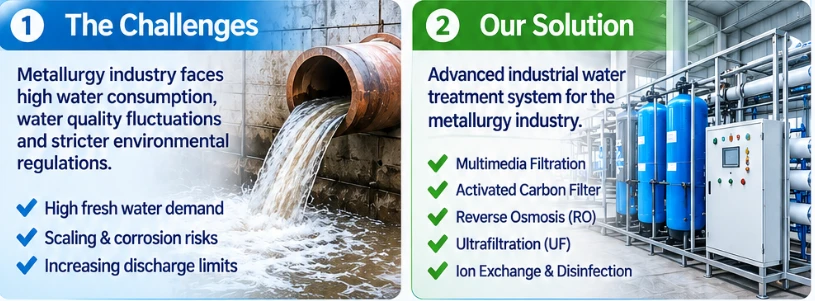
In steel production and other metallurgical processes, water is typically used for equipment cooling, process cleaning, circulating system makeup water, and the preparation of certain process media. However, improperly treated raw water may contain suspended solids, colloids, hardness ions, dissolved salts, organic matter, microorganisms, and other impurities. These substances may cause pipeline blockages, decreased heat exchange efficiency, scaling, corrosion, membrane fouling, or water quality fluctuations, affecting the stable operation of the production system.
For metallurgical enterprises, the traditional model of relying solely on large amounts of fresh water makeup and discharging wastewater is increasingly difficult to meet the dual requirements of economic benefits and environmental management. Especially in regions with water scarcity, high water supply costs, strict discharge management, or where enterprises need to optimize energy and resource utilization, establishing a stable industrial water treatment system has practical significance.
The core value of industrial water purification equipment is not just purifying water, but helping enterprises manage water quality, water quantity, operating costs, and production risks more reasonably.
ECOLINK TECHNOLOGY focuses on actual water treatment needs in industrial production and can provide metallurgical enterprises with industrial water purification equipment and supporting water treatment solutions based on raw water conditions, process water standards, site space, and operational goals, helping enterprises improve water quality, increase water resource utilization efficiency, and optimize production water costs.
II. Water Treatment Challenges Faced by the Global Metallurgical Industry
With the expansion of global industrial production scale, the water treatment needs of metallurgical enterprises are no longer limited to a single water purification link, but are gradually developing toward water quality stability, recycling, system efficiency, and comprehensive cost control.
2.1 Large Industrial Production Water Consumption and Increasing Water Resource Utilization Pressure
Steel and metal processing production usually involves multiple water-using links; circulating cooling water, equipment cooling water, cleaning water, and process makeup water all need to be managed according to different uses.
The original materials show that, under the domestic steel production statistical background cited therein, an average of about 20 cubic meters of water is consumed per 1 ton of steel produced, of which the fresh water makeup volume is about 10 cubic meters.
With the continuous expansion of the global metallurgical industry layout, enterprises in different countries and regions also face different challenges such as water resource supply, industrial water prices, infrastructure conditions, and environmental policies. For metallurgical plants in water-scarce regions, reducing fresh water consumption and improving circulating water utilization efficiency can directly affect production costs and long-term operational capabilities.
By configuring reasonable industrial water purification equipment, enterprises can treat water sources according to different process water needs, and use the qualified treated water for production or other suitable purposes, reducing dependence on external water resources.
2.2 Unstable Water Quality Affects Equipment Operation and Production Efficiency
Water quality requirements in the metallurgical industry vary by application. Circulating cooling water, equipment cleaning water, process makeup water, and high-purity water cannot adopt completely identical treatment standards.
Suspended solids, colloids, hardness, dissolved salts, and other impurities in raw water may bring different problems:
Suspended solids and colloids: May deposit in filtration systems, pipelines, and heat exchange equipment, increasing cleaning frequency.
Hardness ions: May form scale under high temperature or concentrated conditions, affecting heat exchange efficiency.
Dissolved salts: May affect the water quality requirements of specific production processes and increase subsequent purification burdens.
Microorganisms: May reproduce in circulating water systems under suitable conditions, forming biofouling.
Organic matter and other pollutants: May affect membrane system performance or the stability of specific processes.
Therefore, the design of industrial water purification equipment cannot focus solely on a single filtration indicator, but needs to select corresponding treatment processes based on raw water quality, process application, and equipment operating conditions.
2.3 Continuously Increasing Requirements for Wastewater Discharge and Recycling
Global industrial environmental management is paying more attention to resource utilization efficiency, pollutant control, and the sustainability of production systems. Metallurgical enterprises not only need to treat the wastewater generated during production, but also need to consider which water can be recovered, which water requires further treatment, and whether the reused water meets the requirements of the corresponding processes.
For water sources that meet reuse conditions, adopting filtration, membrane treatment, or other suitable water treatment technologies can, upon verification, allow the treated water to be used for circulating cooling, auxiliary production, or other purposes.
Actual reuse solutions need to be designed based on wastewater pollutant composition, treatment targets, concentration cycles, system blowdown, and water quality requirements; different plants are not suited to adopt a uniform reuse ratio.
III. Main Roles of Industrial Water Purification Equipment in Metallurgical Production
Industrial water purification equipment treats raw water in stages by combining different water treatment technologies to meet different water needs during industrial production. For the metallurgical industry, a reasonable industrial water treatment system can play a role in multiple aspects such as water quality assurance, recycling, equipment protection, and operation management.
3.1 Improving Water Quality to Meet the Water Needs of Different Metallurgical Processes
Different metallurgical processes have obvious differences in water quality requirements. For example, circulating cooling systems may focus on hardness, suspended solids, and microbial control; specific cleaning processes may focus on residual ions and pollutants in water; and some production links with higher water quality requirements need to further reduce the dissolved salt content in water through reverse osmosis or ion exchange.
Industrial water purification equipment can treat raw water through process combinations such as multi-media filtration, activated carbon filtration, softening, ultrafiltration, reverse osmosis, and ion exchange to reduce the impact of different types of impurities on the production system.
For metallurgical production enterprises requiring stable water quality, industrial water treatment systems can design different treatment levels according to specific points of use, rather than treating all production water to the same high standard. This graded treatment approach helps avoid unnecessary treatment costs and energy consumption.
3.2 Improving Water Resource Utilization Efficiency and Reducing Fresh Water Makeup Volume
Water resource recycling is one of the important directions of industrial water treatment.
By purifying raw water and reprocessing water that meets reuse conditions, enterprises can use part of the water resources for suitable production links. For example, appropriately treated water can be used for circulating cooling systems, auxiliary cleaning, or other process makeup water according to water quality requirements.
Reasonable coordination between industrial water purification equipment and circulating water systems can help enterprises reduce fresh water makeup volume and decrease the discharge of certain wastewater. For long-term operating industrial production systems, improving water recycling efficiency not only helps conserve water resources, but may also reduce water supply, drainage, and related treatment costs.
3.3 Protecting Production Equipment and Reducing Maintenance and Operational Risks
There is a direct correlation between water quality and equipment operating status. Filtration systems, heat exchangers, pumps, pipelines, membrane modules, and other water treatment equipment may all be affected by particulate matter, scaling substances, or other pollutants in the water.
In industrial water purification systems, reasonably configuring pretreatment equipment can reduce the pollution load on subsequent treatment units. For example:
Multi-media filters are used to reduce suspended solids and certain particulate pollutants in water.
Activated carbon filters are used to remove certain organic matter and residual chlorine under appropriate conditions.
Softeners are used to reduce the hardness impact caused by calcium and magnesium ions in water.
Security filters are used to reduce particulate matter entering the membrane system.
Reverse osmosis systems are used to further reduce dissolved salts and other rejectable substances in water.
Through reasonable process design and maintenance management, industrial water purification equipment can help reduce the fouling risk of subsequent equipment, improve system operational stability, and reduce the maintenance burden caused by water quality issues.
3.4 Automatic Control to Improve System Operation Management Efficiency
Modern industrial water treatment equipment can usually be equipped with automatic control systems, pressure monitoring, flow monitoring, liquid level control, and water quality monitoring functions. Depending on system configuration, equipment start/stop, operating status monitoring, abnormal alarms, and certain automatic adjustments can be achieved.
Automated control can reduce some manual operations and improve the convenience of system operation management. For continuously operating metallurgical production enterprises, automatic control and online monitoring help detect abnormal situations in a timely manner, reduce operational risks, and provide data support for operation and maintenance.
IV. ECOLINK TECHNOLOGY Metallurgical Industrial Water Purification Equipment Solutions
ECOLINK TECHNOLOGY focuses on industrial water treatment chemicals and equipment, providing water treatment solutions based on customer requirements, raw water quality and industrial applications.
Targeting the production water needs of the metallurgical industry, industrial water purification equipment needs to be designed in combination with on-site water sources, production scale, process water standards, equipment layout, and operating conditions. The water sources of different enterprises may come from tap water, groundwater, surface water, or pretreated industrial water, so system configurations also need to be adjusted accordingly.
The following is an industrial water purification equipment case for a metallurgical enterprise from the original materials.
4.1 Project Background
This metallurgical enterprise is mainly engaged in steel smelting and processing, with an annual output reaching 1 million tons.
The enterprise originally used tap water as production water, but because the water contained relatively high levels of impurities such as suspended solids, colloids, bacteria, and organic matter, it could affect reaction rates during production, product quality, and equipment service life. At the same time, using tap water as the main production water source also brought high water expenses.
To improve production water quality, increase water resource utilization efficiency, and reduce water costs, the enterprise selected the industrial water purification equipment solution provided by ECOLINK TECHNOLOGY after multi-party comparison and investigation.
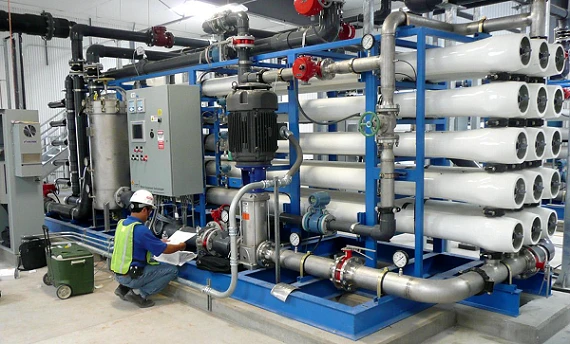
4.2 Industrial Water Purification Equipment System Configuration
This project adopts a multi-stage water treatment process, building a system from raw water pretreatment to deep purification based on the functional division of each treatment unit.
A. Pretreatment System
The pretreatment system is mainly composed of multi-media filters, activated carbon filters, softeners, and security filters.
This system is used to reduce suspended solids, colloids, certain organic matter, residual chlorine, and hardness in raw water, improving the influent conditions for subsequent treatment units.
The pretreatment system is an important component of industrial water purification equipment. By reducing the impact of particulate matter, residual chlorine, and hardness on subsequent equipment, the fouling risk of reverse osmosis membranes can be lowered, and overall system operating conditions can be improved.
B. Reverse Osmosis System
The reverse osmosis system is mainly composed of high-pressure pumps, reverse osmosis membrane modules, and control cabinets.
Reverse Osmosis (RO) is a water treatment technology that uses pressure to drive water through a semi-permeable membrane to separate dissolved salts and other rejectable substances. It is widely used in industrial pure water preparation, process water treatment, and certain wastewater reuse scenarios.
In this metallurgical enterprise's solution, the reverse osmosis system is used to further reduce dissolved salts, certain organic matter, microorganisms, and other pollutants in raw water, providing more stable water quality conditions for production water.
C. Ion Exchange System
The ion exchange system is mainly composed of cation exchange columns, anion exchange columns, mixed beds, and regeneration devices.
Ion exchange technology exchanges specific ions in water through resins, which can further reduce the residual ion content in water. In industrial applications with higher water purity requirements, the ion exchange system can serve as a post-treatment unit for reverse osmosis to improve water purity.
D. Ultrafiltration System
The ultrafiltration system is mainly composed of ultrafiltration membrane modules and cleaning devices.
Ultrafiltration (UF) utilizes the sieving action of membranes to remove particulate matter, colloids, and certain microorganisms from water. Its main role is to reduce the content of macromolecular pollutants and particulate pollutants in water, improving water quality stability.
The ultrafiltration system can serve as a pretreatment or independent treatment unit depending on the water source and process requirements, but it cannot replace reverse osmosis treatment targeting dissolved salts.
E. Ultraviolet Disinfection System
The ultraviolet disinfection system is mainly composed of ultraviolet lamps and disinfection devices.
Ultraviolet disinfection acts on microorganisms through ultraviolet light, reducing their reproductive capacity or inactivating them, and can be used in suitable water treatment scenarios. The disinfection effect of the system is related to factors such as water transmittance, ultraviolet dose, flow rate, and equipment operating status.
In this solution, the ultraviolet disinfection system is used to further control microbial risks in the treated water.
V. Operating Effects of Industrial Water Purification Equipment: Metallurgical Enterprise Case Data
After professional design, installation, and commissioning, this industrial water purification equipment solution was officially put into operation in June 2023. According to the original materials, after more than a year of operation, this solution achieved obvious results in water quality improvement, water use efficiency, and economic costs.
5.1 Water Quality Improvement
After being treated by the industrial water purification equipment, the relevant indicators of the treated water in this project met or exceeded the national or industry standard requirements stated in the original materials, with specific data as follows:
| Water Quality Indicator | Post-Treatment Project Data |
| Conductivity | <0.1 μS/cm |
| Resistivity | >10 MΩ·cm |
| Suspended Solids | <0.1 mg/L |
| Total Bacterial Count | <10 CFU/mL |
The treated water quality can meet the requirements for cooling water, washing water, electrolytic water, and other production uses involved in this project.
The above is the project data listed in the original materials. Specific water quality indicators and applicability should be confirmed in combination with project test reports, actual points of use, and corresponding process requirements.
5.2 Improvement in Water Resource Utilization Efficiency
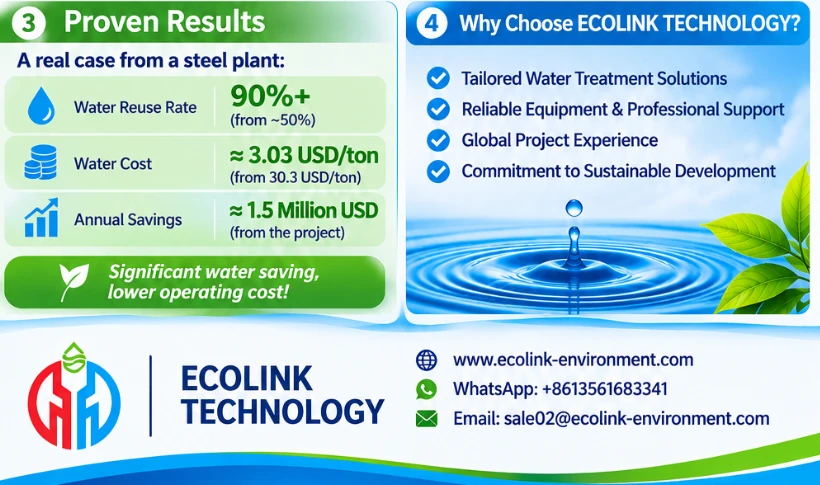
According to the original project materials, after treatment by the industrial water purification equipment, the enterprise's production water utilization rate increased from the original approximately 50% to over 90%.
| Indicator | Original Situation | Post-Project Operation |
| Production Water Utilization Rate | Approx. 50% | Over 90% |
| Water Consumption per 1 Ton of Steel Produced | 20 m³ | Approx. 2 m³ |
As stated in the original materials, the enterprise originally needed about 20 cubic meters of tap water per 1 ton of steel produced; after industrial water purification equipment and corresponding water use optimization, only about 2 cubic meters are needed per 1 ton of steel produced.
The project data in the original materials indicate that the fresh water usage in this case decreased significantly, helping to reduce water resource consumption and wastewater discharge.
It should be noted that enterprise production water consumption, fresh water makeup volume, circulating water volume, and system recovery rate belong to different statistical concepts. Water use indicators for actual projects need to be accounted for based on system boundaries and water balance.
5.3 Reduction in Production Water Costs
According to the original materials, the enterprise's production water costs were also significantly improved.
| Indicator | Original Situation | Post-Project Operation |
| Tap Water Cost Corresponding to Each Ton of Steel | Approx. USD30.3 | Approx.USD3.03 |
The original materials show that after treatment by the industrial water purification equipment, the enterprise's production water cost decreased from the original approximately USD30.3 per ton of steel to approximately USD3.03. According to the original materials, the project can save nearly USD1.5 million in expenses annually.
In addition to direct changes in water fee costs, water quality improvement may also have a positive impact on equipment maintenance, production stability, and the operating efficiency of certain process links.
Cost data comes from original project materials; actual economic benefits will be affected by factors such as water prices, energy costs, equipment operating expenses, output, and water volume accounting methods.
VI. How Does the Global Metallurgical Industry Choose Suitable Industrial Water Purification Equipment?
For metallurgical enterprises of different countries and different scales, the selection of industrial water purification equipment should not be based solely on equipment price or a single water quality indicator, but should start from actual operational needs.
6.1 Selecting Treatment Processes Based on Raw Water Quality
Raw water quality is an important foundation for industrial water treatment system design.
Different water sources may have different contents of suspended solids, hardness, salinity, organic matter, and other pollutants. For projects with large fluctuations in raw water quality, preliminary water quality analysis can help determine the configuration of pretreatment, membrane treatment, and subsequent purification units.
ECOLINK TECHNOLOGY can assist in evaluating suitable industrial water purification equipment configurations based on water quality analysis results and water requirements provided by customers.
6.2 Determining Water Quality Standards Based on Production Uses
Different points of use do not require completely identical water quality standards.
For example:
Circulating cooling water: Needs to focus on suspended solids, hardness, corrosion, scaling, and microbial control according to system design.
Equipment cleaning water: Needs to determine suitable water quality in combination with the cleaning object, residues, and subsequent processes.
Process makeup water: Needs to select treatment technologies based on production process requirements for salinity, impurities, and water quality stability.
High-purity water applications: May require combinations of reverse osmosis, ion exchange, or other deep treatment processes.
Reasonable water quality grading can avoid treating water to unnecessarily high standards and also helps control system investment and operating costs.
6.3 Focusing on Equipment Operating Costs, Not Just Initial Investment
Industrial water purification equipment belongs to long-term operating production auxiliary systems, and equipment investment is only part of the project cost.
When selecting industrial water treatment equipment, enterprises should also pay attention to:
Power consumption and pump operating efficiency;
Service life of filter media, membrane modules, and resins;
Reverse osmosis system cleaning frequency;
Convenience of equipment maintenance;
Automatic control and monitoring capabilities;
System water production rate and concentrate disposal methods;
Equipment operating personnel and maintenance requirements.
For long-term continuously operating metallurgical enterprises, the operational stability, maintenance convenience, and comprehensive operating costs of the system are often more important than the pure initial purchase price.
6.4 Designing Water Treatment Systems in Combination with Local Conditions
Project environments for global metallurgical enterprises vary; water source conditions, climate, power supply conditions, site space, transportation conditions, operator staffing, and environmental requirements may all affect equipment selection.
For example, in water-scarce regions, enterprises may pay more attention to water reuse rates; in high-hardness water source regions, pretreatment and softening solutions may be more important; in process links with higher water quality requirements, deeper purification technologies may need to be adopted.
Therefore, industrial water purification equipment should be designed based on actual project needs rather than simply copying the configurations of other plants.
VII. ECOLINK TECHNOLOGY: Providing Equipment and Solution Support for Global Industrial Water Treatment Needs
ECOLINK TECHNOLOGY focuses on water treatment chemicals and equipment, helping industrial customers identify suitable products and treatment systems based on their water quality, process requirements and project conditions.
We focus on practical problems in industrial production, including unstable raw water quality, treatment process matching, production water costs, equipment operation and maintenance, and water resource recycling.
For metallurgy, metal processing, and other industrial production fields, industrial water purification equipment can adopt different treatment process combinations according to project needs, from basic filtration to deep purification, providing suitable water treatment solutions for different production uses.
Our project support directions include:
Industrial Water Purification Equipment: Industrial water purification equipment, used for industrial production water source purification and process water preparation.
Reverse Osmosis Water Treatment System: Reverse osmosis water treatment system, used to reduce dissolved salts and certain pollutants in water.
Ultrafiltration System: Ultrafiltration system, used for particulate matter, colloids, and certain microbial control.
Ion Exchange Water Treatment System: Ion exchange water treatment system, used to further reduce ion content in water.
Industrial Water Recycling System: Industrial water circulation and reuse system, designed according to water quality conditions and reuse requirements.
Our goal is not only to provide equipment, but also to start from the actual production needs of customers, assist in matching suitable water treatment technologies and equipment configurations, and enable projects to achieve a more reasonable balance in water quality, operating efficiency, and comprehensive costs.
VIII. Conclusion: Industrial Water Purification Equipment Is an Important Link for Metallurgical Enterprises to Optimize Water Resource Management
With the continuous development of the global metallurgical industry, water resource management, production efficiency, and environmental requirements have become increasingly important factors in enterprise operations. By reasonably configuring industrial water purification equipment, enterprises can improve production water quality, increase water resource utilization efficiency, reduce certain operating costs, and provide technical support for water recycling.
From multi-media filtration, softening, and ultrafiltration to reverse osmosis, ion exchange, and ultraviolet disinfection, a reasonable combination of different water treatment technologies can help metallurgical enterprises cope with the water quality challenges brought by different water sources and production processes.
The original case shows that after industrial water purification equipment and corresponding water resource management optimization, the metallurgical enterprise achieved obvious changes in water quality improvement, water use efficiency, and production water costs. Although actual project results will vary depending on plant conditions, the reasonable design and continuous optimization of water treatment systems remain an important direction for industrial water conservation and resource management.
ECOLINK TECHNOLOGY is committed to providing global industrial customers with water treatment products, equipment matching, and technical support. Whether it is industrial water purification equipment, reverse osmosis water treatment systems, or industrial water recycling solutions, we hope to help customers improve water quality, optimize operations, and achieve more efficient water resource management through solutions tailored to actual production needs.